Best Table Saws with Cast-Iron Trunnions for Stable Blade Angles
What's inside
As an Amazon Associate I earn from qualifying purchases. This post may contain affiliate links at no extra cost to you.
A table saw’s trunnions are the brackets and pivots that hold the arbor assembly under the table. They control how the blade raises, lowers, and tilts. Cast-iron trunnions are valued because they resist flexing and vibration better than many stamped-steel or aluminum assemblies. That matters when you need a bevel angle to remain consistent through a cut, especially at 45 degrees.
They are not a guarantee of accuracy by themselves. A poorly aligned saw with cast-iron trunnions can still cut badly. The table, arbor, handwheels, locking mechanism, fence, and cabinet all contribute. Still, a heavy cast-iron trunnion is a sensible feature to prioritize for a stationary saw that will see regular use.
As an Amazon Associate we earn from qualifying purchases at no extra cost to you.


Contents
What cast-iron trunnions do
The trunnion assembly supports the arbor and motor while allowing the blade to tilt. On a typical cabinet saw, the blade tilts from 0 to 45 degrees, sometimes slightly beyond 45 degrees. When you unlock the bevel mechanism, the assembly moves along curved tracks or pivots around a fixed point. Tightening the bevel lock should clamp it firmly without shifting the setting.
Cast iron is stiff and heavy. That helps limit movement from motor vibration, blade loading, and the force of pushing a large panel through the cut. It also tends to hold machined surfaces and threaded hardware securely. The downside is weight: a saw with cast-iron trunnions is harder to move, and a damaged or poorly machined assembly is not easy to repair or replace.
Which saw type makes sense?
| Saw type | Typical trunnion situation | Best use | Main trade-off |
|---|---|---|---|
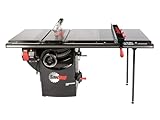
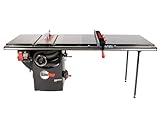
| Cabinet saw | Usually heavy cast iron, mounted to the cabinet or table | Frequent ripping, sheet goods, hardwood, and accurate bevel work | High cost, weight, and permanent floor space |
| Hybrid saw | Often cast iron, but designs vary; some use lighter components | Small shops and serious hobby work | Less mass and adjustment range than a full cabinet saw |
| Contractor saw | May use lighter cast, stamped, or mixed construction | Portable shop use and moderate workloads | More vibration and potentially more difficult bevel alignment |
| Portable jobsite saw | Generally compact, lightweight mechanisms rather than heavy cast iron | Remodeling and occasional cutting | Not the best choice for stable, repeatable bevel work |
For a fixed woodworking shop, start with cabinet table saws with cast-iron trunnions. A hybrid saw can be the better value if you cut mostly plywood, pine, and boards under 1-1/2 inches thick. The cheaper option is fine when the saw is properly aligned and you are not constantly changing bevel angles under load.
Features that matter more than the label
Look for a trunnion that is securely attached, has smooth adjustment, and locks without a noticeable jump. A heavy handwheel is useful, but smooth travel matters more than its size. Check whether the bevel scale is readable and whether the 0- and 45-degree stops are adjustable. Fixed, inaccurate stops are a common source of frustration.
Front-mounted trunnions are generally easier to service and adjust than assemblies buried deep inside the cabinet. However, the mounting arrangement matters more than the marketing term. A well-supported rear-mounted system can work accurately, while a poorly machined front-mounted system will not.
Also inspect the arbor and table. The arbor should have minimal radial or axial play, and the blade should sit flat against the flange. A 10-inch blade typically spins at roughly 3,500 to 4,500 rpm. At that speed, a small amount of flange dirt or runout can become a visible error at the teeth. Cast iron cannot correct a bent arbor or a warped blade.
A practical buying checklist
Before buying, confirm that the saw has a full-size 10-inch arbor, a reliable bevel lock, and a table large enough for your work. A 27- to 30-inch rip capacity is adequate for many shops; more capacity helps with sheet goods but adds table and fence cost. A 1-3/4 to 2 horsepower motor is generally suitable for a 120-volt home shop. Three-horsepower cabinet saws offer more reserve for thick hardwood but may require 240-volt power.
Choose a saw with a rigid fence that locks parallel to the miter slot. A stable blade angle is not useful if the fence shifts by 1/16 inch during a rip. A decent dust port, enclosed cabinet, and riving knife are also worth prioritizing. For many buyers, a better fence and easier alignment are more valuable than an extra inch of rip capacity.
If you are comparing hybrid saws, search for hybrid table saws with cast-iron trunnions and verify the actual specifications on the manufacturer’s page. Retail listings sometimes use “cast iron table” to describe a saw that has lighter trunnion parts. The table material and trunnion material are separate specifications.
Alignment and common failure modes
After setup, unplug the saw and check the blade against the miter slot with a dial indicator or a reliable combination square. The front and rear readings should be very close; a difference of a few thousandths of an inch is a reasonable target for a well-adjusted machine. Then check the blade at 0 degrees and 45 degrees. If the angle changes when you tighten the lock, adjust the stop, pivot, or locking hardware rather than forcing the handwheel.
Common problems include sawdust packed into the trunnion tracks, loose mounting bolts, worn bevel gears, and a stop that has been hit hard enough to move. A blade that returns to 0 degrees differently after every adjustment may indicate a loose lock or damaged pivot surface. If the blade is parallel at 0 degrees but not at 45 degrees, the bevel mechanism or stop is more suspect than the fence.
Keep the trunnion mechanism clean and use only the lubricant specified by the manufacturer. Excess oil attracts dust and can turn into abrasive paste. Do not use the bevel handwheel to force a jammed assembly; remove the dust or loosen the appropriate hardware first.
Making the choice
Buy a cabinet saw with cast-iron trunnions if repeatable bevel cuts, thick hardwood, and long-term stability are priorities. Choose a hybrid saw if budget, power, and shop space matter more and your workload is moderate. A contractor saw is acceptable for many straightforward 90-degree cuts, particularly if it is already aligned and you need occasional portability.
For replacement or upgrade planning, table saw bevel trunnion parts are worth researching before purchase. Some brands support replacement gears and stops; others require an expensive complete assembly. That parts support can matter more than a modest difference in cast-iron thickness.