Best Table Saws for Cutting Thick Hardwood Joinery
What's inside
As an Amazon Associate I earn from qualifying purchases. This post may contain affiliate links at no extra cost to you.
Thick hardwood joinery puts more demand on a table saw than ordinary sheet-goods work. Cutting 8/4 or 12/4 oak, maple, beech, and similar stock requires a rigid saw, a sharp blade, dependable alignment, and enough power to prevent the motor from bogging down. The saw also needs to hold its settings when you make repeated shoulders, cheeks, tenons, and rabbets.
The best choice is usually a cabinet saw, but a good hybrid saw can handle serious joinery if you work at a measured feed rate and avoid oversized cuts in one pass. Portable jobsite saws are useful for installation work and small shops, but they are the least forgiving option for thick hardwood.
Contents
What Makes a Table Saw Good for Thick Hardwood
Start with the arbor and motor, not the advertised maximum cut depth. A full-size saw should accept a 10-inch blade and provide at least 3 inches of cutting capacity at 90 degrees. That is enough for most 8/4 stock and many 12/4 cuts, although the exact capacity depends on the blade plate and saw design.
Power matters when the blade is buried in dense wood. A 3-horsepower cabinet saw has a clear advantage over a 1-3/4-horsepower hybrid saw, especially when ripping wide maple or making a deep tenon cut. However, horsepower alone does not prevent burning. A dull blade, a pinched kerf, poor alignment, or feeding too slowly can overload either motor.
Look for a cast-iron table and substantial trunnions. The table should remain flat under pressure from a heavy board, while the trunnions should hold the arbor square to the table after bevel adjustments. A stiff fence is equally important. If the fence bows or shifts, a supposedly precise shoulder cut can vary by several thousandths of an inch—or worse, pinch the workpiece against the rear of the blade.
A reliable 10-inch cabinet table saw is the best fit for a dedicated shop making thick hardwood furniture. Its extra mass reduces vibration and its enclosed base usually gives better dust collection than portable designs.
Table Saw Types Compared
| Type | Best use | Thick hardwood strengths | Main drawbacks |
|---|---|---|---|
| Cabinet saw | Dedicated furniture shop | Power, stability, low vibration, accurate fence | Heavy, expensive, usually needs 240-volt power |
| Hybrid saw | Small stationary shop | Good accuracy and adequate power for moderate production | Less reserve power and lighter trunnions than a cabinet saw |
| Contractor saw | Budget stationary setup | Can cut 8/4 stock with a sharp blade and careful feeding | More vibration and often less effective dust collection |
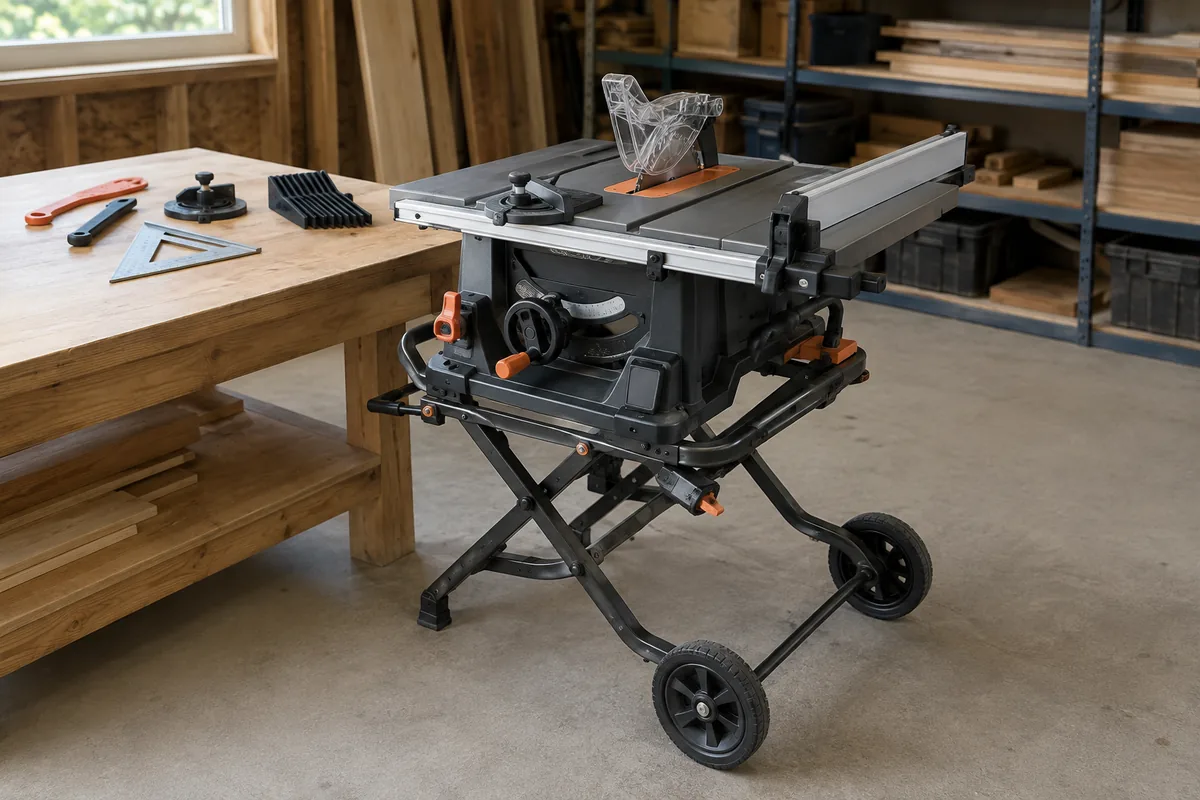
| Jobsite saw | Mobile or temporary work | Convenient and inexpensive | Small table, limited power, less forgiving fence and stand |
Choosing by Workload
For occasional mortises, tenons, and furniture repairs, a hybrid saw is often the sensible purchase. You can make accurate work with a 1-3/4- to 2-horsepower saw if the blade is sharp, the stock is flattened, and you take multiple passes when necessary. The cheaper option is fine when you cut a few boards per week rather than processing a shop full of hardwood.
For frequent production in 8/4 hardwood, move to a cabinet saw with a 3-horsepower motor. The additional cost buys faster ripping, less stalling, a heavier fence system, and better long-term stability. It also makes large joinery parts safer because the saw is less likely to slow suddenly as grain density changes.
If your shop has only a standard 120-volt circuit, check the saw’s electrical requirements before buying. Some cabinet saws can be configured for 120 volts, but they may draw close to the circuit limit and still have less available power. A dedicated 240-volt circuit is preferable for a true 3-horsepower machine.
A 10-inch hybrid table saw makes sense when space, wiring, and budget matter more than production speed. Do not buy one expecting it to behave like a cabinet saw when ripping 12/4 hard maple all afternoon.
Blade and Setup Requirements
Use a high-quality combination or general-purpose blade for mixed work, but switch to a dedicated ripping blade for long cuts in thick stock. A 10-inch ripping blade with roughly 20 to 30 teeth clears waste more efficiently than a 40- to 60-tooth crosscut blade. Too many teeth can make the cut slower, hotter, and more prone to burning.
Set the blade only slightly higher than the material. For joinery, the gullets should clear the top surface by about 1/8 inch to 1/4 inch. Excessive blade height increases exposed carbide and can worsen tear-out. Check that the blade is parallel to the miter slot and that the fence is parallel—or very slightly open—relative to the blade. A fence that closes toward the rear of the blade can trap wood and cause kickback.
Before cutting expensive stock, test the setup on scrap from the same board. Measure the shoulder or cheek with calipers, then make a second pass if the cut is undersized. Never force a board through a cut that has begun to smoke. Stop, let the blade cool, and inspect for resin, dull teeth, poor alignment, or a fence that has moved.
Joinery-Specific Buying Details
For tenons and rabbets, a stable miter gauge or a well-supported crosscut sled is more useful than a very large rip capacity. The table should have a smooth surface without a step at the extension wing. A good riving knife that stays aligned through height adjustments is preferable to removing the splitter for joinery cuts.
Choose a saw with accessible adjustment wheels and a bevel mechanism that locks firmly. Bevel cuts in thick hardwood expose any looseness in the trunnion or arbor. A saw that is difficult to adjust encourages rushed setups, and rushed setups produce inconsistent shoulders.
Dust collection is not just housekeeping. Fine hardwood dust can obscure the cut line and fill the motor housing or surrounding shop. An enclosed cabinet connected to a collector with a 4-inch hose generally outperforms a small portable saw’s dust port. For a fixed shop, compare table saw dust collection systems as part of the purchase, not as an afterthought.
Safety and Realistic Expectations
Use a riving knife, push handles, and outfeed support whenever the cut requires your hands to approach the blade. Long or thick boards can lift as internal stress releases, even when the saw is perfectly aligned. Support the workpiece before it reaches the blade and after it leaves the fence. For narrow tenon cheeks, use a jig or carrier rather than balancing a small piece beside the blade.
The ideal saw is the one that stays aligned, supports the stock, and lets you feed without force. For most serious hardwood joinery, that means a cabinet saw. For occasional work, a carefully tuned hybrid saw is a legitimate lower-cost choice. A jobsite saw can complete the work, but it demands more setup, slower feeds, smaller pieces, and greater attention to support and kickback control.