Best Table Saws with Rack-and-Pinion Fence Adjustments
What's inside
As an Amazon Associate I earn from qualifying purchases. This post may contain affiliate links at no extra cost to you.
Contents
Why Rack-and-Pinion Fence Adjustment Matters
A rack-and-pinion fence uses a toothed rail and a geared handwheel to move the fence. That is different from a standard sliding fence, where you push the fence into position and lock it with a lever. The geared system is slower for very large adjustments, but much easier to fine-tune accurately.
For sheet goods, cabinet parts, and repeated narrow cuts, the main advantage is control. A quarter-turn of the handwheel may move the fence only a small distance, so you can set a dimension without repeatedly releasing, tapping, measuring, and relocking the fence. The fence also tends to remain parallel as it moves, provided the rail is installed correctly and the mechanism is not damaged.
These saws are most common among portable and jobsite table saws. They are not a replacement for a heavy cast-iron cabinet saw. A jobsite saw has less mass, a smaller table, and usually more vibration, but it is easier to transport and often costs substantially less.
Best Overall: DeWalt 10-Inch Jobsite Saws
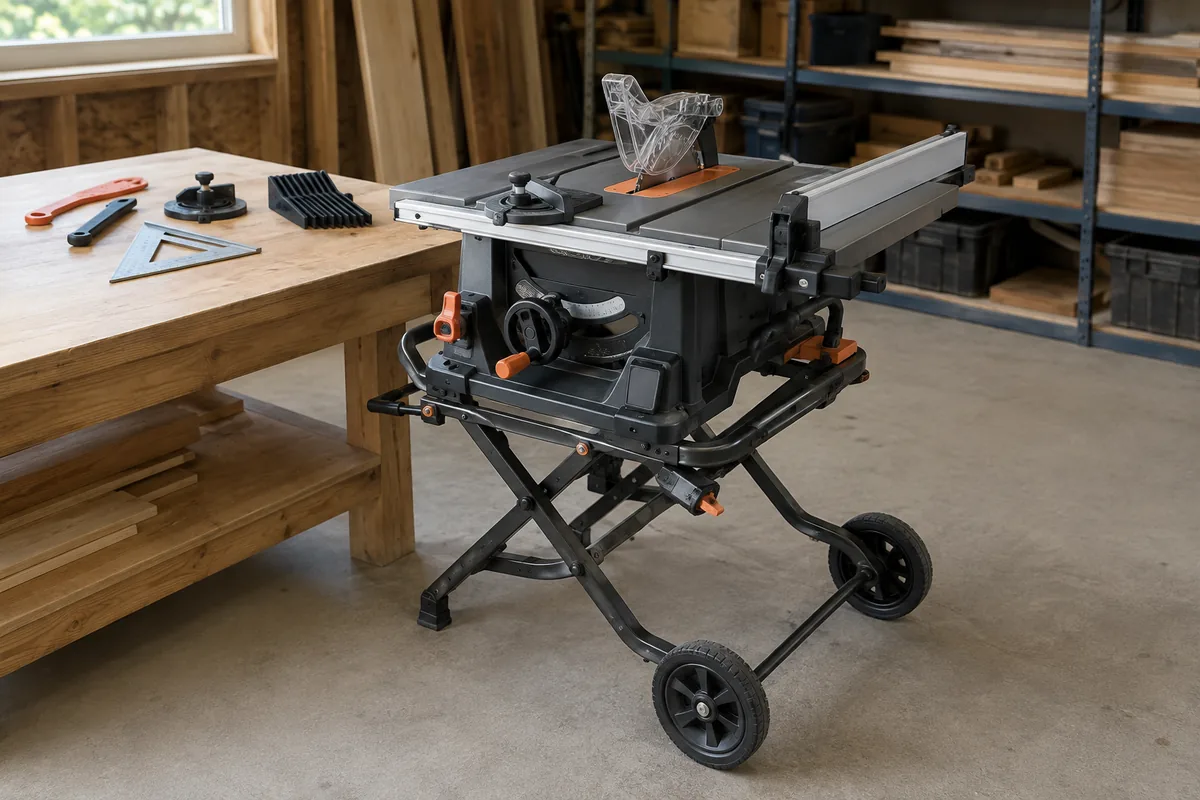
DeWalt’s 10-inch jobsite saws with rack-and-pinion telescoping fences are the strongest all-around choice for many woodworkers. The fence can be moved quickly with the adjustment knob, then locked firmly with the main lever. The rack system also provides useful scale markings and a broad capacity on models that include a rolling stand.
The common trade-off is size. A 10-inch blade and roughly 3-1/8 inches of cutting depth at 90 degrees are useful for 2-by material, but the saw is less compact than an 8-1/4-inch model. A rolling stand adds convenience but makes the complete package heavier and more expensive. If the saw will live in a shop and you do not need a stand, buying the saw separately can be the better value.
Look at 10-inch DeWalt table saws with rack-and-pinion fences when you need full-size jobsite capacity, frequent rip cuts, and a fence that is easier to adjust than a basic sliding design.
Best Compact Option: DeWalt 8-1/4-Inch Jobsite Saws
An 8-1/4-inch DeWalt jobsite saw is the better choice when portability matters more than maximum depth. These saws generally provide about 2-9/16 inches of cut at 90 degrees, enough for standard 1-1/2-inch-thick lumber and most cabinet panels. They are shorter, lighter, and easier to carry up stairs or load into a vehicle.
The smaller blade does limit you. Cutting a 4-by post in one pass is not realistic, and thick hardwood takes more care because the smaller blade has less depth available. The table and rip capacity are also less generous than on the larger 10-inch versions. For trim work, shelving, flooring, and occasional furniture parts, those limitations are usually acceptable.
Choose an 8-1/4-inch rack-and-pinion table saw if you value carrying weight and storage space more than deep cuts. It is not simply a cheaper version of a 10-inch saw; it is a different portability trade-off.
Rack-and-Pinion Table Saw Comparison
| Type | Typical blade | Best use | Main limitation |
|---|---|---|---|
| Compact jobsite saw | 8-1/4 inches | Trim, shelving, small shops, transport | Less cutting depth and table area |
| Full-size jobsite saw | 10 inches | Sheet goods, framing lumber, furniture parts | Heavier and louder |
| Jobsite saw with rolling stand | Usually 10 inches | Frequent setup and breakdown | Higher cost and more parts to maintain |
| Cabinet saw | 10 inches | Stationary precision and production work | Usually uses a different fence design and costs more |
What to Check Before Buying
Do not judge a fence only by the presence of a handwheel. Check the usable rip capacity, fence height, rail stiffness, and how the fence locks at both ends. A rack-and-pinion adjustment cannot compensate for a short, flexible fence. For breaking down plywood, a capacity around 24 to 32 inches is much more useful than a compact 16-inch setup.
Inspect the measurement scale as well. A scale is only a starting point; it must be calibrated to the actual blade kerf and fence position. Make a test cut, measure the result with a reliable rule or caliper, and adjust the indicator if necessary. If the cut is consistently off by 1/16 inch, the problem may be the scale, not the gear mechanism.
Dust collection is another practical concern. Portable saws commonly leave some dust above the table and around the motor. A shop vacuum with a 2-1/2-inch hose helps, but it will not perform like a cabinet saw connected to a large dust collector. Keep the rack clean and use only a light, dry lubricant if the manufacturer permits it. Sticky oil attracts sawdust and can make the adjustment rough.
Common Failure Modes
The most common issue is misaligned telescoping rails. If the front and rear rails are not level and parallel, the fence may feel smooth at one end of its travel and bind at the other. A fence that is not parallel to the blade can pinch the workpiece, burn the edge, or cause kickback. Verify alignment with the blade unplugged and the fence locked, then adjust the rail and fence according to the manual.
Stripped or damaged rack teeth are less common but more serious. Forcing the knob against a locked fence, dropping the saw, or allowing grit into the gear track can damage the mechanism. Never keep turning the adjustment knob when it has reached the end of its travel. The fence should move with moderate hand pressure; resistance is a reason to inspect the rail, not apply more force.
When a Cheaper Fence Is Fine
A basic sliding fence is perfectly adequate for occasional crosscuts, rough construction work, or a saw that stays set to one common width. If your normal accuracy requirement is about 1/8 inch and you confirm each setup with a tape measure, paying extra for geared adjustment may not improve the finished project.
Rack-and-pinion is worth prioritizing when you change widths repeatedly, work with narrow strips, or need consistent settings across many parts. In those cases, the convenience reduces setup errors and saves time. For a stationary shop where maximum accuracy, low vibration, and a large cast-iron table matter most, compare cabinet saws instead of assuming a portable rack-and-pinion saw is the upgrade.
Buying Verdict
Choose the compact 8-1/4-inch format for transport and limited storage. Choose a 10-inch version for general woodworking and deeper cuts. Add a rolling stand only if you regularly move the saw between storage and the work area. Whatever you buy, budget for a quality blade, a stable support surface, and time to calibrate the fence. A well-aligned, modest saw will produce safer and straighter cuts than an expensive saw with a loose fence and a poorly supported workpiece.