Best Table Saws for Cutting Solid-Wood Tabletop Parts
What's inside
As an Amazon Associate I earn from qualifying purchases. This post may contain affiliate links at no extra cost to you.
Solid-wood tabletop parts put more demands on a table saw than ordinary shelf parts. You may need to rip long, heavy boards, cut accurately across wide panels, and keep the cut straight as grain tension is released. A saw that is merely adequate for plywood can struggle with 8/4 hardwood, especially when the stock is cupped, twisted, or wider than 12 inches.
For most furniture makers, the best choice is a 10-inch cabinet saw with a reliable fence, a riving knife, and enough table area to support large workpieces. A good hybrid saw can also do the job at a lower price. The right decision depends less on maximum horsepower than on how often you cut thick material and how much space you have.
Contents
What to Look For in a Table Saw
Choose a saw with a flat cast-iron or rigid steel table, a fence that locks parallel to the blade, and a riving knife that stays close to the teeth. Solid wood can pinch the blade as internal stress changes during a rip. That is when kickback happens. A riving knife reduces the chance of the kerf closing onto the blade, but it does not make crooked or poorly supported stock safe.
A 10-inch blade is the practical standard. It can cut approximately 3-1/8 inches at 90 degrees, although the real capacity varies by saw and blade. That covers most 4/4 and 8/4 tabletop stock in one pass. If you regularly cut 12/4 or thicker lumber, a 12-inch saw offers more depth, but it costs more and has fewer readily available blade choices.
Horsepower matters when ripping wide hardwood. A true 3-hp cabinet saw on 240 volts will maintain speed better than a 1-3/4-hp saw when cutting thick maple or oak. However, a sharp, appropriately sized blade and a steady feed rate matter just as much. Do not expect any saw to cut safely through a bowed board simply because it has a larger motor.
Which Saw Type Makes Sense?
| Saw type | Best use | Main strengths | Important compromises |
|---|---|---|---|
| Cabinet saw | Frequent hardwood furniture work | Power, stability, dust collection, durable adjustment hardware | Heavy, expensive, usually needs 240-volt power |
| Hybrid saw | Serious home workshops | Good accuracy and enclosed base at a lower price | Less reserve power and lighter construction than a cabinet saw |
| Contractor saw | Mobile or budget-conscious shops | Lower cost, often runs on 120 volts, easier to move | More vibration, weaker dust collection, less support for large stock |
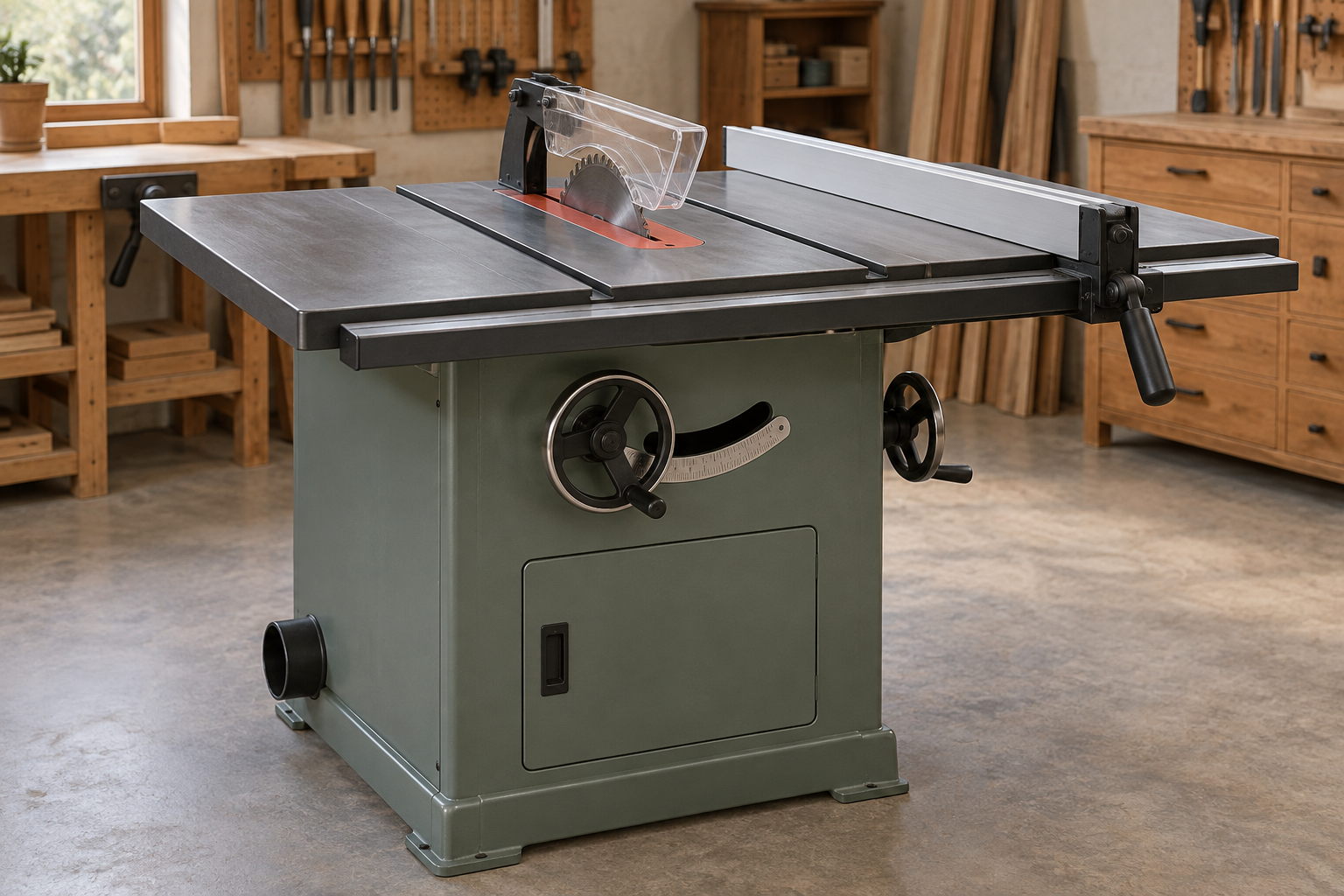
A cabinet saw is the best long-term buy if you routinely process rough hardwood for tables. Look for a 3-hp, 10-inch model with a 50-inch rip fence if your shop has room. The extra rip capacity is useful for breaking down wide boards, but it does not replace an outfeed table or a helper for heavy panels.
A hybrid saw is the sensible middle ground. Many have 1-3/4 to 2 hp motors, cast-iron tops, enclosed stands, and decent dust ports. They are capable of ripping 8/4 walnut or ash with a sharp 24-tooth ripping blade, provided you do not force the feed. For occasional tables, this is often enough. Search current options in the hybrid table saw category rather than paying for cabinet-saw capacity you will rarely use.
A contractor saw is fine when budget, storage, or electrical service is the constraint. It can produce accurate tabletop parts, but you will need to improve the setup. Add a rigid outfeed table, verify the fence alignment, and support the left side when ripping wide stock. A lightweight saw can shift several millimeters while feeding a heavy board, ruining a straight edge and creating a dangerous bind.
Features Worth Paying For
The fence is more important than a long list of electronic features. It should lock without twisting, remain parallel to the miter slot, and have a face tall enough to support boards on edge. A fence that moves 1/32 inch when locked can turn a glue-up into a stepped or uneven assembly.
A 4-inch dust port connected to a capable collector is strongly preferable to a bare open stand. Ripping solid wood creates chips and fine dust, and poor collection lets debris accumulate around the motor and blade guard. A cabinet saw generally contains dust better, but even it works best with a short, unobstructed hose and a properly fitted blade guard.
Buy a saw with tool-free or quick-release riving-knife adjustment if possible. You will remove the knife for dado work, concealed cuts, or certain jigs; a difficult system encourages unsafe shortcuts. An over-table blade guard is useful, but it must not interfere with narrow ripping or your crosscut sled.
If you are comparing portable-style machines, focus on a model with a sturdy rack-and-pinion or T-square-style fence, a real riving knife, and an adjustable stand. Browse 10-inch contractor table saws with those features rather than choosing by motor wattage alone.
Blade and Setup for Tabletop Parts
Use a 24-tooth or 30-tooth ripping blade for breaking boards down, then switch to a 40-tooth or 50-tooth combination blade for cleaner crosscuts. A high-tooth-count blade can work for ripping narrow pieces, but it removes less waste per tooth and may overheat in thick hardwood. Burning, a slowing motor, and a dark line along the cut are signs to stop and change the setup—not to push harder.
Before cutting valuable stock, check that the blade is parallel to the miter slot and that the fence is parallel to the blade or opens slightly at the rear. A difference of only 0.005 to 0.010 inch is worth correcting. Confirm the tabletop is flat, the insert is level, and the blade reaches full height without excessive exposed teeth.
Break down long boards with a support stand or helper. For wide tabletop sections, use an outfeed table at the same height as the saw and a side support that prevents the workpiece from falling away from the fence. Crosscut wide parts with a well-fitted sled or miter gauge rather than balancing them against the standard gauge.
Best Choice by Workshop
Choose a cabinet saw if you build tables regularly, cut thick hardwood every week, and can provide 240-volt power. Choose a hybrid saw if you want cabinet-saw stability but make furniture intermittently. Choose a contractor saw if you need portability or the lowest reasonable purchase price, and are willing to build support tables and spend time tuning it.
Do not buy a larger saw to compensate for poor stock preparation. Flatten one face and joint one edge before ripping whenever possible. A properly supported, surfaced board on a modest hybrid saw will outperform twisted stock on an expensive cabinet saw. For most home furniture shops, accurate setup, a sharp blade, and safe support provide more usable performance than another horsepower.