Best Drain Cleaning Machines for Tough Clogs
What's inside
- Quick picks by drain problem
- Drain cleaning machine comparison
- How cable diameter changes the result
- Motor power, speed, and drum design
- Decision matrix: which format fits your work?
- Portability and access matter more than they appear
- A simple sizing and cost calculation
- What wears out first
- Safe operating sequence
- Final buying advice
- Quick picks by drain problem
- Drain cleaning machine comparison
- How cable diameter changes the result
- Motor power, speed, and drum design
- Decision matrix: which format fits your work?
- Portability and access matter more than they appear
- A simple sizing and cost calculation
- What wears out first
- Safe operating sequence
- Final buying advice
As an Amazon Associate I earn from qualifying purchases. This post may contain affiliate links at no extra cost to you.
The best drain cleaning machines are chosen by matching cable diameter and working range to the clog—not by buying the largest motor available: compact 1/4-inch machines suit sinks, 3/8-inch drums handle showers and branch lines, and 5/8- to 3/4-inch machines are built for larger sewer and main-line work.
As an Amazon Associate we earn from qualifying purchases at no extra cost to you.


Contents
- Quick picks by drain problem
- Drain cleaning machine comparison
- How cable diameter changes the result
- Motor power, speed, and drum design
- Decision matrix: which format fits your work?
- Portability and access matter more than they appear
- A simple sizing and cost calculation
- What wears out first
- Safe operating sequence
- Final buying advice
Quick picks by drain problem
- Kitchen or bathroom sink: Choose a 1/4-inch or 5/16-inch drum machine with approximately 25 to 50 feet of cable. A compact electric unit is easier to control beneath a cabinet than a full-size sewer machine.
- Shower, bathtub, or laundry branch line: A 3/8-inch cable machine with 50 to 75 feet of cable is the most versatile choice. It has enough stiffness for many indoor branch lines without being excessively heavy.
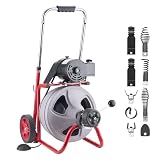
- Frequent residential service: A 1/2-inch or 5/8-inch drum machine with 75 to 100 feet of cable offers more reach and better resistance to roots and packed debris. RIDGID K-400 and K-750-class machines represent this category.
- Long sewer or main-line blockage: Use a professional 5/8-inch or 3/4-inch drum, sectional, or trailer-mounted machine with 100 feet or more of cable. The heavier cable and larger motor are important when distance, roots, or hardened buildup create high resistance.
- Occasional homeowner use: A compact corded drum machine is usually a better value than a large gas-powered unit. For several properties or repeated service calls, cordless options such as Milwaukee M18 FUEL drain-cleaning machines can reduce setup time, provided their cable capacity matches the pipe.
Drain cleaning machine comparison
| Machine class | Typical cable | Typical cable length | Recommended pipe range | Typical weight | Best use |
|---|---|---|---|---|---|
| Compact sink drum | 1/4 in or 5/16 in | 25–50 ft | 1-1/4–2 in | 15–35 lb | Sink, lavatory, short indoor branch lines |
| Medium indoor drum | 3/8 in | 50–75 ft | 1-1/2–3 in | 30–60 lb | Shower, tub, laundry, kitchen branch lines |
| Heavy residential drum | 1/2–5/8 in | 75–100 ft | 2–4 in | 70–140 lb | Frequent service and difficult branch lines |
| Professional sewer drum | 5/8–3/4 in | 100–150 ft | 3–6 in | 150–250 lb | Long sewer runs and root intrusion |
| Sectional machine | 5/8–1-1/4 in sections | Variable; add sections | 3–8 in | 60–250 lb | Commercial drains and repeated main-line work |
These are useful buying ranges rather than universal limits. Actual capacity depends on the machine, cable construction, access point, fittings, and the material blocking the pipe. Always check the manufacturer’s stated pipe diameter and cable capacity before purchase.
How cable diameter changes the result
Cable diameter is the most important specification after access. A thin 1/4-inch cable can negotiate tight P-traps and sharp bends, but it may kink or stall against heavy grease and roots. A 3/8-inch cable is stiffer and reaches farther, making it a practical all-around size for showers and many household branch lines.
Thicker 1/2-inch, 5/8-inch, and 3/4-inch cables transfer more torque and resist deformation. They are appropriate for larger pipes and tougher obstructions, but they also require a wider opening and can damage small, fragile, or poorly supported plumbing. Do not force a large cable through a narrow trap simply because the motor has enough power.
Match the cable to the opening
- A sink with a removable P-trap or cleanout usually favors 1/4-inch cable.
- A shower drain often accepts a 3/8-inch cable, although the trap and access fitting must be checked first.
- A 3- or 4-inch cleanout commonly supports 1/2-inch or 5/8-inch cable.
- Main-line cleanouts may require 5/8-inch, 3/4-inch, or sectional cable, particularly where roots are involved.
Motor power, speed, and drum design
Motor wattage alone does not predict cleaning performance. A machine must combine useful torque, controlled rotation, a suitable clutch, and a cable that matches the obstruction. Compact electric machines commonly use motors in roughly the 1/4- to 1/2-horsepower class. Heavy professional machines may use approximately 1/2 to 1 horsepower, while gas-powered sewer machines can exceed that range.
For indoor work, variable speed is more valuable than maximum speed. Lower speed improves control near traps and reduces cable whipping; higher speed can help clear soft grease after the cable is safely engaged. A torque-limiting clutch or automatic feed is particularly useful for less experienced operators because it can reduce the chance of cable kinking.
Drum machines store the cable inside a rotating housing and are relatively tidy and easy to transport. They are a good fit for homes and service vehicles. The disadvantages are that the entire cable becomes contaminated inside the drum, and a hidden cable break or corrosion may be difficult to spot.
Sectional machines use separate cable sections that are added as needed. They are easier to inspect, clean, and replace in pieces. They can also reach farther than many drums, but the exposed rotating cable requires more room, careful handling, and stronger operator technique.
Decision matrix: which format fits your work?
| Your situation | Recommended format | Why | What to avoid |
|---|---|---|---|
| Low budget, one or two clogs per year | Compact 1/4-inch corded drum | Lowest ownership cost and enough capacity for sinks | Oversized sewer machines that are difficult to store |
| Apartment or small workshop | 3/8-inch drum, 50–75 ft | Balanced reach, storage, and versatility | Gas-powered equipment and exposed sectional cable |
| Frequent property maintenance | 1/2-inch or 5/8-inch heavy drum | Faster setup and greater resistance to hard blockages | Thin cables used repeatedly in large pipes |
| Professional main-line service | 5/8-inch or 3/4-inch drum or sectional machine | Long reach and better performance against roots | Small indoor machines that cannot reach the obstruction |
| Worksites without reliable power | Battery-powered drum machine | Fast deployment and no extension cord | Assuming battery voltage guarantees cable capacity |
Portability and access matter more than they appear
A 100-foot machine that cannot be moved to the cleanout is not useful. Compare the machine’s loaded weight, wheel design, handle height, and width. A 30-pound compact drum can be carried upstairs, whereas a 150-pound sewer machine may need a ramp or two-person lift.
Measure the access route before buying: vehicle door, stairway, gate, crawl-space opening, and distance from the cleanout to the drain. For indoor work, a machine with a sealed switch, splash protection, and an integrated ground-fault circuit interrupter or GFCI-compatible plug is preferable. Keep electrical connections away from standing water regardless of the machine’s protection rating.
A simple sizing and cost calculation
Suppose a branch line is about 45 feet from the access point. Add approximately 10 feet for the path through the cleanout, bends, and working slack. The required reach is therefore about 55 feet, so a 50-foot machine is marginal while a 75-foot machine provides useful reserve.
If a 75-foot machine costs $600 and is used 20 times, the equipment cost is $30 per use before cable replacement and maintenance. A 100-foot professional machine costing $1,500 used 100 times costs $15 per use. The larger machine may be the economical choice for regular service, but not for an occasional sink clog where storage, transport, and cable damage are greater concerns.
What wears out first
- Cable: Kinks, corrosion, broken welds, and flattened coils are common failure points. Replace damaged sections rather than continuing to operate a visibly distorted cable.
- Cable guide or feed rollers: Dirt and worn rollers can make feeding erratic and increase cable damage.
- Clutch components: Repeatedly forcing a stalled cable overheats or wears the clutch. Let the machine work at a controlled feed rate.
- Cutters: Grease, roots, and scale dull cutting heads. Keep several shapes available, including a straight auger, bulb auger, spade cutter, and root-capable cutter where appropriate.
- Drum and frame: Trapped water promotes corrosion. Drain, rinse, and dry the drum after use.
Safe operating sequence
- Identify the pipe size and open the nearest suitable cleanout. Avoid guessing through a small fixture opening when a cleanout is available.
- Choose a cable no larger than the access and pipe can safely accept. Install the cutter appropriate to the suspected obstruction.
- Wear eye protection, waterproof gloves, and work clothing. Keep loose clothing and hands away from rotating cable.
- Feed the cable slowly while rotating. When resistance increases, advance in short movements instead of forcing the cable.
- Withdraw the cable while continuing controlled rotation, then flush with water to confirm flow.
- Clean and disinfect the cable, dry it, inspect for kinks, and lubricate it according to the manufacturer’s instructions.
Stop if the cable repeatedly jams, the pipe appears damaged, sewage backs up from multiple fixtures, or roots return quickly. Those signs can indicate a collapsed, offset, or severely invaded pipe that needs inspection and professional repair rather than another pass with a drain machine.
Final buying advice
For most homeowners, the best drain cleaning machines are compact 1/4-inch units for sinks or 3/8-inch drums for general indoor use. Choose a heavier 1/2- to 5/8-inch machine when you regularly service 3- or 4-inch lines, and move to a 5/8- or 3/4-inch professional drum or sectional machine for long sewer and main-line work. Prioritize correct cable size, usable reach, controlled feeding, cleanout access, and transport weight; motor power should support those choices, not replace them.