Best Table Saws with Heavy Trunnions for Stable Blade Angles
What's inside
As an Amazon Associate I earn from qualifying purchases. This post may contain affiliate links at no extra cost to you.
Contents
What heavy trunnions do
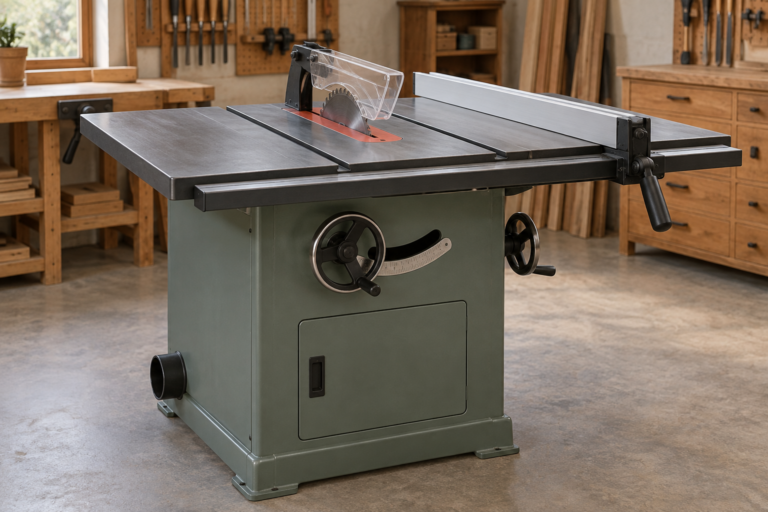
A trunnion is the support and pivot assembly that lets a table saw’s arbor and blade tilt for bevel cuts. On most cabinet saws, the trunnions attach to the cabinet; on many contractor and jobsite saws, the tilt mechanism hangs from the underside of the tabletop. Heavier, well-fitted trunnions can resist flex and vibration, helping the blade hold its angle when the saw is adjusted, locked, and used under load.
But “heavy trunnions” is not a guarantee of accuracy. A stiff mechanism can still be poorly aligned, and a blade can drift if its locking hardware, arbor, or tabletop is at fault. Check the whole saw: how the tilt mechanism locks, whether the blade stays parallel to the miter slots, and how much effort it takes to adjust the bevel. For repeatable work, verify the blade angle with a reliable square or digital angle gauge rather than trusting the scale alone.
As an Amazon Associate we earn from qualifying purchases at no extra cost to you.


What to buy for your shop
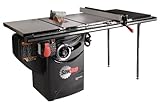
If the saw will stay in one place and you routinely cut hardwood, thick stock, or bevels, start with a cabinet saw or a substantial hybrid saw. Their mass and cabinet-mounted mechanisms generally suit a fixed shop better than a portable saw. A cabinet saw also needs room, a suitable electrical circuit, and dust collection; confirm those requirements before ordering. Many larger saws use 230-volt power, so check the exact machine’s specifications and your shop wiring rather than assuming it will plug into a standard outlet.
A hybrid saw can be a sensible middle ground for a home shop: typically heavier and more shop-oriented than a jobsite model, but less demanding on space and budget than a full cabinet saw. If you make occasional bevel cuts in sheet goods or small projects, a jobsite saw may be accurate enough. Its lighter adjustment structure and stand can be more susceptible to movement, but that drawback may not matter for short, carefully supported cuts.
Compare cabinet table saws if stability is your first priority, and consider hybrid table saws when floor space, power, or cost rules out a larger cabinet machine. Those categories are starting points, not a substitute for checking the actual trunnion layout and adjustment hardware.
Compare saw types
| Saw type | Best fit | Stability trade-off | Before buying |
|---|---|---|---|
| Cabinet | Fixed shop, frequent hardwood and bevel work | High mass and typically robust cabinet-mounted mechanism | Check voltage, footprint, dust port, and bevel adjustment |
| Hybrid | Home shop needing a stationary machine | Often steadier than portable saws, but construction varies | Inspect how the trunnions mount and how the blade locks |
| Contractor | Shop use where portability is still useful | Can offer useful capacity, but stand and mechanism may move more | Check weight, stand rigidity, and access to adjustments |
| Jobsite | Mobile work and occasional bevel cuts | Lightweight setup may shift or flex more under demanding use | Prioritize a stable stand, accurate fence, and easy calibration |
Features worth checking in person
Turn the handwheel through the full tilt range. It should move smoothly without a sudden tight spot, scraping, or obvious play. Then lock it at 90 degrees and at 45 degrees. A positive stop is convenient, but it should be adjustable: if the stop is wrong, every cut made against it will be wrong too. A heavy assembly that is hard to reach or difficult to fine-tune can be less useful than a lighter mechanism with a dependable lock.
Ask how the blade-to-miter-slot alignment is adjusted. Some saws allow the table or trunnion assembly to be shifted; the adjustment should not require a risky workaround or leave the mechanism under uneven tension. After setup, check that the blade is parallel to a miter slot and that the fence is parallel to that same reference. A practical target is alignment within a few thousandths of an inch, but follow the manufacturer’s procedure and avoid treating one number as a universal specification.
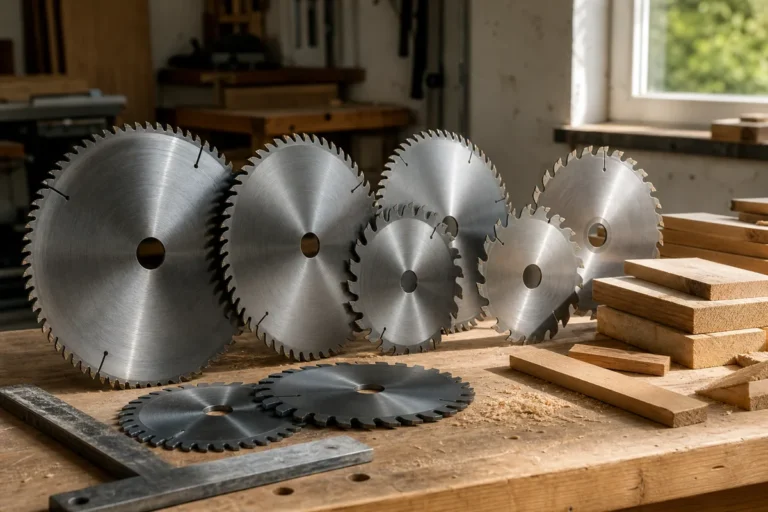
Look at the blade’s condition when judging angle stability. A warped blade, dirty arbor flange, loose insert, or buildup on the tilt mechanism can mimic a trunnion problem. Likewise, a fence that is out of alignment can cause binding and make a saw feel unstable. For safe operation, keep the blade guard and riving knife installed where the cut allows; never test stability by forcing stock through a blade that is binding.
When a cheaper saw is enough
Do not pay for a cabinet saw solely because it has heavier parts. If you cut mostly plywood, make few bevels, and need to store or transport the saw, a well-aligned jobsite machine may be the better purchase. Spend time checking the fence, miter-slot alignment, stand, and blade-lock repeatability. A solid setup and careful calibration can matter more to your results than extra casting weight.
If you want a portable saw for occasional shop use, compare jobsite table saws with stable stands and accessible adjustment controls. For a stationary budget option, contractor table saws can provide more capacity without the cost or electrical demands of some cabinet models, though the stand and trunnion design deserve close inspection.
Setup and maintenance matter
Once the saw is installed, level and secure its base according to the manual. Recheck blade alignment after moving the machine, changing a blade, or tightening a loose component. Keep pitch and dust from accumulating around the tilt mechanism, and do not lubricate parts unless the manufacturer specifies an appropriate product; oil can attract sawdust and turn it into abrasive grime.
A stable blade angle comes from the whole system: rigid support, sound locking hardware, correct alignment, and regular checks. Choose the heaviest saw that fits your real workload and shop, not the heaviest one you can afford. If the saw holds its setting and cuts accurately after calibration, extra trunnion mass may offer little practical benefit for the work you do.