Best Table Saws with Digital Blade Angle Readouts
What's inside
As an Amazon Associate I earn from qualifying purchases. This post may contain affiliate links at no extra cost to you.
Contents
What counts as a digital blade-angle readout?
A table saw’s bevel scale is usually a pointer moving past printed degree marks. A digital readout replaces, or supplements, that scale with an electronic angle display. The distinction matters: many saws advertised with digital controls show the fence position or blade height—not the blade’s tilt. Check the product details for an actual blade-angle display before buying.
Dedicated saws with integrated digital bevel readouts are uncommon, and availability changes. For most buyers, the practical choices are a saw with a conventional bevel mechanism plus an aftermarket digital angle gauge, or a saw with a built-in digital system if one is available in the required size and configuration. A magnetic gauge can be moved between machines, but it measures the blade directly only when you can place it against a clean, accessible blade plate.
Compare the practical options
| Option | Best for | Trade-off |
|---|---|---|
| Contractor or cabinet saw plus digital gauge | Repeatable bevel setup, including on a saw you already own | Requires calibration and a suitable blade-access position |
| Jobsite saw plus digital gauge | Portability and occasional bevel cuts | Less mass and smaller tables make large workpieces harder to control |
| Saw with integrated digital bevel display | Frequent angle changes without attaching a separate gauge | Fewer choices; verify that the display measures blade tilt and that the saw fits your shop |
| Conventional bevel scale only | Infrequent cuts where a small setup error is acceptable | Harder to set accurately, especially between marked detents |
Choose the saw before the readout
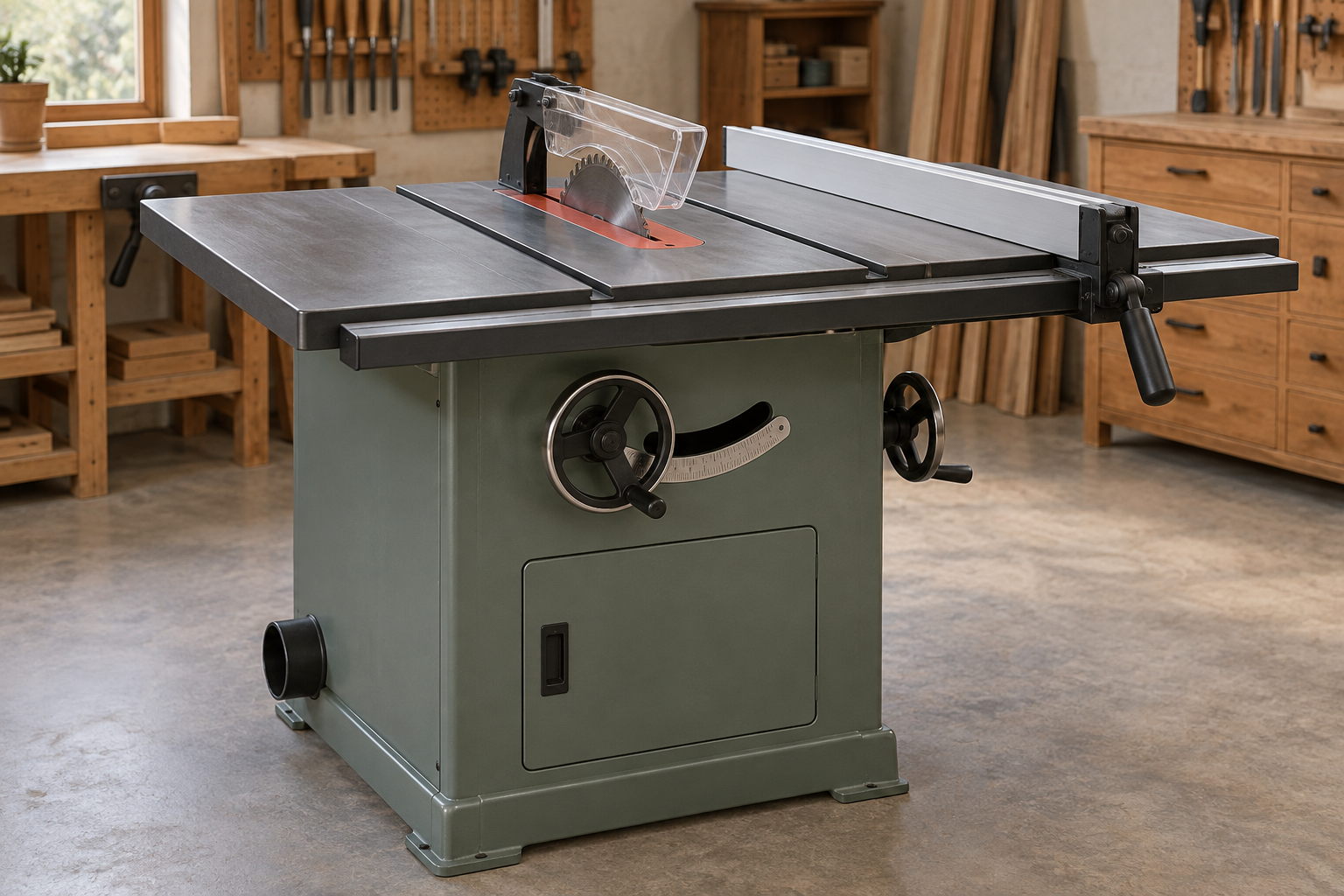
Start with the machine’s capacity, stability and safety equipment. A digital display cannot compensate for a short table, a fence that shifts under pressure, or a blade that is out of alignment with the miter slot. For a fixed shop, a heavier contractor or cabinet-style saw is generally easier to keep steady while cutting wide stock. For a site or a small garage, a jobsite saw is easier to store and move, but its compact support surfaces demand more attention when handling sheet goods.
Confirm the saw’s bevel range and how it locks at an angle. Many common saws tilt to 45 degrees, but the useful range, direction of tilt and ease of adjustment vary. Check that the blade guard, riving knife and dust collection arrangement are usable at the angles you cut. A digital angle display is a convenience, not a reason to compromise on guarding, fence quality or a sound blade brake.
For a new machine, compare table saws with digital blade-angle readouts carefully: listings sometimes use “digital” to describe unrelated controls. If a suitable integrated option is hard to find, a stable saw with a standard bevel mechanism and a separate gauge can be the better buy.
When an aftermarket gauge makes sense
A magnetic digital angle gauge is usually the economical route. It attaches to the blade plate, reports its angle relative to gravity, and can be zeroed against the table. That lets you set an angle without trusting the saw’s printed scale. The gauge is also useful on jointers, bandsaws or drill-press tables, though it does not replace each machine’s own alignment checks. Look for a clear display, a repeatable zero function, a strong magnet and a stated resolution and accuracy. Resolution is not the same as accuracy: a display that changes in 0.1-degree steps may still be off by more than that.
Search for a magnetic digital angle gauge for a table saw if you already own a saw you like. Check that the magnet can sit flat on your blade and that the housing clears the throat plate and saw cabinet. Some gauges are too bulky to attach with the blade fully lowered; raise the blade enough to reach a flat area, then keep hands clear of the teeth and disconnect power before placing or removing the gauge.
Set the angle, then verify the cut
Unplug the saw before touching the blade. Clean pitch or sawdust from the blade plate and table, set the gauge on the table and zero it. Attach it to the blade plate, away from the teeth, and tilt the blade to the target. Lock the bevel mechanism and recheck the display; tightening the lock can pull the setting slightly off. For repeat work, make a test cut in scrap and measure the bevel with a reliable square or angle tool.
At 45 degrees, even a small error can leave a visible gap in a miter. A 0.5-degree error may be insignificant for rough framing but can spoil a tight box corner or furniture joint. Do not assume a display makes the whole cut accurate: blade runout, a misaligned fence, a warped workpiece or pressure that steers the stock can all affect the result. Verify that the blade is square to the miter slot and that the fence is parallel to it, following the saw manual’s procedure.
When the cheaper option is fine
If you make bevel cuts only a few times a year, a sound saw with a readable scale and positive stops may be enough. A basic square and a test cut can confirm a 90- or 45-degree setting without buying electronics. A gauge is most valuable when you regularly set intermediate angles, need to return to a setting, or cannot read the saw’s scale clearly.
Spend first on the saw’s mechanical condition and support for your work. A digital readout that is poorly calibrated, hard to reach or vulnerable to shop dust can be more nuisance than help. Whether you choose an integrated display or a separate gauge, treat the number as a setup reference and confirm critical work with a test cut.