Best Jointers with Heavy Cast-Iron Tables for Stable Cuts
What's inside
As an Amazon Associate I earn from qualifying purchases. This post may contain affiliate links at no extra cost to you.
Contents
What heavy cast-iron tables change
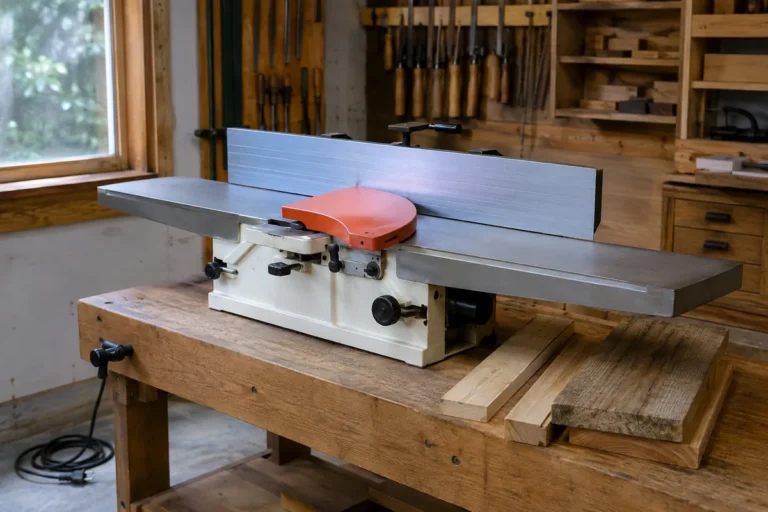
A jointer’s tables support the board as it passes the cutterhead. More mass can help the machine resist vibration, and long, rigid tables make it easier to keep a workpiece flat against the reference surface. That matters most when jointing long boards or taking repeated cuts on stock with some twist.
Cast iron is not a guarantee of accuracy. A jointer still needs coplanar infeed and outfeed tables, a properly aligned fence, sharp knives or a correctly set cutterhead, and a stable stand. A heavy machine that arrives out of adjustment can produce the same tapered or twisted edge as a lighter one. Check the table surfaces and alignment before judging a cut.
As an Amazon Associate we earn from qualifying purchases at no extra cost to you.
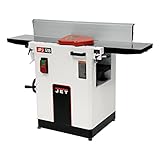


What to shop for
Table length is often more useful than extra motor power for ordinary edge jointing. A 6-inch benchtop jointer commonly has tables around 28 to 36 inches long; a typical floor-standing 8-inch machine has substantially longer beds, often around 70 inches or more. Longer support makes it easier to control long boards, but takes up more shop space and costs more.
Choose width based on your stock. A 6-inch jointer can edge-joint boards up to roughly 6 inches wide, but it cannot flatten a wider face in one pass. An 8-inch machine gives more capacity for face-jointing, although the board must still be manageable and within the machine’s stated limits. For wider panels, a planer sled or a different flattening setup may be more practical.
Look for a fence that locks securely and stays square, accessible table-adjustment controls, and a guard that returns reliably. A helical cutterhead can reduce tear-out on figured wood and usually makes replacement inserts simpler, but it adds purchase cost. Straight knives are less expensive to replace and can leave a very smooth finish when sharp and set correctly.
Compare common options
| Type | Typical capacity | Best fit | Main trade-off |
|---|---|---|---|
| Benchtop, 6-inch | Short tables; 6-inch width | Small shops, occasional edge jointing | Less support for long stock; lighter frame may move or vibrate |
| Floor-standing, 6-inch | Longer tables; 6-inch width | Regular furniture work in a compact shop | More stable than most benchtop units, but limited face-jointing width |
| Floor-standing, 8-inch | Long tables; 8-inch width | Frequent use and wider boards | Higher cost, heavier installation, and more floor space |
These are broad categories, not guarantees: verify the actual table length, cutterhead type, footprint, and electrical requirements in the manufacturer’s specifications. A sturdy 6-inch floor model can be a better buy than an 8-inch machine if your stock is narrow and space is tight.
Choose by shop and workload
For occasional projects and boards under about 4 feet long, a benchtop machine may be enough if it is clamped or bolted to a solid stand. Search 6-inch benchtop jointers and compare table length, fence stiffness, and dust-port size rather than choosing on motor horsepower alone. A light machine can still do useful work, but a stand that flexes or a jointer that shifts during a pass will undermine control.
For regular hardwood work, long boards, or a shop where the jointer will stay installed, a floor-standing cast-iron machine is the more stable choice. Search 6-inch floor-standing cast-iron jointers for a smaller footprint, or 8-inch cast-iron jointers if you routinely work with wider stock. Check shipping weight and whether the machine can be moved into your shop before ordering; these machines may require help or lifting equipment.
Do not pay for 8-inch capacity simply because it sounds more capable. If most of your boards are 4 to 6 inches wide, a 6-inch jointer with long, aligned tables may produce more useful value. Spend the difference on good dust collection, knives or inserts, and a stand that will not rock.
Setup and cut quality
Before the first cut, use a reliable straightedge to check that the infeed and outfeed tables are aligned. With straight knives, set each knife to the cutterhead manufacturer’s specification; a knife that sits too high can pull the board, while one set too low can leave a step. Check the fence at 90 degrees to the tables with a square, then lock it and recheck it. Even a small fence error can turn a square edge into a slight bevel.
Take light cuts—often around 1/32 to 1/16 inch for routine work—and reduce depth for wide, hard, or figured stock. A deep cut can cause tear-out, increase kickback risk, and make it harder to keep the board flat. Feed at a steady pace, keep hands clear of the cutterhead, and use push blocks when they improve control. Never joint stock with loose knots, cracks, or other defects that could break free.
A common failure is a board that looks straight along one edge but will not sit flat against the fence. That usually points to poor face-jointing, table misalignment, or inconsistent pressure—not a need for a more powerful motor. Joint one face flat first, then use that face against the fence while edge-jointing. If the machine leaves snipe or a taper, inspect table alignment and feeding technique before taking heavier cuts.
When a cheaper option is fine
A benchtop jointer is a sensible budget choice for short pieces, occasional edge preparation, and a shop without room for a permanent floor machine. It is less appealing for long boards, wide face-jointing, or daily production. If you only need to flatten a few boards each year, consider whether a hand plane, router sled, or local milling service would cost less and take up less room.
For frequent work, the extra mass and longer beds of a floor-standing jointer can make setup and feeding more consistent, but they do not remove the need for careful technique. Buy the capacity you will use, measure the space and electrical supply first, and treat table alignment and cutter maintenance as part of the purchase—not as optional finishing steps.