Best Jointers with Cast-Iron Tables for Stable Milling
What's inside
As an Amazon Associate I earn from qualifying purchases. This post may contain affiliate links at no extra cost to you.
A jointer does one job: it makes one face flat and one edge square so your planer and table saw have a true reference. Cast-iron tables are the reason a good jointer can hold that accuracy for years. They add mass, damp vibration, and stay flat under load in a way stamped steel and aluminum can’t match. If you’re milling rough-sawn hardwood or gluing up panels, that stability shows up directly in less snipe, fewer tapered boards, and tighter glue lines.
As an Amazon Associate we earn from qualifying purchases at no extra cost to you.

Contents
Why cast iron still matters
Mass is the point. A floor-standing jointer with cast-iron infeed and outfeed tables typically weighs 180 to 450 lbs, versus 60 to 85 lbs for an aluminum benchtop. That weight resists the lateral push you put into a board and lowers the resonant frequency, so the machine doesn’t chatter when you take a 1/16″ cut in hard maple.
Flatness and wear are the other factors. Properly ground cast iron will hold within 0.003″ to 0.005″ over its length if you keep it waxed and avoid moisture. Aluminum extrusions flex more with temperature and clamp pressure, and they dent easily. Once an aluminum table gets a ding on the lip near the cutterhead, every board drags over it. Cast iron can be re-ground; aluminum usually can’t.
The failure mode to watch for is not the material itself but the support under it. Three-point bases, thin stamped stands, and short dovetailed ways will let even thick cast-iron tables sag or go out of coplanar. Check how the tables are supported, not just what they are made from.
What actually determines stability
Four specs matter more than brand:
Table length: A 46″ total bed will flatten a 30″ board reliably. Once you try to face-joint 4-5 foot boards for a table top, you need 65″ to 75″ of total length to keep the board registered without tipping. Short beds force you to add roller stands, which introduces another alignment variable.
Table width: 6″ jointers handle most S4S stock and narrow glue-ups, but you will run out of capacity the first time you need to flatten a 7″ wide cherry board. An 8″ bed covers about 90% of furniture stock without needing a planer sled.
Ways and gibs: Look for long dovetail ways with adjustable gibs, not just a single pivot. Dovetails let you dial in table parallelism and take up wear. On a parallelogram design, the tables move on four pivot arms which keeps the gap at the cutterhead tight through the depth range and makes depth changes more repeatable.
Fence system: A cast-iron fence that locks at 90 and 45 degrees with a positive stop saves time. The fence should be at least 32″ long and 4″ tall, and it should not deflect when you lean a heavy board against it. If you can flex the fence with hand pressure in the store, walk away.
Motor power is often overstated for jointers. A true 1 HP (12-13A at 120V) is enough for 6″ machines taking 1/32″ to 1/16″ passes. For an 8″ machine you want 1-1/2 to 2 HP, ideally on 240V, so you can take a full-width cut in white oak without stalling or tripping a breaker.
6-inch vs 8-inch cast-iron jointers
Most buyers hesitate between a compact 6″ floor model and a full-size 8″. Here is how they compare in practice:
| Category | 6-Inch Benchtop / Short-Bed | 6-Inch Floor-Standing (Cast Iron) | 8-Inch Long-Bed (Cast Iron) |
|---|---|---|---|
| Total Table Length | 30″ – 46″ | 55″ – 66″ | 72″ – 76″ |
| Typical Weight | 60 – 85 lbs (often aluminum) | 180 – 280 lbs | 300 – 450 lbs |
| Max Face-Jointing Width | 5-3/4″ usable | 6″ usable | 8″ usable |
| Motor | 6-10A universal motor | 1 HP induction, 120V | 1-1/2 to 2 HP, 120/240V |
| Best For | Small shop, trim work, short boards | General furniture, 3-4′ boards | Panels, wide hardwood, 5’+ boards |
| Common Trade-off | Vibration, short reference surface | Limited width for wide stock | Footprint and 240V requirement |
If your work is mostly 4/4 walnut and maple under 4 feet long, a 6-inch cast-iron jointer on a closed stand is stable enough and far cheaper to run. If you regularly buy rough 8/4 slabs or wide 6-7″ boards, the extra 2″ of width and 12″ of bed length on an 8-inch machine will save you from building planer sleds for every other project.
Cutterhead: straight knives vs. helical inserts
Cast iron gives you stability; the cutterhead decides surface finish and maintenance.
Straight-knife heads with two or three HSS or carbide knives are cheap and leave a clean shearing cut when sharp. They are loud (95-102 dB) and nick easily. If you hit a staple, you are re-setting all knives to within 0.001″ height or you get ridges. Knife setting jigs help, but expect 30-45 minutes for a change.
Helical insert heads use 4-sided carbide inserts arranged in a spiral. They cut with a shearing action, so tear-out in figured maple or reversing grain drops dramatically. Noise falls to about 85-88 dB. When an insert chips, you rotate one insert in two minutes instead of resetting the whole head. The downside is cost: typically $150-$300 more upfront, and a full set of inserts is $120-$180 when you eventually need it. They also leave very faint scallops that need a light pass on the planer or 150-grit sanding – not a defect, just the geometry.
For stable milling, either head works if the tables are flat and coplanar. If you mill a lot of highly figured wood or reclaimed stock with hidden grit, an 8-inch helical head jointer with cast-iron tables pays for itself in less rework. If you mill straight-grained poplar and soft maple and don’t mind sharpening, straight knives are fine and cheaper to keep sharp.
Fence and coplanarity: where cheap machines fail
Two problems cause most jointer frustration and both are fixable if you know to check them.
First, tables out of parallel. Lay a 48″ straightedge diagonally across the infeed and outfeed with the infeed set to zero. You should see no light gap and no rocking. A 0.010″ twist over 48″ will put a twist in every board you joint. On used machines, check gib screws for backlash. If the handwheel has more than 1/8 turn of slop before the table moves, the ways are worn or loose.
Second, fence not square to the tables along its full travel. Set the fence to 90 degrees, lock it, and check with a square at the front, middle, and back of the fence. Then push moderately on the top of the fence while checking – it shouldn’t move more than 0.002″-0.003″. Rack-type fences hold better than single-point locks. Wax the fence face so boards slide without grabbing, which is a common cause of tapered edges.
Who should buy what
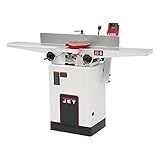
Buy a 6-inch floor-standing cast-iron jointer if you have a single-car garage shop, work mostly with 4-6″ wide stock, and run on 120V only. It takes up about 24″ x 55″ and you can move it with a mobile base. Keep cuts to 1/32″ on face joints and 1/16″ on edges and it will stay accurate for years.
Step up to an 8-inch long-bed cast-iron machine if you build tables, large cases, or doors, or you buy rough lumber wider than 6″. The longer infeed alone makes flattening 60″ boards practical without help. Plan for 240V, a 36″ x 76″ footprint, and help to get it off the pallet – you are not lifting a 350 lb top by yourself.
Avoid benchtop jointers with aluminum tables if stable milling is your goal. They are light and easy to store, but even when new they lack the mass to damp cut vibration and their short beds make accurate flattening harder than it needs to be. That trade-off only makes sense if you joint edges only and have no floor space.
Whatever size you choose, budget for setup. A new cast iron jointer with helical cutterhead usually needs 1-2 hours to clean the rust coating, wax the tables with paste wax (not silicone), check table coplanarity, and square the fence. Recheck after two weeks – cast iron settles after shipping and temperature changes. That one re-check prevents most of the “my jointer cuts convex” complaints.