Best Band Saws with Rigid Frames for Accurate Straight Cuts
What's inside
As an Amazon Associate I earn from qualifying purchases. This post may contain affiliate links at no extra cost to you.
A rigid-frame band saw is easier to tune and more likely to hold a straight cut than a light benchtop saw, especially when resawing thick boards. The frame matters because it resists flex as blade tension rises and as the workpiece pushes against the blade. That does not make the saw automatically accurate: poor guides, a dull blade, low tension, or a misaligned fence can still produce a wandering cut.
For most serious woodworking, the best choice is a 14-inch floor-standing saw with a cast-iron or heavy welded-steel frame, at least 1-1/2 hp, and enough throat and resaw capacity for the material you actually cut. A rigid 12-inch saw can be a better buy for smaller parts, while a 17-inch machine is justified when you routinely resaw wide boards.
Contents
What Makes a Band Saw Frame Rigid?
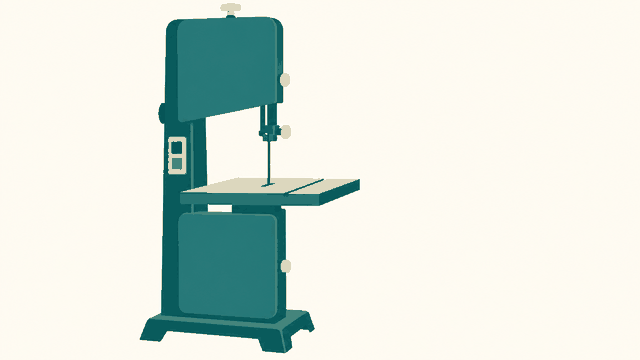
Frame stiffness comes from material, shape, and the quality of the wheel supports. Cast-iron frames are heavy and naturally resistant to vibration. Welded-steel frames can also be very rigid, particularly on larger saws, but thin sheet-metal cabinets and narrow upper columns flex more noticeably under high tension.
Look for a thick upper column, a substantial lower cabinet, and wheels with little side-to-side play. A machine that weighs 200 to 300 pounds generally stays planted better than a 60-pound benchtop model. Weight is not a guarantee of precision, but it reduces vibration and makes the saw less sensitive to changes in feed pressure.
The frame must also tolerate proper blade tension. A saw rated for a 1-inch resaw blade but equipped with a flexible tensioning mechanism may not deliver the claimed performance. If the upper wheel shifts while tension is applied, the blade can track differently each time you change blades.
Specifications That Matter for Straight Cuts
| Feature | Useful target | Why it matters |
|---|---|---|
| Throat capacity | 12 to 14 inches for general work | Provides room between the blade and frame for curves and wide stock |
| Resaw height | 10 to 12 inches for most shops | Allows bookmatching and cutting thick boards into thinner slabs |
| Motor | 1-1/2 to 2 hp for demanding work | Maintains blade speed when feeding dense or wide lumber |
| Blade width | 3/4 to 1 inch for straight resawing | Wider blades resist deflection better than narrow blades |
| Table | Cast iron, roughly 18 by 24 inches or larger | Supports heavy stock and stays flatter under pressure |
Do not select a saw solely by horsepower. A 1 hp machine with good wheels, guides, and a rigid frame can cut more cleanly than a poorly designed 2 hp saw. Also check the blade length and availability. A saw that accepts common 105-inch or 111-inch blades is easier and less expensive to maintain than one requiring an unusual size.
Best Rigid-Frame Band Saw Types
For a general-purpose workshop, a 14-inch floor-standing band saw is the practical middle ground. It normally offers around 12 inches of resaw height, a stable table, and enough frame strength for a 3/4-inch blade. This is the category to choose for furniture parts, bowl blanks, tenons, and occasional resawing.
A 12-inch floor-standing band saw suits smaller shops and users who rarely cut stock thicker than 6 inches. It occupies less floor space and usually costs less. The trade-off is reduced resaw height and a smaller table. For straight cuts in 4-inch boards, a well-tuned 12-inch machine is often entirely adequate.
Choose a 17-inch heavy-duty band saw when wide resawing is routine rather than occasional. These machines have longer blades, larger wheels, stronger frames, and more powerful motors. They are expensive and take substantial floor space, and their extra capacity is wasted if most of your work involves small joinery parts.
A benchtop saw is acceptable for thin plywood, small curves, and parts under roughly 2 inches thick. It is not the economical choice for repeated resawing. Its frame, table, and tensioning system usually flex sooner, and the short distance between the wheels limits blade stability. The cheaper option is fine when the work matches its limits; buying one for wide hardwood and then forcing it to perform like a floor-standing saw is false economy.
Blade and Guide Setup
A rigid saw still needs the correct blade. For straight resawing, use a wide blade with three or four teeth per inch and a relatively low tooth profile. A 1/2-inch blade is more forgiving on smaller saws; a 3/4-inch or 1-inch blade generally tracks better on a rigid 14-inch or larger machine. A blade with too many teeth packs with dust and heats up, while a very coarse blade can leave a rough, uneven cut.
Set the blade tension according to the blade maker’s instructions rather than relying blindly on the saw’s built-in scale. Many scales are approximate. Pluck or deflection tests can confirm tension, but the practical test is whether the blade stays centered and does not drift under a steady feed.
Set the thrust bearing just behind the blade and the side guides close enough to control it without touching during free running. On a 3/4-inch blade, guides about 1/32 inch behind each side of the blade are a useful starting point. Lower the upper guide assembly to within 1/4 inch of the workpiece. A guide left 2 inches above the board gives the blade too much room to twist.
Why Straight Cuts Fail
If the cut angles away from the fence, first check drift and blade sharpness. A dull blade needs more feed pressure, which bends the blade and exaggerates drift. If the cut starts straight and then wanders, the blade may be overheating, the gullets may be packed with dust, or the stock may be forcing the blade sideways.
Blade drift is not necessarily a frame problem. Adjust the fence to follow the blade’s natural travel, or use a resaw fence that can be pivoted slightly. If the blade visibly bows between the guides, increase tension only within the blade’s rating; excessive tension can damage bearings, wheels, or the frame.
Finally, check that the table is square to the blade and that the fence is parallel to the actual cutting path. A rigid frame helps preserve these settings, but it cannot correct a warped board, an incorrectly installed blade, or a fence aligned to the miter slot instead of the blade.