Kreg Work Table Review: Features, Capacity, and Best Uses
What's inside
- Kreg Work Table specifications at a glance
- How much usable workspace does it provide?
- Height and ergonomics
- Capacity: the 350-pound rating needs context
- Clamping options and limitations
- Portability for workshops and job sites
- Best uses—and poor matches
- Decision guide: is this the right folding work table?
- Ownership realities and maintenance
- Bottom line
- Related Guides
- Kreg Work Table specifications at a glance
- How much usable workspace does it provide?
- Height and ergonomics
- Capacity: the 350-pound rating needs context
- Clamping options and limitations
- Portability for workshops and job sites
- Best uses—and poor matches
- Decision guide: is this the right folding work table?
- Ownership realities and maintenance
- Bottom line
- Related Guides
As an Amazon Associate I earn from qualifying purchases. This post may contain affiliate links at no extra cost to you.
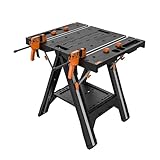
The Kreg Work Table is best suited to woodworkers who need a portable, clamp-friendly assembly and cutting station rather than a replacement for a heavy permanent workbench; the Kreg Mobile Project Center (KWS1000) offers a roughly 31½-inch working height, a 27½-by-31½-inch main surface, a rated capacity of up to 350 pounds, and folding legs for storage and transport.
As an Amazon Associate we earn from qualifying purchases at no extra cost to you.



Contents
- Kreg Work Table specifications at a glance
- How much usable workspace does it provide?
- Height and ergonomics
- Capacity: the 350-pound rating needs context
- Clamping options and limitations
- Portability for workshops and job sites
- Best uses—and poor matches
- Decision guide: is this the right folding work table?
- Ownership realities and maintenance
- Bottom line
- Related Guides
Kreg Work Table specifications at a glance
Kreg’s folding work table is commonly sold as the Mobile Project Center. Because product listings and regional packaging sometimes round dimensions differently, check the label or current manufacturer documentation before buying replacement accessories. The practical specifications below are the figures most useful for planning a workshop or job site.
| Feature | Kreg Mobile Project Center | What the number means in use |
|---|---|---|
| Working height | About 31½ inches | Comfortable for many standing tasks; lower than a typical 34–36-inch workbench |
| Main work surface | About 27½ × 31½ inches | Approximately 6 square feet before adding the auxiliary surface or supporting material |
| Rated load | Up to 350 pounds | Suitable for many cabinets, doors, benchtop tools, and sheet-good sections when the load is centered and stable |
| Folded thickness | Approximately 8 inches | Can be stored against a wall or in a vehicle, although the folded unit is still fairly heavy |
| Weight | Roughly 55 pounds | Portable for one strong adult over short distances, but not a lightweight sawhorse |
| Clamping provision | Bench dogs, clamp channels, and clamping faces | Supports Kreg bench clamps and many compatible hold-down arrangements |
| Construction | Steel folding frame with molded work surfaces | Resists ordinary job-site abuse, but is less rigid than a solid timber or welded-steel bench |
How much usable workspace does it provide?
The nominal surface area is approximately 27.5 × 31.5 inches, or 866 square inches—about 6.0 square feet. That is enough for a cabinet door, a small tabletop, a benchtop planer, or several boards being joined. It is not enough to comfortably support a full 4-by-8-foot sheet of plywood by itself.
For sheet goods, the useful approach is to place the Kreg work table between additional supports. For example, a 96-inch panel can be supported by the table in the middle and two stable sawhorses near the ends. The table then provides a clamping and cutting station rather than carrying the entire panel unsupported. Keep the combined load within the manufacturer’s limit and prevent the panel from rocking before cutting.
The split or adjustable worktop arrangement is useful when you need to clamp a board edge, hold a small assembly, or create an opening around a saw blade. The gaps and channels also give clamps somewhere to pass through, which is more versatile than a completely flat plastic top.
Height and ergonomics
At about 31½ inches, the Kreg work table sits below many full-size woodworking benches. That height is a reasonable compromise: it is low enough to remain stable during planing and assembly, yet high enough for general cutting, routing, drilling, and pocket-hole work without working directly on the floor.
Whether it is comfortable depends on your task and height. A taller woodworker may prefer risers under the table for light assembly, but risers reduce stability and should not be used for aggressive hand-planing or heavy impacts. For precision routing or sawing, keep the table directly on a level surface and use its adjustable feet or leg locks as intended.
Capacity: the 350-pound rating needs context
The stated capacity of up to 350 pounds is considerably higher than the weight of most projects placed on it. A small cabinet carcass, door, or benchtop machine will normally fall well below that limit. However, the rating is not a guarantee that the table will feel like a 350-pound stationary bench.
- Center heavy loads over the frame rather than placing them on one overhanging corner.
- Lock the folding legs completely before applying force.
- Use extra supports for long boards and sheet goods.
- Do not treat the table as a step, scaffold, or lifting platform.
- Expect more movement during hand-planing than with a bolted workbench.
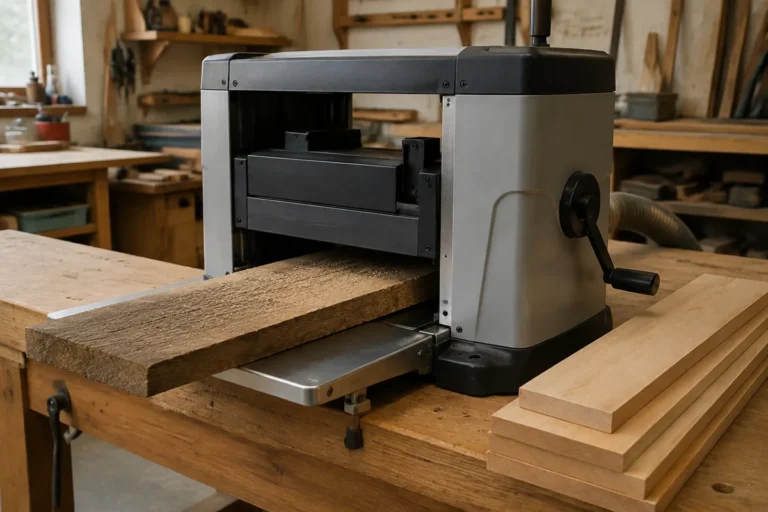
A useful planning calculation is to total the machine, workpiece, and accessories. A 65-pound benchtop planer, a 35-pound board, and 10 pounds of supports equal 110 pounds—well below the rated load. The more important concern in that example is length and vibration, so the planer should be centered and the boards supported at both ends.
Clamping options and limitations
Clamping is the Kreg table’s main advantage over ordinary folding tables. The work surface is designed around clamp channels and dog-hole-style positioning points, while the frame and top provide faces against which a workpiece can be held. Kreg Bench Clamps and similar compatible hold-down clamps are particularly useful for routing, drilling, sanding, and pocket-hole joinery.
There are limits. A clamp can hold a board down, but it cannot compensate for a table that is not level or for a long workpiece that is unsupported. Clamp pressure can also distort thin panels if it is concentrated in one spot. Use a caul or scrap block under the clamp foot when working with softwood, veneered plywood, or finished parts.
For edge-jointing with a hand plane, the table can work for short boards, but the clamping arrangement is not a substitute for a long front vise and substantial bench mass. For routing, attach the router only with a suitable accessory or fixture and follow the tool maker’s instructions; the folding table itself is not a universal router-table top.
Portability for workshops and job sites
The folding mechanism is valuable when one surface must serve several purposes. Folded, the table can be stored vertically in a compact workshop, transported in a van, or carried to a driveway or remodeling site. Its approximately 55-pound weight is manageable for short moves, but the unit is bulky enough that carrying it up stairs or across uneven ground may require two people.
Portability is strongest when compared with a fixed bench, not with lightweight plastic sawhorses. The steel frame gives the Kreg work table useful stability, while the folding design introduces hinges, locks, and joints that must be checked periodically. Sand, dried glue, and packed sawdust around the folding hardware can prevent the legs from locking fully.
Best uses—and poor matches
Good uses
- Assembly of cabinets, drawers, doors, and small furniture.
- Pocket-hole drilling and other repetitive joinery.
- Clamping boards for sanding, routing, drilling, or trimming.
- A temporary outfeed or support station when paired with other supports.
- Remodeling and installation work where a permanent bench is unavailable.
- Compact workshops that need one table to fold away after each project.
Less suitable uses
- Heavy hand-planing of long, wide boards.
- Supporting an entire sheet of plywood without auxiliary stands.
- Permanent production work where a rigid bench is used every day.
- Large machines that generate substantial vibration or require a broad footprint.
Decision guide: is this the right folding work table?
| Your situation | Recommendation | Reason |
|---|---|---|
| Very limited storage and occasional DIY projects | Good choice | It folds away and provides more clamping capability than basic sawhorses |
| Frequent cabinet assembly in a garage | Good as a secondary station | Useful for clamping and layout, but a fixed bench may be better as the primary surface |
| Job-site trim, repair, and installation work | Good choice if transport weight is acceptable | Its folding design and integrated clamping features are practical away from the shop |
| Mostly long-board hand-planing | Choose a heavier bench | Mass, length, and a substantial vise matter more than portability |
| Need to support full plywood sheets | Use it with two or more additional supports | The approximately 6-square-foot top is not a full-sheet work platform |
| Daily use with heavy benchtop machinery | Consider a fixed machine stand or workbench | Greater rigidity and vibration control will usually justify the extra space |
Ownership realities and maintenance
The parts most likely to need attention are the folding-leg locks, hinge areas, adjustable feet, and clamp contact surfaces. Inspect the leg locks before every substantial project. If a lock does not engage cleanly, remove sawdust and dried finish rather than forcing the mechanism. Keep the top free of glue squeeze-out, since cured glue can interfere with flat clamping and sliding accessories.
Do not use oily lubricant on the work surface or near areas where finishes will be applied. A dry lubricant suitable for metal hardware can help a sticky hinge, but follow the product instructions and keep it away from workpieces. Replace damaged bench dogs, clamp pads, or feet when they no longer hold securely; improvised loose parts can allow a project to shift during cutting.
Price varies by region and availability, but the Kreg folding work table generally occupies the mid-range portable-workbench category. Budget for compatible clamps if you do not already own them. The table’s value improves when it replaces several temporary setups—such as a clamping station, assembly surface, and portable support—but a basic pair of sawhorses remains cheaper for occasional rough cutting.
Bottom line
The Kreg work table is a strong fit for compact workshops, mobile woodworkers, and anyone who values integrated clamping more than maximum bench mass. Its approximately 31½-inch height, 6-square-foot surface, 350-pound rating, and folding frame cover a broad range of assembly and repair tasks. Buy it as a versatile portable work center, not as a full substitute for a heavy woodworking bench. Add stable supports for long stock, respect the load rating, and keep the folding hardware clean to get the most reliable service from it.