Best Table Saws with Riving Knives for Safer Furniture Work
What's inside
As an Amazon Associate I earn from qualifying purchases. This post may contain affiliate links at no extra cost to you.
Contents
Why a riving knife matters
A riving knife sits behind the blade and moves up and down with it, keeping a kerf from closing onto the teeth. That matters when cutting solid wood for furniture: internal stresses can make a board pinch the blade, stall the saw, or kick the workpiece back toward you. A riving knife does not prevent every kickback, but it addresses one common cause without the large gap of a splitter fixed to the saw table.
For safer everyday work, look for a knife that stays close to the blade and can be fitted without tools. Check that the saw also has a blade guard and anti-kickback pawls, and use them when the cut allows. A guard is not a substitute for a knife, or vice versa.
What to buy for furniture work
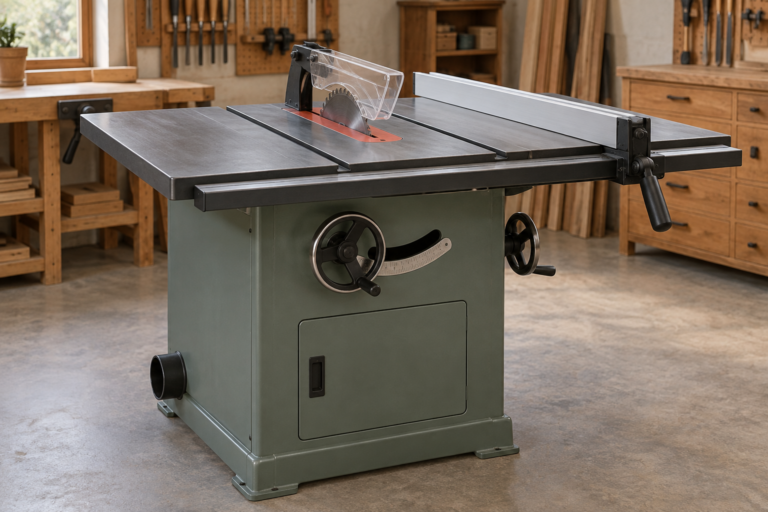
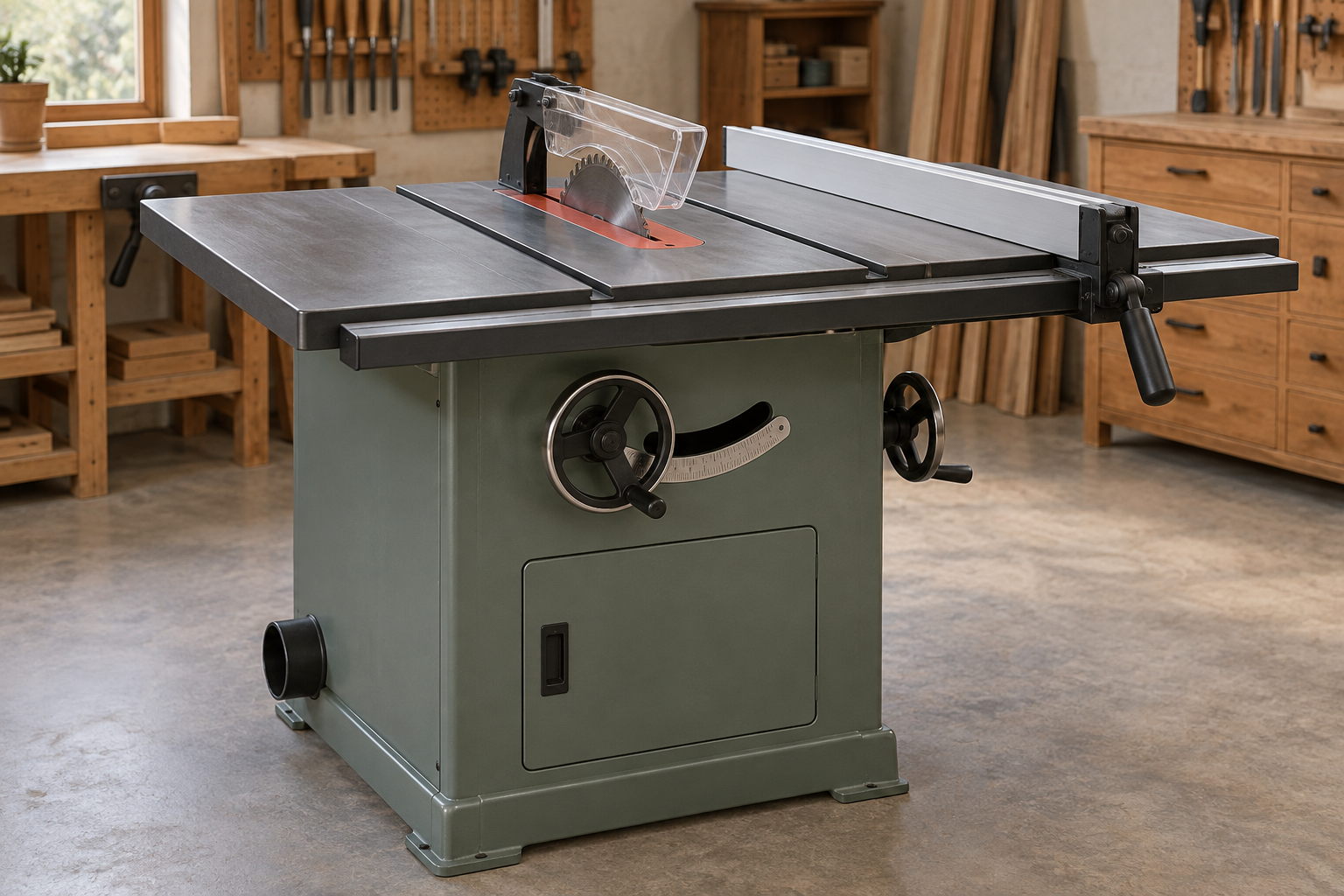
For a small shop making cabinets, tables, and chairs, a 10-inch contractor-style or cabinet saw is usually the useful middle ground. A 10-inch blade handles typical 4/4 and 8/4 stock and leaves room for standard dado work if the saw supports a dado stack. Choose a cabinet saw if you have a dedicated shop, adequate power, and need mass and a rigid fence. A contractor-style saw is easier to move and costs less, though its lighter stand can be less stable and its dust collection may be weaker.
Before buying, confirm the riving knife is included, not an accessory you must source later. Verify its thickness is appropriate for the blade’s kerf: the knife should be thicker than the blade plate but thinner than the kerf. Also check whether the knife can be set below the blade for non-through cuts, and whether the guard and knife can be removed and reinstalled quickly. If they are awkward, people are more likely to leave them off.
Compare 10-inch cabinet saws with riving knives with contractor-style saws with riving knives. Search results can include saws that lack a true riving knife, so inspect the manufacturer’s specifications and manual rather than relying on a listing headline.
Compare the main saw types
| Saw type | Best fit | Trade-off | Check before buying |
|---|---|---|---|
| Cabinet saw | Permanent shop, frequent hardwood work | Heavy, costly, often needs a suitable electrical circuit | Knife adjustment, fence alignment, dust port size |
| Contractor-style saw | Serious hobby shop with limited space or budget | Less mass; stand and dust collection vary widely | Stability, rip capacity, included guard and knife |
| Jobsite saw | Portability is essential, occasional furniture work | Smaller table and fence can make large panels harder to control | Fence locking, support for long stock, knife compatibility |
A less expensive saw can be fine if it holds alignment and the fence locks parallel to the blade. Spend time checking those basics in person if possible. A premium cabinet saw does not make an unsafe setup safe; a low-cost saw with a poorly locking fence can make accurate rip cuts needlessly difficult.
Set up the saw for safer cuts
Read the manual for the exact knife positions and blade limits. With the saw unplugged, confirm that the knife is centered behind the blade and does not rub it. On many saws, the knife is slightly thinner than the blade kerf; the exact dimensions depend on the blade and saw. Fit the correct knife when changing blades, and do not assume a knife supplied for a thin-kerf blade suits a full-kerf blade.
For a through-rip, raise the blade so the gullets—the valleys between teeth—clear the top of the workpiece. Fit the knife and guard, then use a push stick once your hands approach the blade. Keep the stock against the fence without forcing it sideways. Stand out of the line where a kicked-back board would travel, and support long boards so they cannot pivot off the table.
Do not rip a board that is visibly bowed, twisted, or under compression unless you can establish a safe reference edge and control the cut. A closing kerf can trap the blade even with a knife installed. If the wood binds, stop the saw and wait for the blade to stop; do not pull the workpiece backward while the blade is turning.
Non-through cuts and alternatives
Grooves and rabbets do not pass through the top face, so a full-height knife and blade guard may not fit. Use the manufacturer-approved low-profile knife where available, set the blade only as high as the cut requires, and use a purpose-made jig or featherboard where appropriate. If the saw’s knife cannot be used for the operation, follow the manual’s procedure and choose a method that keeps hands clear. Never improvise by leaving a loose splitter in the kerf.
A dado stack is convenient for repeated cabinet joinery, but it is not essential for most furniture work. A standard blade with multiple passes, a router, or a hand tool can make the same groove with less setup cost. If you do buy a dado stack, confirm the saw’s arbor length and maximum stack width first; some saws require a separate dado insert. The knife must be removed for many dado setups, so plan the cut and use suitable guarding rather than treating that as routine permission to work unprotected.
A practical buying checklist
Prioritize a properly fitted riving knife, a reliable fence, a stable table, and parts you can get locally. Measure your shop’s available footprint and the longest boards you expect to handle; a saw’s advertised rip capacity does not provide outfeed support. Budget for a suitable blade, push sticks, eye and hearing protection, and dust extraction. For a first furniture saw, a solid contractor-style machine with a working knife is often a better buy than a larger saw that strains the budget or the shop’s electrical supply.