Best Table Saws for Building Hardwood Drawer Boxes
What's inside
As an Amazon Associate I earn from qualifying purchases. This post may contain affiliate links at no extra cost to you.
Hardwood drawer boxes are small parts, but they demand more from a table saw than their size suggests. A typical box has four narrow pieces, repeated many times, with joints that expose every error. If the saw drifts 1/32 inch between cuts, the drawer may rack, the bottom groove may not line up, and the front and back can end up different lengths.
The best table saw is not necessarily the largest one. For this work, prioritize a rigid fence, reliable blade height and angle controls, low vibration, and dust collection. A saw with a 30-inch rip capacity is useful for cabinet work, but drawer-box parts rarely need more than 8 or 10 inches of ripping width. Accuracy and repeatability matter more than maximum capacity.
As an Amazon Associate we earn from qualifying purchases at no extra cost to you.


Contents
What to Look For in a Drawer-Box Table Saw
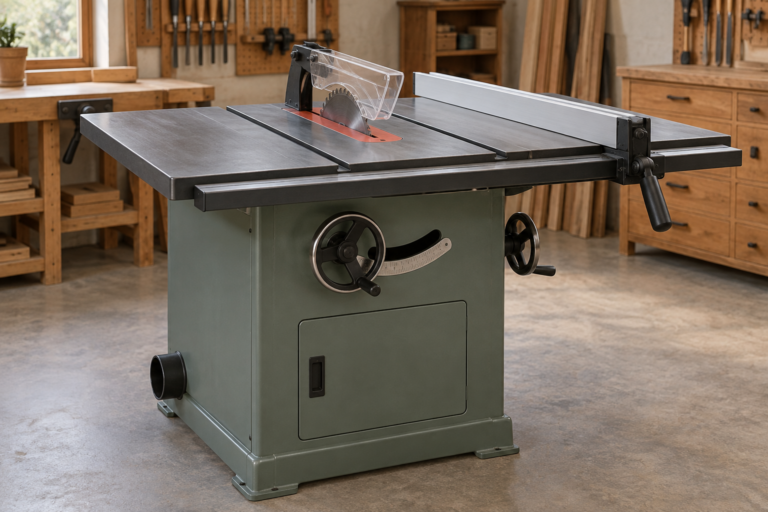
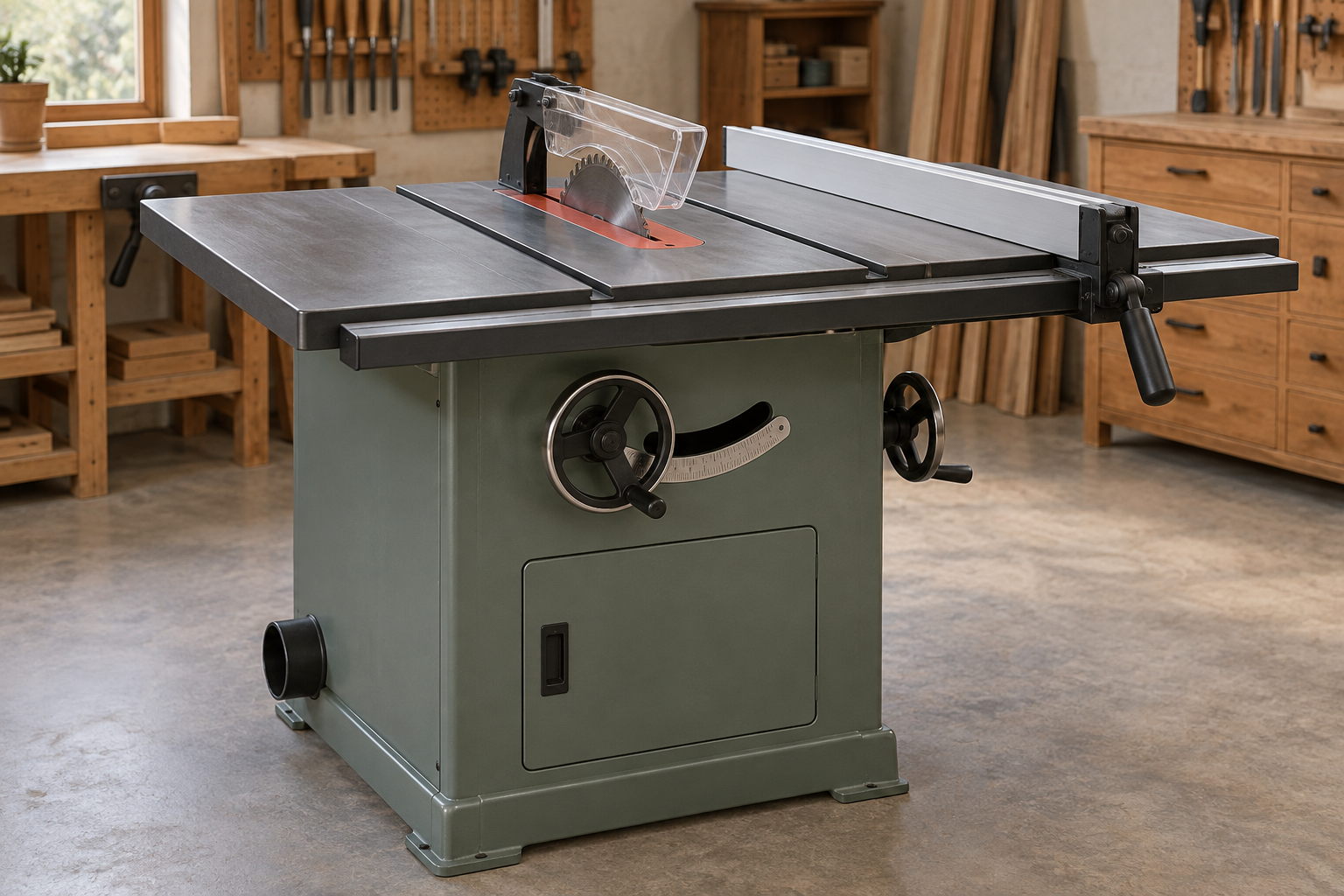
A cast-iron table and trunnions help keep the blade aligned when cutting dense maple, oak, or walnut. A heavy cabinet saw is the most stable choice, but a well-built hybrid saw can produce equally accurate drawer parts if its fence locks parallel to the blade and the table is properly tuned.
Look for a fence that locks without shifting at the far end. Test it with a tape measure or dial indicator: set the fence 4 inches from the blade at the front, then check the same distance at the back. A small amount of toe-out at the rear is safer than a fence that pinches the work against the blade, but the change should be measured in thousandths, not sixteenths.
A 10-inch saw is the practical standard. It accepts a wide range of 10-inch blades and cuts material up to roughly 3-1/8 inches thick at 90 degrees, far more than drawer sides require. A 1-1/2 to 2 horsepower motor is adequate for ripping 1/2-inch or 5/8-inch hardwood. Three horsepower gives more reserve for thick stock and full-width rips, but it usually requires a 240-volt circuit.
For a dedicated shop, compare 10-inch cabinet table saws with hybrid models. A cabinet saw costs more and occupies more space, but its weight reduces vibration and its enclosed base generally improves dust collection. A hybrid is often the better value for a one-person shop making occasional or moderate quantities of drawers.
Cabinet, Hybrid, and Compact Options
| Saw type | Best use | Main strengths | Important drawbacks |
|---|---|---|---|
| Cabinet saw | Frequent cabinet work and production batches | Best stability, power, fence support, and dust collection | Highest cost, weight, and space requirement |
| Hybrid saw | Serious hobby shops and occasional built-ins | Good accuracy at a lower price; usually runs on 120 volts | Less rigid and sometimes less refined than a cabinet saw |
| Compact benchtop saw | Small shops and limited budgets | Low price and small footprint | More vibration, shorter tables, weaker fences, and poorer dust control |
A compact saw can be fine when the drawer parts are narrow and the material is already straight and square. It becomes frustrating when cutting a dozen or more identical pieces. Short tables make it harder to support long boards, and lightweight fences can move enough to create visibly mismatched sides.
If a compact saw is your only option, add a rigid outfeed table, use a separate crosscut sled, and verify the fence before every batch. Do not assume a low-cost saw is inaccurate by definition; the problem is that it gives you less margin for setup errors. For a small kitchen project, the cheaper option can be perfectly reasonable.
Blade and Jig Setup for Drawer Parts
Use a sharp 40-tooth combination blade for general ripping and crosscutting, or a high-quality 60-tooth crosscut blade when the cut edges will be visible. A flat-top grind blade is useful for box joints because it leaves a square-bottomed cut. Avoid using a heavily worn blade simply because the drawer parts are hidden; burning and tear-out still affect fit.
For dovetailed drawers, the table saw usually handles stock preparation and groove cutting, while the dovetails are cut on a router table or with a dedicated jig. For rabbeted or dadoed drawer boxes, the table saw does more of the work. Check whether the saw accepts a dado blade set if you plan to cut 1/4-inch bottom grooves or rabbets. Some compact saws do not, and forcing an incompatible dado set onto the arbor is unsafe.
Use a crosscut sled for cutting the front, back, and sides to length. A sled with a fixed stop makes repeated parts consistent, but the stop must be positioned so a cut-off cannot become trapped between the blade and the stop. For narrow pieces, use a sacrificial auxiliary fence and a push block that keeps your hands well away from the blade.
Before cutting expensive hardwood, make a complete test box from cheap poplar or plywood. Check that opposite sides match within about 0.010 inch, that the bottom groove is the same distance from each edge, and that the joints close without force. A small error repeated across four corners becomes obvious after glue-up.
Dust, Safety, and Maintenance
Hardwood dust is a respiratory hazard, and drawer parts generate a surprising amount of fine dust when grooving. A cabinet saw with a sealed base and a 4-inch dust port works best with a true dust collector rather than a small shop vacuum. A 2 HP woodworking dust collector is a sensible match for a permanent shop saw. Use a blade guard and riving knife whenever the cut allows it, and connect a shop vacuum to the guard if it has a collection port.
Wax the cast-iron table periodically so hardwood slides without hesitation, but keep wax off the fence face and blade. Check blade parallelism, miter-slot alignment, and fence calibration after moving the saw. Replace a blade that requires excessive feed pressure or leaves burn marks on clean, properly jointed stock.
The Practical Buying Choice
For frequent hardwood drawer production, buy a cabinet saw with a dependable fence, riving knife, enclosed dust collection, and a 10-inch blade. For a smaller shop making a few kitchens or furniture projects each year, a hybrid saw is usually the sensible middle ground. Spend the savings on a good blade, crosscut sled, and dust collection rather than chasing extra horsepower.
If your budget is tight, choose the most rigid 10-inch hybrid table saw you can fit, then tune it carefully. For drawer boxes, a stable fence and repeatable setup will improve the finished work more than a larger motor or an impressive rip-capacity number.