Best Table Saws for Cutting Hardwood Slabs into Furniture Parts
What's inside
As an Amazon Associate I earn from qualifying purchases. This post may contain affiliate links at no extra cost to you.
Cutting a hardwood slab into table legs, aprons, shelves, and other furniture parts is a harder job than ordinary board ripping. Slabs are often wide, heavy, slightly warped, and under internal tension. A saw that handles construction lumber can still struggle when the workpiece is 2-1/2 inches thick, 30 inches wide, or several feet long.
The best table saw depends on the parts you need to make. For repeated ripping of thick stock, motor power and fence capacity matter. For smaller components, accuracy, a good crosscut sled, and safe support may matter more than maximum horsepower. No table saw makes a badly flattened slab safe to cut, so surface preparation is part of the buying decision.
As an Amazon Associate we earn from qualifying purchases at no extra cost to you.


Contents
What to look for in a slab-cutting table saw
Use a 10-inch saw with at least 3 hp when thick hardwood is routine. A 1-3/4 to 2 hp cabinet saw can cut many furniture parts, particularly when the stock is under 1-1/2 inches thick and the feed rate is sensible. For frequent work in hard maple, oak, ash, or beech, a 3 hp cabinet saw gives more reserve and is less likely to bog down. A 5 hp machine is useful for production work, but it requires a suitable 240-volt circuit and costs more to operate and install.
The saw should have a cast-iron top, a rigid base, a dependable riving knife, and a fence that locks parallel without needing to be pushed into alignment. A 30-inch rip capacity is enough for most furniture parts. Choose 36 inches or more if you regularly cut wide panels or want to rip slab sections without using a separate track saw.
Blade height is another practical limit. A 10-inch blade typically cuts about 3-1/8 inches at 90 degrees, though the usable depth varies by blade and arbor design. That is adequate for many legs and aprons, but not for every thick live-edge slab. Do not remove the guard and riving knife simply to gain a little clearance.
The best table saw types for furniture parts
| Saw type | Best use | Main advantage | Main limitation |
|---|---|---|---|
| 3 hp cabinet saw | Regular hardwood furniture work | Power, accuracy, stability, and dust collection | Expensive, heavy, and usually needs 240 volts |
| 1-3/4 to 2 hp hybrid saw | Serious hobby shops | Good accuracy at a lower price | Less reserve in thick, dense stock |
| Heavy-duty contractor saw | Occasional slab breakdown and furniture parts | Lower cost and easier installation | Less rigid stand, smaller dust system, limited capacity on some models |
| Portable jobsite saw | Small parts and mobile work | Compact and inexpensive | Short table, less power, and poor support for heavy slabs |
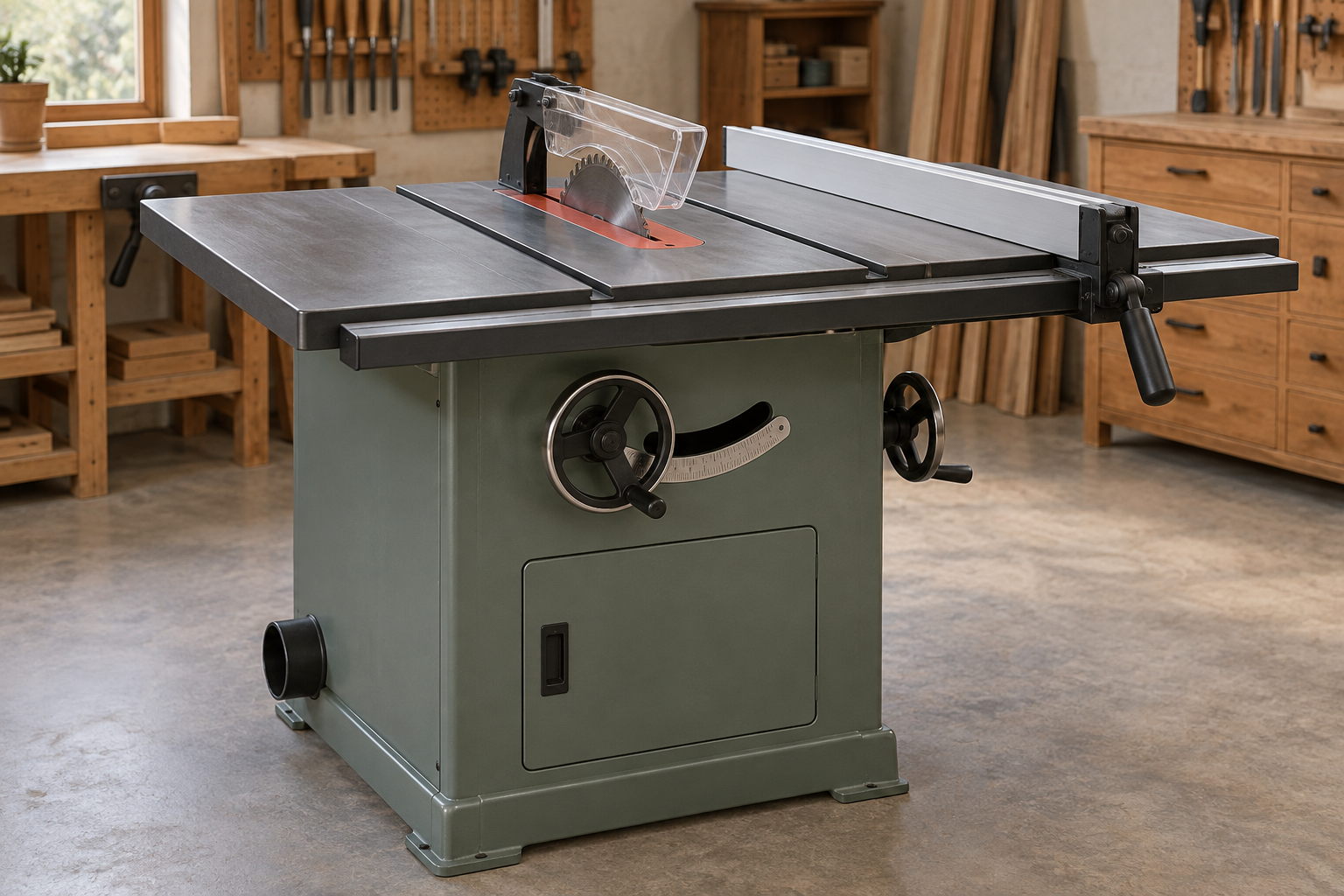
For a permanent shop, a 3 hp cabinet table saw is the strongest all-around choice. It provides the mass needed to keep a slab stable and usually has better dust collection and fence hardware than portable designs.
A hybrid saw is the value choice for many owners. If your slab work means cutting flattened blanks into 2-inch legs, 4-inch aprons, or narrow rails a few times a month, the cheaper machine is fine. Feed the stock steadily, use a sharp blade, and support the material before and after the cut. The limitation becomes obvious when ripping long, thick, wet, or highly figured stock.
Blade, fence, and support equipment
Start with a sharp, full-kerf, 40-tooth combination blade or a 24-tooth ripping blade for long grain cuts. A thin-kerf blade reduces motor load on a smaller saw, but it can deflect more easily in dense hardwood and may leave a less consistent edge if the saw arbor or blade has runout. Use a ripping blade for long cuts and a crosscut or combination blade for short furniture components.
The fence should lock firmly at both ends and stay parallel to the miter slot. Check it with a reliable rule or dial indicator; even a 0.010-inch error can create binding over a long cut. A long fence is helpful, but the workpiece must remain supported on the infeed and outfeed sides. A slab hanging off the table can lever the stock into the blade or pull it away from the fence.
For crosscutting legs and rails, use a table saw crosscut sled rather than the stock miter gauge when possible. A sled supports both sides of the blade and makes repeated cuts more consistent. For pieces wider than the sled, a well-fitted miter gauge with an auxiliary fence is acceptable.
Prepare the slab before it reaches the saw
Do not use the table saw to flatten a rocking slab. First flatten one face with a router sled, wide planer, or other suitable method, then flatten or joint one edge. A stable reference face and straight reference edge are what make the fence useful. On a slab with twist, mark the high spots and remove them before ripping.
Inspect for nails, screws, stones, bark pockets, and embedded grit. A metal detector is cheap insurance when salvaged wood is involved. Metal can destroy carbide teeth and throw fragments. Let the wood acclimate to the shop before final sizing; a thick slab that changes moisture content can move enough to close a kerf or open a joint.
A safer cutting method
For a very wide slab, break it down with a corded track saw before bringing manageable pieces to the table saw. Trying to balance a 30-inch-wide, 8-foot slab on a table saw is a support problem, not a horsepower problem.
Set the blade only slightly higher than the workpiece, generally about 1/8 inch above the top surface. Keep the riving knife installed and use the blade guard whenever it does not interfere with the cut. Stand to the side of the blade path, not directly behind the stock. Use push handles for narrow parts and never reach over the blade to retrieve an offcut.
Watch for pinching, burning, and sudden changes in feed pressure. Internal stress can cause a slab to close on the blade after the cut begins. If the cut starts binding, stop the saw and let the blade come to a complete stop before backing out. Do not pull a trapped workpiece backward while the blade is spinning.
When a cheaper saw is enough
Buy the less expensive hybrid or contractor saw if your stock is already flattened, your parts are relatively short, and you work mostly in softwood or moderate-thickness hardwood. Spend the saved money on a better blade, outfeed support, dust collection, and a stable crosscut sled. Those accessories can improve results more than a larger motor.
Choose the cabinet saw when you routinely process thick slabs, need repeatable dimensions across many parts, or expect the machine to serve as the center of a permanent shop. Its extra mass and power do not eliminate setup work, but they reduce vibration, bogging, and fence movement—the problems most likely to turn expensive hardwood into scrap.