Cordless Miter Saw Review
Key takeaways
- A criteria-led cordless miter saw review covering fence design, base flatness, slide rails, dust collection and vibration, plus which battery platform fits your shop.
What's inside
As an Amazon Associate I earn from qualifying purchases. This post may contain affiliate links at no extra cost to you.
Cordless miter saws stopped being a compromise a few tool generations ago, which created a different problem: the spec sheets now all read alike. Brushless motor, electric brake, 60 degrees of miter, dual bevel, shadow-line indicator. So this cordless miter saw review sets the marketing copy aside and judges on mechanics instead: fence geometry, base flatness, how the slide rails are supported, where the dust actually goes, and how much the head shakes on spin-up.
We should say plainly what this is not: we have not clamped a numbered model to a dial indicator on your behalf. What we can tell you is which parts of a cordless miter saw go wrong first, which of those a shim and a hex key will fix, and which you are stuck with for good. That distinction separates a saw you keep for a decade from one you resent.
As an Amazon Associate we earn from qualifying purchases at no extra cost to you. Product prices and availability are accurate as of the date shown and are subject to change.


| Class | Realistic 90-degree crosscut | Where it makes sense |
|---|---|---|
| 7-1/4 in. slider | About 8 in. of 3/4 in. stock | Trim work, tool bags, small shops |
| 8-1/2 in. slider | Roughly 10 to 12 in. | Shelving, face frames, furniture stock |
| 10 in. slider | 12 in. and a little more | Best all-round shop compromise |
| 12 in. slider | Wide baseboard, 4x material | Framing, stair work, wide casing |
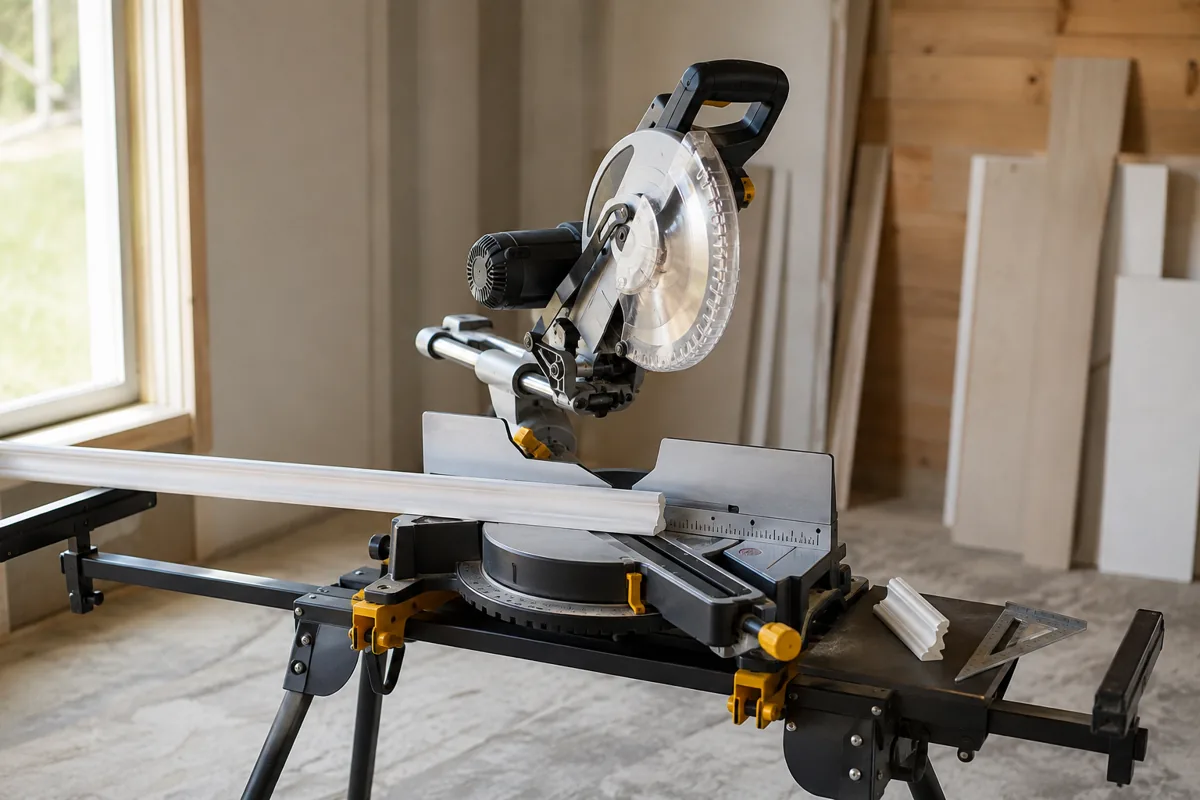
What This Cordless Miter Saw Review Actually Judges
A miter saw is a fence, a table and a pivot. The motor gets the advertising, but nothing about a brushless motor makes a joint close. Our criteria run in order of how much each one affects the cut and how little you can fix after purchase.
Fence height, coplanarity and clamping
Two things matter here: how tall the fence stands where crown and wide baseboard need support, and whether the left and right halves sit in the same plane. Machined cast fences hold their setting; thin stamped fences flex when you lean stock into them. Sliding upper sections buy bevel clearance, but the lever should pin them, not just squeeze them. A fence that creeps a few thousandths under hand pressure will chase you through every mitered return.
Base and table flatness
Set a straightedge across the cast base from wing to wing, then across the rotating table. Low wings bow a long board, and the error appears as an out-of-square cut at the far end even with the blade set perfectly. Shimming a low wing is a legitimate fix; a twisted wing is not, which is why this gets checked before the return window closes.
Slide rails and head deflection
Sliders split into rear-rail designs and forward-rail or glide-arm layouts that shorten the footprint against a wall. Neither wins outright; what matters is bearing preload and how far the head droops at full extension. Pull the head out, then lift and press down on the handle. Any clunk you feel there lands in the cut as a step in the kerf.
Compact cordless sliding miter saws
The sweet spot for most woodworkers is a mid-size slider on a platform you already own: a little less capacity than a 12 in. saw, and light enough to lift onto a stand alone. Buy where returns are easy, because fence flatness is the one thing no product page will tell you.
Vibration, Blade Guides and the Cheapest Upgrade
Vibration says more about build quality than any headline figure. A well-mounted motor settles into a steady hum within a second and stops clean on the brake. A saw that buzzes through the handle or rings after the brake engages is usually reporting a cheap blade, a sloppy arbor washer, or head bearings with too little preload.
Suspect the blade first, since factory blades are almost always the weak link and swapping one is the cheapest real gain here. A 40-tooth general blade suits framing lumber; miters that get finished want a high tooth count and a negative hook angle, matched to the arbor and plate. A thin kerf also buys runtime, because removing less material draws less current.
- ✔ No cord to drag over a finished floor or trip a job-site breaker
- ✔ Brushless saws hold blade speed in hardwood far better than early cordless models
- ✔ You can set up outside and keep fine dust out of the shop
- ✔ One battery platform lowers the cost of every tool you buy after it
- ✘ Runtime in wide hardwood is shorter than the marketing implies
- ✘ A rear-mounted pack adds weight where you least want it when carrying
- ✘ Dust capture is the weakest link on nearly every design, corded or not
- ✘ Corded 12 in. saws still cost less for the same capacity
Fine-finish miter saw blades
A high-tooth-count finish blade changes cut quality more than moving up a price tier on the saw. Match diameter, arbor and kerf to your machine, and keep the coarse blade for framing and dirty lumber.
Dust Ports, Detents and Battery Platform
Dust collection is where we are hardest on this class. Most miter saws throw a fan-shaped plume no small shroud can gather, and a shop vacuum only catches the part of it the hood contains. Judge the hood, not the port: it should stay close to the blade through the full bevel range. Indoors, plan on a plywood catch box behind the fence.
Detents matter as much. Stamped plates with positive stops at the common angles are fine, provided an override handles in-between settings and the fine adjustment does not fight the miter lock. Swing out to 45, come back to zero, and cut two pieces to check the joint; repeatability at zero matters more than the extreme miter range printed on the box.
On platform, be honest with yourself. DeWalt XR and FlexVolt, Milwaukee M18 FUEL, Makita LXT and XGT, Ryobi ONE+, Bosch and Metabo HPT all field competent saws, and the packs already on your shelf outweigh a small spec advantage. Use high-output batteries, since a miter saw pulls hard in short bursts and small cells sag.
Miter saw stands with outfeed support
A saw supported only at its own base cannot cut long stock square, whatever the fence does. Adjustable outfeed rollers correct more cut errors than most tool upgrades.
Frequently Asked Questions
Is a cordless miter saw accurate enough for furniture? Yes, provided you treat it as a machine to be set up rather than a tool that arrives tuned. Check bevel stops and fence square against a reliable reference square, shim what needs it, fit a finish blade, and support the stock along its length. Base flatness and fence geometry limit accuracy long before the power source does.
Do I need a slider or will a non-sliding saw do? If most of your work is 1x stock under about 6 in. wide, a non-sliding saw is lighter, cheaper and stiffer, and often more accurate for the money. Shelving, wide casing and 12 in. panels are where a slider stops being a luxury.
How many cuts should I expect per battery? Enough for a normal session in trim stock, and noticeably fewer in wide hardwood or wet framing lumber. Rather than trusting any cut-count claim, buy two high-output packs and a fast charger, which is the point of going cordless in the first place.
The Verdict
Judged on mechanics rather than feature lists, the honest recommendation is unglamorous. Stay on the battery platform you already own, buy the mid-size slider in that line rather than the largest one, and put the difference into a finish blade and a stand with real outfeed support. Then set it up before the return window closes: straightedge on base and wings, fence halves checked for coplanarity, head droop felt at full extension, two test miters at the zero detent.
Choose a 12 in. saw only if wide baseboard, 4x stock or stair work is genuinely part of your week, and a 7-1/4 in. saw if the tool lives in a vehicle. Everyone else is better served mid-range, where the fence is tall enough to be useful and the saw light enough that you will carry it out to the driveway.
Check prices on Amazon →