Best Table Saws for Making Repeated Chair Components
What's inside
As an Amazon Associate I earn from qualifying purchases. This post may contain affiliate links at no extra cost to you.
Making a batch of chair legs, stretchers, slats, or arm supports is less about maximum horsepower than repeatability. A saw that holds its fence, cuts square, and accepts a reliable stop system will produce better parts than a more powerful saw with a flexible table or difficult adjustments.
For most small shops, the best choice is a stationary contractor-style or cabinet table saw with a cast-iron top, a rigid rip fence, and a 10-inch blade. A portable jobsite saw can handle chair components, especially short parts, but it gives up stability and often makes repeat setups harder. The right choice depends on the size of your stock, how many chairs you plan to build, and whether you need dados or only straightforward ripping and crosscutting.
Contents
What Makes a Table Saw Good for Chair Parts
Chair components expose small inaccuracies. A 1/32-inch error in a rough construction cut may not matter, but a collection of legs or stretchers with slightly different lengths will make a chair twist. Look for a fence that locks parallel to the blade, a miter slot that accepts a snug gauge or sled, and a table large enough to support your stock without tipping.
Power matters when ripping thick hardwood. A true 3-hp cabinet saw is comfortable in maple, oak, and beech, but a 1-1/2- to 2-hp saw is adequate for most home shops if you use a sharp blade and sensible feed rate. A 10-inch blade should cut material up to roughly 3 inches thick at 90 degrees, although chair parts are commonly milled from 4/4 or 8/4 stock and finished to less than those dimensions.
More important than raw power is adjustment quality. If the fence moves when locked, or the blade is not parallel to the miter slot, repeated parts will gradually drift out of specification. Before buying, check replacement parts availability, fence reviews, dust collection provisions, and whether the machine runs on standard 120-volt power or requires a 240-volt circuit.
Best Saw Types for Repeated Components
| Saw type | Best use | Main advantage | Main drawback |
|---|---|---|---|
| Cabinet table saw | Frequent hardwood work and large batches | Stable, powerful, accurate, good dust collection | Expensive, heavy, often needs 240 volts |
| Contractor-style saw | General furniture work in a home shop | Good accuracy without cabinet-saw cost | Less rigid and less powerful than a cabinet saw |
| Jobsite table saw | Occasional work or limited shop space | Portable and relatively inexpensive | Small table, louder operation, weaker repeatability |
| Hybrid saw | Serious hobby furniture making | Enclosed base and useful accuracy at moderate cost | Not as robust as a full cabinet saw |
A cabinet table saw is the strongest long-term choice if you regularly build multiple chairs or work with dense hardwood. Its mass reduces vibration, and the larger table makes long legs and rails easier to control. It is also the easiest type to pair with an outfeed table and a dedicated crosscut sled.
A hybrid table saw is usually the better value for a small furniture shop. It can provide a rigid fence, cast-iron work surface, and enclosed dust collection without the price and electrical requirements of a commercial cabinet saw. For two or three chairs a year, its limitations are unlikely to matter.
When a Jobsite Saw Is Enough
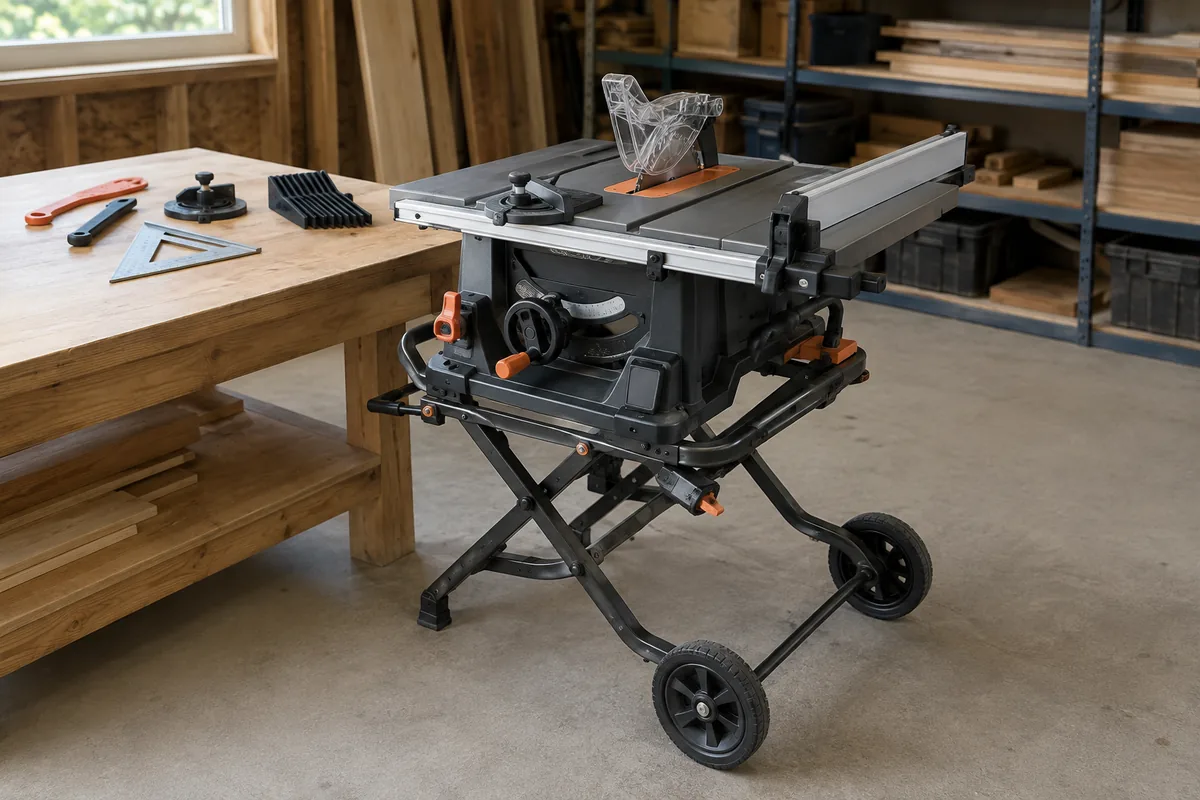
The cheaper option is fine when you are cutting narrow slats, short stretchers, or parts that will be trimmed to final length with a sled. A good jobsite saw can rip chair stock accurately after careful setup, and its folding stand may be the only practical option in a shared garage.
Its limitations appear during batch work. The small table provides little support for a 36-inch leg, the fence may flex under pressure, and the narrow miter slot can make aftermarket sled construction awkward. A portable saw also tends to have more vibration and less effective dust collection. If you choose one, add a solid outfeed surface, support long stock on both sides, and verify every setup cut with a square and a tape measure.
For this use, shop for a jobsite table saw with a rack-and-pinion fence. That fence style is generally quicker to adjust than a basic sliding fence, although it does not eliminate the need to check alignment.
Setup for Repeatable Chair Components
Use a sharp combination blade for general sizing, then switch to a high-tooth-count crosscut blade when tear-out matters. A 40-tooth combination blade is a practical starting point; a 60- to 80-tooth blade leaves cleaner crosscuts but feeds more slowly. Keep the blade only about 1/8 inch above the workpiece for safer, cleaner cutting.
For repeated lengths, do not clamp a stop block directly to the rip fence if the offcut can become trapped between the blade and the block. That creates a kickback hazard. Instead, attach the stop to a crosscut sled or to an auxiliary fence positioned so the offcut can move freely. A stop system that holds parts within 1/32 inch is usually sufficient for chair rails and stretchers; tighten the tolerance to about 1/64 inch when visible pairs must match closely.
Make one test component before cutting the whole batch. Mark the reference face and edge, use the same orientation for every part, and keep a written cut list. For four legs, cut all four blanks together at the same setting, then label them. If the saw drifts or the stop shifts halfway through a batch, the labels will not fix the error, but they will prevent mixing parts from different setups.
Features Worth Paying For
Spend money on a rigid fence, a dependable blade guard and riving knife, a flat cast-iron or well-supported table, and good dust collection. A riving knife that stays aligned through blade-height adjustments is especially useful when ripping narrow chair parts. An integrated mobile base is worthwhile if the saw must move, but it is not a substitute for a level, stable setup during cutting.
Skip electronic readouts unless you genuinely use them. A tape measure, combination square, and test cut are often more trustworthy for chair work. Likewise, a larger motor will not correct a bent fence or a dull blade. Put the budget into accuracy, support, and maintenance first; those are what determine whether the last chair component matches the first.