Best Table Saws for Cutting Repeated Housing Joints
What's inside
As an Amazon Associate I earn from qualifying purchases. This post may contain affiliate links at no extra cost to you.
Repeated housing joints—also called stopped or open dadoes, depending on the design—are easiest to make on a table saw when every cut must match. The saw needs more than raw power. A rigid fence, reliable depth adjustment, a flat table, and a way to set identical positions matter more than an extra few hundred watts.
For most cabinet and shelving work, the best setup is a table saw with a dado-capable arbor, a stable rip fence, and a crosscut sled or miter gauge with a stop block. If you are cutting housing joints across panels 24 to 36 inches wide, a full-size stationary saw is usually more pleasant and more repeatable than a compact jobsite machine. A jobsite saw can still do the work, but you will spend more time controlling vibration and supporting the workpiece.
As an Amazon Associate we earn from qualifying purchases at no extra cost to you.


Contents
What Makes a Table Saw Good for Housing Joints
A housing joint is commonly cut across the grain to receive a shelf or divider. The most repeatable method uses a dado blade, but a standard 1/8-inch blade can also make the joint in several passes. Whichever method you use, the saw must hold its settings accurately.
- Fence stability: The fence should lock without shifting at the far end. Even a 1/32-inch movement is visible when several shelves must line up.
- Arbor capacity: Check the maximum dado width and the arbor length. Many full-size saws accept 6- or 8-inch stacked dado sets, while some compact saws accept only a standard blade.
- Height adjustment: Smooth, low-play elevation makes it easier to set a consistent joint depth, typically 1/4 to 3/8 inch in 3/4-inch stock.
- Flat support: A broad cast-iron table reduces rocking on large panels. An outfeed table is equally important once the workpiece extends past the saw.
- Dust collection: Dado cuts produce a lot of chips. A proper cabinet or enclosed-base saw connected to a dust collector keeps the cut line visible and reduces cleanup.
Table Saw Types Compared
| Type | Best use | Advantages | Limitations |
|---|---|---|---|
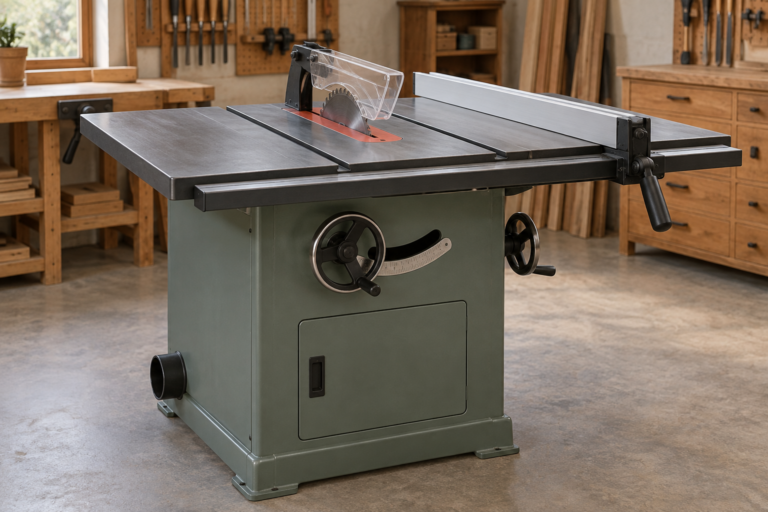
| Cabinet saw | Frequent cabinet and furniture work | Rigid fence, low vibration, strong dust collection, large table | Expensive, heavy, usually needs a dedicated 240-volt circuit |
| Contractor saw | Small shop and regular woodworking | Good accuracy without cabinet-saw weight or price | More open dust path; stands and extensions vary in quality |
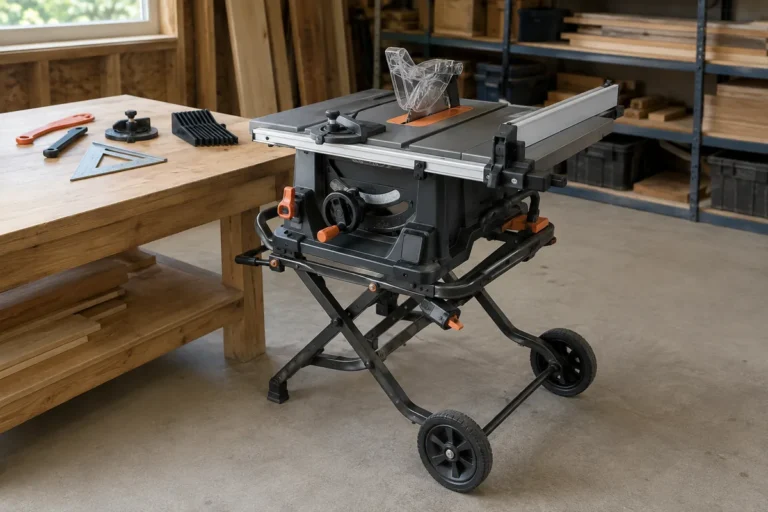
| Jobsite saw | Occasional work or limited shop space | Portable, affordable, often includes a folding stand | Narrower table, more vibration, limited dado compatibility |
| Compact benchtop saw | Light-duty repairs and small parts | Lowest cost and smallest footprint | Poor choice for wide panels and repeated precision joints |
If you are building one bookcase, the cheaper option is fine. A quality dado-compatible jobsite table saw can cut accurate housings when bolted down, fitted with a good blade, and used with a sled. It becomes frustrating when you are processing a dozen panels or need joints to align across a large cabinet.
Best Choice for Regular Work
For a dedicated shop, a cabinet saw is the strongest choice. Its heavier trunnions and cast-iron top resist movement when a wide panel is pushed through a dado cut. The fence typically locks more securely, and the enclosed base works better with a dust collector. Look for a 3-horsepower saw if you routinely cut thick hardwood or use an 8-inch dado set. A 1-1/2- to 2-horsepower saw is enough for plywood and most 3/4-inch hardwood parts, provided the blade is sharp.
A contractor saw is the sensible middle ground. It can deliver cabinet-saw accuracy if its stand is rigid and its fence is well made. It also costs less and may run on ordinary 120-volt power. For most home workshops making furniture from plywood, poplar, oak, or maple, this category offers enough capacity without paying for industrial mass.
When shopping, compare cabinet table saws with a 36-inch fence if you need to rip wide panels before cutting the housings. Fence length is not the same as rip capacity, but a longer rail usually gives better support and more useful layout options.
Dado Blades and Cutting Methods
A stacked dado set is the fastest way to cut a full-width housing joint. Set the width with chippers, make a test cut in scrap from the same material, and measure the actual fit. Nominal blade widths are not always exact, and plywood thickness varies. A shelf should enter with firm hand pressure; it should not need a mallet, and it should not rattle.
For stopped housings, a table saw requires extra care because the blade is exposed while the workpiece is lowered onto or lifted from it. Many woodworkers use a router for stopped joints instead. If the joint runs edge to edge, a table saw is straightforward. If it stops short of the front edge, use a router with a straightedge or a dedicated jig unless you have a proven, safe table-saw method.
If your saw cannot accept a dado set, make multiple passes with a standard blade. A sacrificial auxiliary fence and a stop block can control the repeated offset, but the process is slower and increases the chance of a stepped or uneven bottom. A router plane, shoulder plane, or chisel can clean minor ridges, but those tools should not compensate for a poorly controlled setup.
How to Repeat the Joints Accurately
Use one reference edge on every panel. Mark the joint locations from that edge, then set a stop block on a crosscut sled or miter gauge rather than measuring each part against the fence. Keep the stop block away from the blade’s path so a trapped offcut cannot kick back. For long panels, support the infeed and outfeed sides at the same height as the saw table.
Cut two test pieces first. Check joint width, depth, and position before cutting production parts. Housing depth is often around one-third of the shelf thickness, but the correct value depends on the design. A 3/8-inch-deep housing in 3/4-inch stock leaves enough material for strength without weakening the side excessively.
Common failures include a loose fence lock, a blade set too high, a joint that is wider at one end, and panels being fed at different angles. A dull dado set burns hardwood and encourages excessive force. Stop immediately if the workpiece begins to pinch, lift, or chatter. Use the blade guard and riving knife for through-cuts, and follow the saw manufacturer’s instructions for any dado configuration.
Buying Recommendation
Choose a cabinet saw if you make furniture regularly, have the space, and value repeatability over portability. Choose a contractor saw if you want most of that accuracy at a lower cost. Choose a jobsite saw only when portability or budget is the deciding factor, and plan on adding a rigid stand, a crosscut sled, and careful test cuts. For a compact shop, a contractor table saw with a cast-iron table is often the best balance for repeated housing joints.