Drill Press vs Band Saw for Cutting Small Joinery Components
What's inside
As an Amazon Associate I earn from qualifying purchases. This post may contain affiliate links at no extra cost to you.
For small joinery components, a drill press and a band saw solve different problems. A drill press makes accurate holes and can remove waste for mortises. A band saw separates material, cuts curves, and resaws thin stock. Neither machine replaces the other, and choosing based on the word “small” alone can lead to poor results or unsafe work.
The practical question is whether your parts are defined mainly by holes and mortises, or by their outside shape and thickness. A small box hinge mortise points toward a drill press. Small curved brackets, tenon cheeks, wedges, and repeated components point toward a band saw.
As an Amazon Associate we earn from qualifying purchases at no extra cost to you.

Contents
What Each Machine Actually Cuts
A drill press is not normally a wood-cutting machine. Its rotating spindle drives bits, Forstner bits, brad-point bits, sanding drums, and mortising attachments. It is excellent for drilling repeatable holes because the quill moves vertically and the work can be held against a fence or in a jig.
For joinery, a drill press can bore overlapping holes to remove most of the waste from a mortise. A 3/8-inch mortise, for example, can be roughed out with a 1/4-inch or 5/16-inch bit, leaving material for chiseling. It can also drill dowel holes, loose-tenon holes, hinge cups, and stopped holes with much better control than a handheld drill.
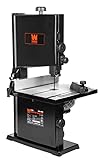
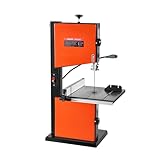
A band saw cuts with a continuous toothed blade. It can cut small blanks to length, bandsaw tenons, cut curved shoulders, and resaw boards into thin components. With a sharp 1/4-inch blade, it can follow relatively tight curves; with a 1/2-inch or 3/4-inch blade, it tracks more steadily for straight cuts and resawing.
Drill Press vs. Band Saw
| Task | Drill press | Band saw |
|---|---|---|
| Dowel or peg holes | Excellent; repeatable depth and alignment | Not suitable |
| Mortise waste removal | Good, followed by chiseling | Possible only with specialized setups; generally poor choice |
| Cutting tenon cheeks | Not practical | Good with a fence and support |
| Curved brackets and small shapes | Only by drilling or sanding portions away | Excellent |
| Small parts under 1 inch | Safe when clamped or jigged | Risky unless held in a carrier or sled |
| Dust and cleanup | Usually modest | Continuous sawdust; dust collection is useful |
When a Drill Press Is the Better Buy
Choose a drill press if your joinery depends on consistent hole location, square drilling, or controlled depth. A 10-inch benchtop machine is usually enough for furniture-scale parts. Look for at least 2 inches of quill travel, a table that tilts and locks securely, and a chuck that accepts the bits you use. Variable speed is useful because a large Forstner bit should run much slower than a small twist bit.
For repeated dowel holes, clamp a fence to the table and use a stop block. For mortises, drill overlapping holes inside a marked layout, then square the ends with a sharp chisel. Do not try to plunge a standard twist bit sideways or use it like a router. The bit can grab, bend, and spin the workpiece.
A drill press is also the cheaper option when you only need holes and occasional mortise preparation. A basic benchtop drill press costs less than a capable band saw and takes less floor space. The limitation is that it cannot efficiently produce a finished outside profile or cut stock apart.
When a Band Saw Is the Better Buy
Buy a band saw when the joinery components start as rectangles but need to become shapes. It is useful for curved drawer fronts, small feet, brackets, wedged tenons, spline stock, and cutting thin blanks from thicker boards. It also wastes less material than a table saw when cutting curves or resawing.
For small joinery, a 14-inch saw is not automatically necessary. A compact 9- or 10-inch band saw can handle parts a few inches thick, provided the blade is sharp and properly tensioned. Check the saw’s actual resaw capacity, blade guide adjustment, table size, and availability of replacement blades. A 1/4-inch, 6-tooth-per-inch blade is a useful general-purpose choice for curves. A 1/2-inch blade with fewer teeth is steadier for straight cuts.
The main failure mode is a blade that wanders. Pushing too fast, using a dull blade, or forcing a tight curve causes drift, burned edges, and undersized parts. Small pieces also create a safety problem: fingers can approach the blade quickly, especially when the work is less than 2 inches wide. Use a carrier board, a push handle, or a purpose-made small-parts jig rather than gripping the work close to the cut.
A compact woodworking band saw is the better investment if you expect to make many shaped components or resaw thin stock. It becomes less attractive if your shop has no room for blade changes, dust collection, and safe infeed and outfeed space.
The Small-Part Problem
Both machines become less forgiving as the component gets smaller. On a drill press, a loose block can spin around the bit and injure your hand. Clamp the work, use a vise, or make a simple plywood carrier. Keep the bit speed appropriate and retract it periodically to clear chips, particularly in deep holes.
On a band saw, never hold a tiny offcut between your fingers and the blade. Attach the part to a larger sacrificial board, cut several components from a longer blank, or use a sled that keeps your hands behind the blade. The blade should project only slightly above the work, generally about 1/8 to 1/4 inch, to reduce exposed teeth.
A Practical Buying Order
If your first projects involve dowels, mortises, hinges, or accurate perpendicular holes, buy the drill press first. Add a drill press woodworking vise or make a clamping jig; the machine’s accuracy is wasted if the part moves.
If you already have a reliable way to drill holes and your work calls for curves, tenons, or thin resawn pieces, buy the band saw. A band saw small-parts safety jig is inexpensive insurance for the work that a compact saw handles poorly by hand.
For many shops, the sensible answer is eventually both: use the band saw to create the component’s outside shape, then use the drill press for accurately placed holes and mortises. If your joinery is limited to a few projects each year, a handheld drill, chisels, and a coping saw may be cheaper still. The stationary machine earns its space when repetition, accuracy, or difficult grain makes those hand tools slow and inconsistent.