Best Drill Presses for Forstner Bit Work in Hardwood
What's inside
- What Makes a Drill Press Good for Forstner Bits
- Best Drill Press Types for Hardwood
- Best Budget Choice: A Sturdy Benchtop Press
- Best General-Purpose Choice: A Full-Size Benchtop or Compact Floor Press
- Best Heavy-Duty Choice: A Floor-Standing Drill Press
- How to Use Forstner Bits in Hardwood
- Buying Checklist
- What Makes a Drill Press Good for Forstner Bits
- Best Drill Press Types for Hardwood
- Best Budget Choice: A Sturdy Benchtop Press
- Best General-Purpose Choice: A Full-Size Benchtop or Compact Floor Press
- Best Heavy-Duty Choice: A Floor-Standing Drill Press
- How to Use Forstner Bits in Hardwood
- Buying Checklist
As an Amazon Associate I earn from qualifying purchases. This post may contain affiliate links at no extra cost to you.
Forstner bits reward a drill press that runs smoothly, holds its speed under load, and lets you control depth precisely. In hardwood, the bit’s large cutting rim creates much more resistance than a standard twist drill. A press that feels adequate for occasional holes in pine can stall, chatter, or burn its way through oak and maple.
The best choice depends less on headline horsepower than on speed range, quill travel, spindle accuracy, and the size of the work you need to support. A compact benchtop press can be excellent for drawer fronts and small furniture parts. A floor-standing machine earns its space when you drill deep holes, use bits larger than 2 inches, or work with wide panels.
As an Amazon Associate we earn from qualifying purchases at no extra cost to you.


Contents
- What Makes a Drill Press Good for Forstner Bits
- Best Drill Press Types for Hardwood
- Best Budget Choice: A Sturdy Benchtop Press
- Best General-Purpose Choice: A Full-Size Benchtop or Compact Floor Press
- Best Heavy-Duty Choice: A Floor-Standing Drill Press
- How to Use Forstner Bits in Hardwood
- Buying Checklist
What Makes a Drill Press Good for Forstner Bits
Variable or multi-step speed control is essential. Forstner bits generally need slower speeds as diameter increases. As a practical starting point, a 1/2-inch bit may run around 1,000 to 1,500 rpm in hardwood, while a 2-inch bit is better around 400 to 600 rpm. A 3-inch bit may need roughly 250 to 350 rpm. These are starting ranges, not universal rules; follow the bit maker’s guidance when available.
Many inexpensive presses have a top speed of 3,000 rpm but cannot go slow enough for large bits. That is a real limitation. Running a 2-inch cutter too fast produces heat, burns the rim, and can grab the workpiece. A belt-driven press with several pulley steps is usually preferable to a machine with only one fixed speed.
Quill travel matters for deep holes. At least 2-1/2 inches of travel is useful for normal furniture work. Three inches or more gives additional room for deep mortises, overlapping holes, and boring through thick stock without resetting the table. Depth stops should lock firmly and return consistently. A sloppy stop turns repeated holes into a measuring exercise.
Low runout protects the cut. Runout is the amount the chuck and spindle wobble as they rotate. Excessive runout makes a Forstner bit cut an oversized, rough hole and can cause the bit to vibrate at the bottom. For woodworking, a properly aligned chuck and spindle with runout around 0.003 inch or less is a worthwhile target. Budget machines may work perfectly well, but inspect the chuck and arbor before assuming the published specification is accurate.
Best Drill Press Types for Hardwood
| Drill press type | Best use | Advantages | Limitations |
|---|---|---|---|
| Compact benchtop | Small parts, hinges, drawer components | Low cost, small footprint, adequate accuracy | Short quill travel, small table, limited capacity |
| Full-size benchtop | General furniture work and medium Forstner bits | Better table and depth range without floor space | Still limited by column height and throat depth |
| Floor-standing | Wide panels, deep holes, frequent hardwood work | More capacity, longer travel, stable base | Higher price, larger footprint, heavier setup |
| Radial-arm drill press | Large or awkward workpieces | Adjustable reach and flexible positioning | More alignment variables and usually more expense |
Best Budget Choice: A Sturdy Benchtop Press
A quality variable-speed benchtop drill press is the sensible choice for many home woodworkers. Look for a 10- to 12-inch swing, at least 2-1/2 inches of quill travel, a table that tilts and locks without flexing, and a published low speed near 500 rpm or below.
These machines handle 1/4- to 1-1/2-inch Forstner bits comfortably when the stock is supported properly. They are also easier to tune and less intimidating for occasional work. The cheaper option is fine if your largest routine hole is about 1 inch, your material is less than 2 inches thick, and you are willing to clear chips frequently.
The trade-off is capacity. A small table may not support a wide cabinet side, and the column can obstruct long boards. You can solve some of that with a plywood auxiliary table, but do not use an oversized table to compensate for a weak column or unstable base.
Best General-Purpose Choice: A Full-Size Benchtop or Compact Floor Press
For regular work in oak, ash, hard maple, and walnut, step up to a machine with a 12- to 15-inch swing, 3 inches of quill travel, and a more substantial rack-and-pinion table. A 12-inch woodworking drill press offers a useful middle ground: enough reach for furniture parts, but not the cost or footprint of a large production machine.
Prioritize a rigid column and table over extra motor horsepower. A 3/4-horsepower motor is generally sufficient for Forstner work in normal furniture stock. More power helps prevent stalling, but it does not cure chuck wobble, a flexible table, or a poorly tensioned belt. A machine with 1 horsepower can still perform badly if the spindle bearings are loose.
Best Heavy-Duty Choice: A Floor-Standing Drill Press
Choose a floor-standing drill press when you routinely bore large holes, work on thick timbers, or need to position wide panels without fighting the column. A 14- to 17-inch machine normally provides a larger table, longer quill travel, and a more stable base.
Heavy machines are not automatically more accurate. Check that the table locks solidly, the column does not twist under pressure, and the quill returns without side play. If possible, test the spindle with a straight shank or known-good bit. A visible wobble at the chuck is a reason to keep shopping.
A floor press is also safer for large Forstner bits because its weight resists the torque generated when the bit grabs. Bolt the base down if the machine rocks or if you regularly use bits over 2 inches.
How to Use Forstner Bits in Hardwood
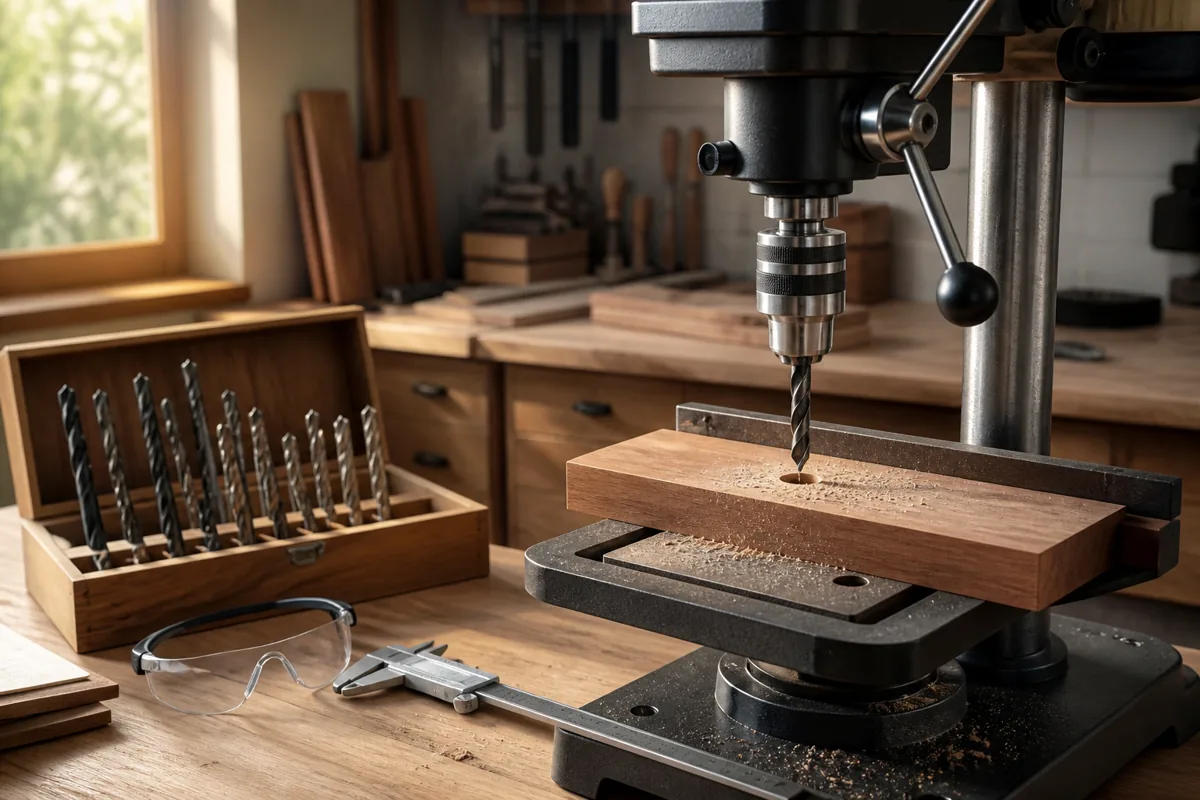
Clamp the workpiece or use a sacrificial board underneath. Holding a board by hand is risky when the bit breaks through and the cutters catch the lower fibers. Start the hole at a moderate speed, then reduce speed for larger diameters. Feed firmly enough to keep the cutting edges working, but do not force the bit until the motor slows noticeably.
For holes deeper than about 1 inch, raise the bit every few seconds to clear chips. Packed chips increase friction and can scorch both the bit and the workpiece. If the rim begins smoking, stop immediately, let the bit cool, and check the speed and sharpness. Dull Forstner bits often create more heat than a small motor can overcome.
When a clean through-hole matters, drill from one side until the center spur just marks the opposite face. Then finish from the other side. This prevents the torn-out exit common in brittle hardwood and is more effective than simply increasing motor power.
Buying Checklist
Before buying, verify the lowest spindle speed, quill travel, swing, chuck capacity, table size, and depth-stop design. Confirm that the machine accepts the shank sizes used by your Forstner set; many larger bits have 3/8-inch or 1/2-inch shanks. Finally, budget for a proper clamp, a sacrificial board, and a sharp bit set. Those accessories often improve results more than moving from a 3/4-horsepower motor to a 1-horsepower one.