Best Drill Presses for Large Forstner Bits and Hole Saws
What's inside
As an Amazon Associate I earn from qualifying purchases. This post may contain affiliate links at no extra cost to you.
A large Forstner bit or hole saw can make a drill press feel underpowered even when its motor rating looks generous. The real limits are usually low-speed torque, spindle travel, throat depth, workpiece support and the ability to keep the cutter from grabbing. For occasional holes in thin stock, a modest bench press may be enough. For deep holes in hardwood or repeated large-diameter cuts, prioritize speed range and a rigid table over headline horsepower.
As an Amazon Associate we earn from qualifying purchases at no extra cost to you.


Contents
What to look for
Check the machine’s lowest spindle speed before buying. Forstner bits commonly work best at slower speeds as their diameter increases; a 2-inch bit in hardwood may call for roughly 500–700 rpm, while a 3-inch cutter may need around 300–500 rpm. Hole saws also need reduced speed for large diameters. Consult the cutter maker’s chart, and start conservatively: too much speed builds heat, dulls teeth and can scorch wood.
A press that bottoms out at 600 rpm may be acceptable for 1-inch bits but limiting for larger cutters. A belt-drive machine with several pulley steps often offers a lower range than a compact press with a fixed or limited electronic speed range. Variable speed is convenient, but confirm that it provides useful torque at low rpm; an electronic speed dial alone does not guarantee it.
Look for at least 3 inches of spindle travel if you expect to bore thick stock. A deep hole may require withdrawing the bit several times to clear chips, so travel is not the same as usable hole depth. Throat depth—the distance from the column to the spindle center—determines how far from an edge you can drill. A 12-inch swing gives about 6 inches from column to spindle center; a larger swing offers more reach, but takes more floor space and can flex more if the head or table is poorly supported.
Bench or floor model?
A well-built 12- to 15-inch bench press is often the sensible choice for furniture parts, cabinet work and occasional holes up to about 2 inches. It costs less, fits a small shop and can handle large cutters when the speed range and setup are right. The trade-off is limited throat depth, shorter travel and a smaller table. Mount it securely to a heavy bench; a press that walks or vibrates under load is a safety problem, not just an annoyance.
Choose a floor press when you routinely drill thick material, need more reach, or want a larger table and longer travel. Many floor models offer more capacity, but size alone does not make a press more accurate or powerful. Compare the minimum speed, quill travel, table support and stated capacity in mild steel. Steel capacity is not a direct measure of wood-cutting performance, but it can help distinguish heavier designs from light-duty presses.
For shopping, compare bench drill presses with a low speed range against floor drill presses designed for slower drilling. Verify the manufacturer’s specifications rather than relying on a listing’s capacity headline.
Compare the trade-offs
| Press type | Best fit | Typical trade-off |
|---|---|---|
| Compact bench press | Small bits and occasional holes around 1–2 inches | Less throat depth, travel and low-speed torque |
| Heavier bench press | Regular shop use without a floor footprint | Costs more; still limited by bench height and reach |
| Floor press | Thick stock, larger workpieces and repeated use | More space and expense; quality varies widely |
Use these as broad categories, not guarantees. Two presses of the same swing can differ substantially in rigidity, speed range and table design.
Set up large cutters to avoid trouble
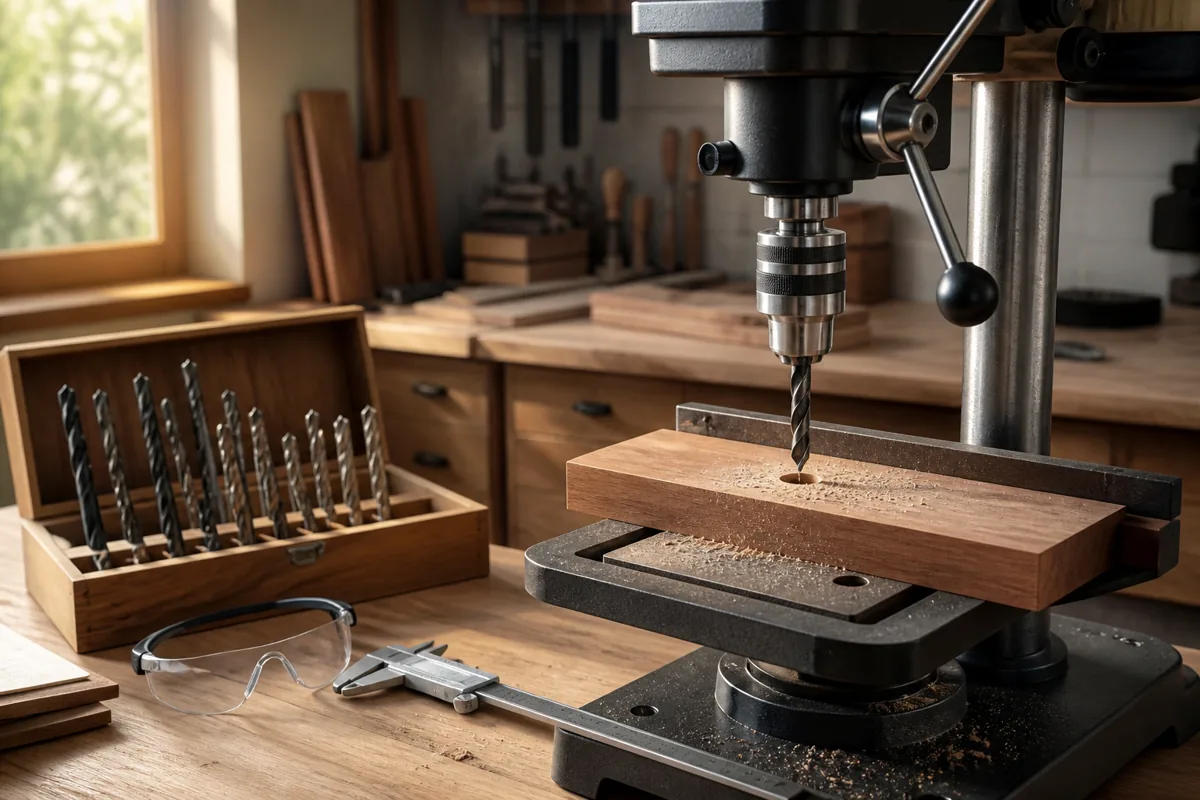
Clamp the workpiece to the table, and clamp a sacrificial backing board beneath it when the cut exits through the bottom. Never hold a board by hand: a Forstner bit can catch suddenly, and a hole saw can spin the stock hard enough to injure your wrist. If the workpiece is too large for the table, support it at the same height and keep the drilling area stable. A drill-press vise can help with small parts, but it is not a substitute for supporting a wide panel.
For Forstner bits, drill in short passes and clear chips from deep holes. Packed chips create heat and can stall the press. If the motor slows sharply, stop feeding; do not lean harder on the handle. A dull cutter, excessive speed, or an overly aggressive feed can burn the wood, deflect the bit or loosen the work. For very large holes, a pilot hole can reduce strain, but follow the cutter maker’s instructions because some bits rely on the center point to guide the cut.
Hole saws need a different kind of attention. Their teeth can bind when the plug traps sawdust, especially in thick stock. Withdraw the saw periodically to clear debris, and avoid forcing a dull or overheated saw. A hole saw with a suitable arbor and sharp teeth may be a more practical choice than a large Forstner bit for a through-hole, but it leaves a rougher edge and can be less controlled in deep cuts.
Make the purchase fit the work
Before choosing, list your largest cutter diameter, thickest stock and typical hole depth. Then check that the press reaches a suitably low speed, has enough quill travel, and can position the work under the spindle. If your largest job is a few 2-inch holes in ¾-inch plywood, a sound bench press is usually enough; paying for a large floor machine will not improve the cut by itself. If you regularly bore 3-inch holes in hardwood or work with thick timbers, favor a rigid floor press with low-speed capability and a stable, adjustable table.
Also budget for sharp cutters, clamps and a sturdy mounting surface. Those often matter more to clean, safe results than moving up one size in press. If the machine cannot run slowly enough, use a smaller cutter or a different method rather than compensating with force. For a dedicated setup, compare drill presses suited to large Forstner bits and hole saws, then confirm the published minimum rpm and travel before ordering.