Best Drill Presses with Laser Guides for Woodworking Layout
What's inside
As an Amazon Associate I earn from qualifying purchases. This post may contain affiliate links at no extra cost to you.
Contents
What a Laser Drill Press Is Good For
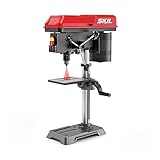
A drill press laser is a layout aid, not a precision measuring system. The two red lines show where the bit’s center should meet the work, which is useful when drilling repeated holes, locating shelf-pin rows, or positioning hardware on a cabinet door. It saves marking time, but it does not correct a crooked board, a wandering bit, or a table that is out of square.
For woodworking, look for a press with a rigid column, a table that tilts and rotates, a depth stop, and a laser that can be adjusted independently. A 10-inch benchtop press is adequate for most small shops. A 12-inch model gives more reach and usually has a more substantial table. Floor presses make sense when you regularly drill wide panels, long stock, or large Forstner-bit holes.
As an Amazon Associate we earn from qualifying purchases at no extra cost to you.

The Best Types to Consider
| Type | Typical capacity | Best use | Main compromise |
|---|---|---|---|
| Compact benchtop | 8 to 10 inches of swing; 1/2-inch chuck | Small parts, dowels, light hardware | Shorter quill travel and less table area |
| Full-size benchtop | 10 to 12 inches of swing; 5/8-inch chuck | General furniture and cabinet work | Needs a sturdy bench and takes significant space |
| Floor-standing | 13 to 18 inches of swing; 5/8-inch chuck | Large panels, deep holes, frequent use | Higher cost and a larger footprint |
| Variable-speed press | Usually 10 to 18 inches of swing | Frequent changes between wood, metal, and large bits | Costs more; electronic controls add another failure point |
For a first woodworking machine, a 10-inch benchtop drill press with laser is the sensible budget choice. It handles bits from 1/8 to 1/2 inch, common Forstner bits, and most cabinet hardware. The cheaper option is fine if you drill occasionally and can accept slower speed changes using stepped pulleys.
Features That Matter More Than the Laser
Quill travel: Aim for at least 2 inches. A press with only 1-5/8 inches can force you to reposition the work when boring through thick legs or drilling deep mortises. Check the actual travel in the specifications rather than assuming a larger swing means a longer quill.
Depth stop: A threaded depth stop with a locknut is more useful than a basic scale. It lets you drill a row of holes to the same depth. Test it with the quill locked: some inexpensive stops have enough play to vary hole depth by 1/16 inch or more.
Table adjustment: The table should lock firmly without shifting as you tighten the clamp. A rack-and-pinion height adjustment is convenient, but table stiffness matters more. For angled work, verify that the table returns to 90 degrees; the printed angle scale is only a starting point.
Speed range: Woodworking presses should cover roughly 250 to 3,000 RPM. Large Forstner bits cut better around 300 to 600 RPM, while small brad-point bits can run near 2,000 to 3,000 RPM. A five-speed pulley press is adequate, but changing belts takes time. Electronic variable speed is convenient when switching between a 1/4-inch bit and a 2-inch cutter.
Chuck and runout: A 5/8-inch chuck gives more room for larger woodworking accessories, but chuck capacity is not the same as accuracy. Excessive runout causes oversized holes and visible wobble. With a straight test bar installed, around 0.003 to 0.005 inch of runout is a reasonable target for general woodworking. Budget machines can exceed that.
Laser Guide Limitations
Most drill press lasers are twin-beam crosshairs. They are useful only after calibration, and calibration can shift if the laser housing is bumped. Before trusting one, install a sharp brad-point bit, lower it until the tip is just above scrap, and adjust both beams so they meet at the exact point of the bit. Check again after changing the table height.
The laser cannot show whether the bit is perpendicular to the surface. If the table is tilted or the column is not square to the base, the crosshair can look correct while the hole exits in the wrong place. It also becomes hard to see on pale wood in bright light. For critical layout, mark the center with a knife or awl and use the laser as a quick confirmation.
Recommended Buying Options
A full-size 12-inch drill press with laser is the best middle ground for a cabinet or furniture shop. It normally provides a larger table, more stable column, and enough throat depth for drawer fronts and face frames. Choose one with a 5/8-inch chuck if you use large Forstner bits. Expect to spend time leveling the table and checking the laser after setup.
Choose a floor model if you routinely drill panels wider than 18 inches or need to work on tall assemblies. A floor-standing drill press with laser provides better clearance and generally feels less strained with large bits. It is not automatically more accurate, however. A poorly adjusted floor press can still have table tilt, quill play, or chuck runout.
If you change sizes constantly, a variable-speed drill press with laser reduces setup time. This is worthwhile for a working shop, but occasional users get similar results from a stepped-pulley machine at lower cost.
Setup for Accurate Layout
Bolt the press to a bench or stand; vibration makes the laser and depth stop less useful. Install a sacrificial plywood surface on the table and drill a relief hole beneath the bit. Clamp narrow stock instead of holding it by hand, and use a fence for repeated holes. Set the depth stop with the motor off, then make a test hole in scrap before drilling the project.
Finally, measure the first hole in every batch. If the center is off by 1/32 inch, stop and correct the laser or fence rather than compensating by eye. The best laser-equipped drill press is the one with enough rigidity and adjustment to make that correction repeatable.