Best Stationary Drill Presses for Clean Forstner Holes in Hardwood Joinery
What's inside
As an Amazon Associate I earn from qualifying purchases. This post may contain affiliate links at no extra cost to you.
Contents
Why Hardwood Punishes a Sloppy Drill Press
Forstner bits don’t cut like twist drills. They scrape and shear with a rim and two outer spurs, and they need constant, straight downforce to do it. In softwood or plywood you can get away with a wobbly press or a hand drill. In hard maple, white oak, or hickory, every flaw shows up as burned rims, chipped exit edges, oval holes that won’t hold a dowel, or a bit that grabs and stalls the motor.
The two most common failure modes are runout and deflection. Runout is the amount the chuck and spindle wobble off-center. Even 0.005″ of runout makes a 1-1/2″ Forstner scrape instead of cut. The rim heats up, the wood burns, and the hole ends up 1/64″ oversize. Deflection happens when the column, head, or table flexes under load. You start the hole cleanly, push harder, and the whole head leans back a fraction. The entry stays round but the bottom wanders, which is fatal for stopped hinge cup holes or dowel joinery where depth and squareness matter.
As an Amazon Associate we earn from qualifying purchases at no extra cost to you.



What Actually Matters for Clean Forstner Holes
Forget marketing features like laser guides and digital readouts. For Forstner work in hardwood, four specs decide the result:
1. Spindle runout and chuck quality. Look for stated runout under 0.003″ and ideally under 0.002″. A JT33 taper with a cheap bundled chuck is the usual culprit. A press with an MT2 spindle taper and a decent keyed chuck will hold tolerances far longer than a press that uses a straight shanks chuck on a Jacobs taper alone. If you can check in person, chuck a 1/2″ steel rod and indicate it. If you can’t, assume benchtop presses under $300 will need a chuck upgrade.
2. Low-end speed. Forstner bits want to run slow. A 1/2″ Forstner can run at 800-1000 RPM in hardwood, but a 2″ Forstner should be at 250-500 RPM. Many small presses bottom out at 600-750 RPM, which is too fast for large bits. That speed burns the rim, glazes the cutting edges, and forces you to push harder than you should. A press that goes down to 200-300 RPM, either with a 4- or 5-step pulley or an electronic variable speed, is worth paying for if you drill hinge cups or 35mm Euro hinges regularly.
3. Quill travel and rigidity. Check quill stroke, not just throat depth. A 2″ quill travel means you can’t drill a 1-1/2″ deep hole plus clear chips without raising the table mid-hole, which kills accuracy. Look for 3-1/4″ to 4″ of travel for joinery. Column diameter matters too. A 2.8″ to 3.15″ cast iron column on a floor-standing press will deflect far less than a 2″ tube column on a lightweight benchtop.
4. Power and torque at low speed. You don’t need 1.5 HP for Forstner holes, but you do need torque down low. A 1/2 to 3/4 HP induction motor with a belt drive will maintain torque at 300 RPM. Universal motors on compact presses lose torque when slowed electronically and will stall on a 2″ bite in hard maple. If your press stalls or you have to peck every 1/8″, you are losing both time and hole quality.
Benchtop vs. Floor-Standing for Joinery
Both can drill clean holes, but they suit different shops.
A 10- to 12-inch benchtop press is fine if you mostly drill 3/4″ to 1-1/4″ dowel holes and shallow mortise clean-outs in material you can bring to the table. It saves space and costs $200-$450. The trade-off is lower mass, shorter quill travel (often 2″ to 3″), higher minimum speed, and a table that tilts and flexes under load. You’ll need to add a rigid auxiliary table and fence to get repeatable results.
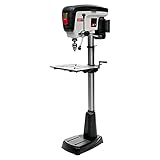
A 15- to 17-inch floor-standing press is the sweet spot for hardwood joinery. You get a larger cast iron table, longer quill travel, a wider speed range, and a heavier head that resists deflection. The throat depth (distance from spindle center to column) on a 15-inch press is about 7.5″, on a 17-inch about 8.5″, which matters when you drill rows of shelf pin or hinge holes in wide door stiles. If you have floor space and drill a lot of 35mm cup holes or 1-1/2″ to 2-1/8″ holes for joinery, the floor model pays for itself in fewer ruined parts.
There is a middle ground that many woodworkers miss: a heavy 12- to 15-inch benchtop press on a dedicated stand or cabinet. You get most of the rigidity of a floor model with a smaller footprint. A 12-inch benchtop drill press with cast iron table in the 90-120 lb range, with an MT2 spindle and a 5-speed pulley, will outperform a lightweight 17-inch press with a thin column and JT33 chuck.
Comparison by Press Category
| Category | Throat Depth | Typical Low Speed | Quill Travel | Best For | Limitation |
|---|---|---|---|---|---|
| 10-inch Benchtop (1/3-1/2 HP) | 5″ | 620-750 RPM | 2″ – 2-1/2″ | Dowels to 1″, small boxes | Too fast for 1-1/2″+ Forstners, flexes on hardwood |
| 12-inch Benchtop (1/2 HP) | 6″ | 500-580 RPM | 3″ – 3-1/8″ | General furniture joinery to 1-1/2″ | Marginal at 2″, needs slow feed |
| 15-inch Floor (3/4 HP) | 7.5″ | 200-350 RPM | 3-1/4″ – 4″ | 35mm hinge cups, 2″ Forstners in oak/maple | Takes floor space, 150-180 lb |
| 17-inch Floor (3/4-1 HP) | 8.5″ | 180-300 RPM | 4″ – 6″ | Large Forstners, repeated production work | Cost, weight over 180 lb |
How to Get Clean Holes Regardless of Press
The press is half the equation. Technique and setup fix the other half. Use these numbers as a starting point and adjust by feel:
Speed by bit diameter in hardwood: 1/2″-3/4″ at 800-1000 RPM, 1″ at 700-800 RPM, 1-3/8″ at 500-600 RPM, 1-1/2″ to 2″ at 250-400 RPM, over 2″ at 200-250 RPM. If you see brown dust or smell burning, you are too fast or feeding too slow.
Clamping is non-negotiable. A Forstner will lift a small part on exit. Use a fence and hold-downs on an auxiliary table made from flat 3/4″ plywood or MDF with a replaceable center insert. For through-holes, always back the workpiece with scrap hardwood or MDF to prevent blowout on the exit side. For stopped holes, set the depth stop and lock the quill, then clear chips every 1/4″ of depth by raising the bit while it spins. Packed chips cause heat and scoring on the hole wall.
Sharpen the spurs. A dull Forstner tears more than it cuts, especially on end grain and in closed-grain woods like maple. A small diamond file on the inside face of the spur and a flat hone on the rim is enough. If the bit needs heavy pressure to start, it is dull.
If your table deflects, you will see a ledge inside the hole when you retract and re-enter. Fix it by supporting long parts level with the table, not letting them hang and lever the workpiece up. A roller stand or side support helps more than tightening the table lock harder.
What to Buy Based on Real Use
If you drill mostly 3/8″ to 1″ holes for dowels and occasional 35mm hinge cups in hardwood, a quality 12-inch benchtop press with at least 3″ of quill travel and a low speed near 500 RPM is enough. Put the money you save into a good set of Forstner bits and an aftermarket keyed chuck if runout is high. You do not need a 17-inch press for this work.
If you build doors, face frames, or furniture where you drill dozens of 1-3/8″ to 2-1/8″ holes in hard maple or white oak, buy a 15-inch floor-standing drill press with MT2 spindle that drops to 250 RPM or lower. The combination of low speed, mass, and quill travel is what keeps large Forstners cutting cool and on center. Variable speed is convenient, but a 12- or 16-speed belt drive is more durable and gives better torque at low RPM for the same money.
Avoid any press where the table lifts with a rack that has noticeable play, or where the depth stop is a single plastic nut. Those parts seem minor until you try to drill a row of 1/2″ deep dowel holes that need to be within 0.010″ of each other. A solid cast iron table with a reliable adjustable depth stop and a smooth, tight quill is more valuable than a built-in work light.
For a shop that wants one press to handle both fine joinery and occasional metal drilling, consider a variable speed drill press with low RPM range that still offers mechanical advantage at low speed. Belt-driven variable speed or Reeves drive systems hold torque better than electronic speed control on universal motors. Test the low end under load if possible — if the motor whines and slows dramatically when you lean on the feed handle, it will not hold up to a 2″ Forstner in hardwood.