Closed-Stand vs Open-Stand Jointer for Dust Collection
What's inside
As an Amazon Associate I earn from qualifying purchases. This post may contain affiliate links at no extra cost to you.
Contents
What the stand changes
A jointer’s stand affects dust collection mostly by controlling where chips go. A closed stand can funnel debris toward a port and reduce the amount that escapes around the machine. An open stand leaves more of the underside exposed, so chips can fall or scatter before they reach the hose. Neither design guarantees clean collection: cutterhead geometry, port size, airflow, hose routing, and the cut itself matter just as much.
For a typical 6-inch jointer, the dust port is often around 4 inches. A 4-inch hose connected to a suitable collector is a sensible starting point; reducing it to a small shop-vac hose usually restricts airflow and can leave chips packed around the cutterhead. Check the machine’s manual for its port size and collection requirements before buying fittings or a collector.
As an Amazon Associate we earn from qualifying purchases at no extra cost to you.

Closed-stand jointers
A closed cabinet gives chips fewer escape routes. When the port is placed low in the cabinet, falling debris can be drawn toward it instead of spreading across the floor. This is useful in a small shop, where chips under the stand can be hard to reach and may be kicked into the air during cleanup.
The cabinet is not a substitute for adequate airflow. A narrow internal passage, clogged filter, leaky connection, or undersized collector can still cause chips to accumulate inside. If chips build up, they may eventually spill from openings or interfere with access to the motor and belt. Keep the cabinet accessible enough to inspect and clean, and don’t assume that a solid enclosure makes weak extraction effective.
Closed stands are generally the tidier choice when the machine stays in one place and connects to a fixed collector. They can also reduce the amount of airborne debris around the base, though they do not capture fine dust at the cutterhead as reliably as they capture heavier chips.
Open-stand jointers
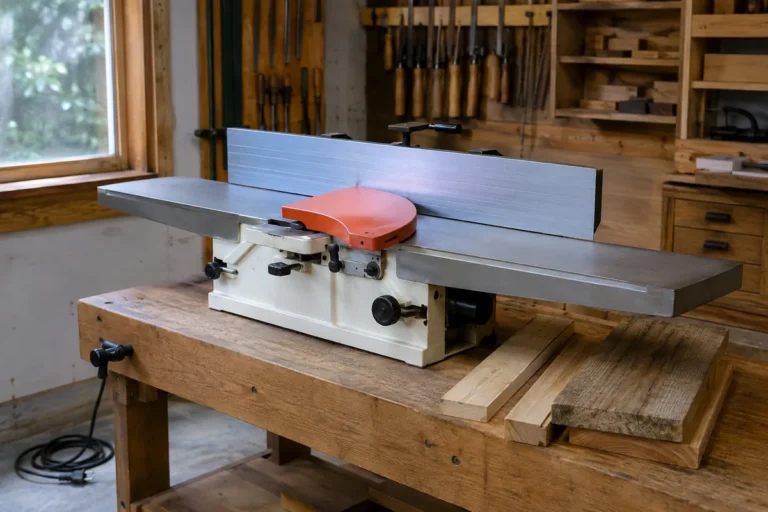
An open stand is easier to inspect, sweep around, and reach through. That can be an advantage when you need to adjust or service the machine, or when the jointer is mobile and its collection hose has to be moved often. The trade-off is that chips can escape through the open frame and collect on the floor, especially if the port is poorly positioned or the hose has a sharp bend.
Open stands can work well with a well-fitted collection hood or a clear, direct hose connection. They can also be perfectly adequate for occasional use if you accept more cleanup. Before choosing one, check whether the dust port actually sits under the cutterhead and whether the frame leaves space for the hose you plan to use. A port that points into a leg or forces a tight elbow can undermine an otherwise capable collector.
Comparison at a glance
| Factor | Closed stand | Open stand |
|---|---|---|
| Chip containment | Usually better around the base | More chips may escape onto the floor |
| Access for cleaning and service | Depends on access panels and cabinet layout | Usually easier to inspect and reach |
| Hose routing | Can be constrained inside the cabinet | Often easier to route, but the port may be exposed |
| Best fit | Fixed machine, cleaner floor, direct cabinet-to-port path | Mobile setup, easier maintenance, lower purchase cost |
| Main failure mode | Chips accumulate inside if airflow or access is poor | Chips bypass the port and spread around the machine |
Collector, hose, and setup
Match the collector to the jointer’s port and the rest of your shop system. A 4-inch port needs a 4-inch path if possible; adapters may be necessary, but each reduction adds resistance. Keep the hose as short and straight as practical. A long run, several elbows, or a crushed flexible hose can reduce airflow enough that chips settle inside the cabinet or chute.
For a small shop, a 4-inch woodworking dust collector is a common match for a jointer with a 4-inch port. Check the collector’s actual airflow and filter arrangement rather than relying only on a high advertised CFM figure; ratings measured without a hose or filter do not describe performance at the machine. Empty the bag before it becomes full, and clean or replace filters when airflow drops.
Use blast gates to direct air to the machine you’re using, and close unused branches. With a shared collector, opening several gates at once can weaken collection at the jointer. If you connect the jointer to a central system, verify that the system can maintain adequate airflow at the end of the run, not just near the collector.
Which one should you buy?
Choose a closed stand if you value less floor cleanup, the machine will remain in one location, and the cabinet provides a direct, accessible route to the dust port. It is a practical advantage, not a magic dust-control feature. A blocked port or weak collector can still leave the cabinet full of chips.
Choose an open stand if price, access, or mobility matters more than keeping the floor spotless. For a hobbyist who joints a few boards at a time and already sweeps after each session, the cheaper stand can be fine. Put the machine where a hose can reach without a kink, and check the floor and underside after the first few cuts to see how much debris escapes.
When comparing machines, look beyond the stand label. Inspect the port diameter and location, the route from cutterhead to port, access for removing packed chips, and whether your existing collector can connect without a string of reducers. A 4-inch dust-collection hose and compatible fittings may matter more to real-world performance than whether the frame is enclosed.
Dust safety and routine checks
Jointer chips are bulky, but fine wood dust is a health hazard and can linger after the visible debris is gone. Keep the collector running while cutting, use a properly maintained filter, and wear respiratory protection when the setup does not control dust well. Don’t use compressed air to blow chips out of the cabinet; it sends fine dust back into the shop air.
After setup, joint a few boards and inspect the port, cabinet, and floor. If chips pile up inside, disconnect power before clearing them and look for a blockage, poor hose fit, or a tight bend. If debris escapes from an open stand, improve the hose path or add a suitable collection hood where the manufacturer permits it. The best stand is the one that fits your space and maintenance habits while letting your collector move chips reliably.