Best Drill Presses for Drilling Accurate Box Joints
What's inside
As an Amazon Associate I earn from qualifying purchases. This post may contain affiliate links at no extra cost to you.
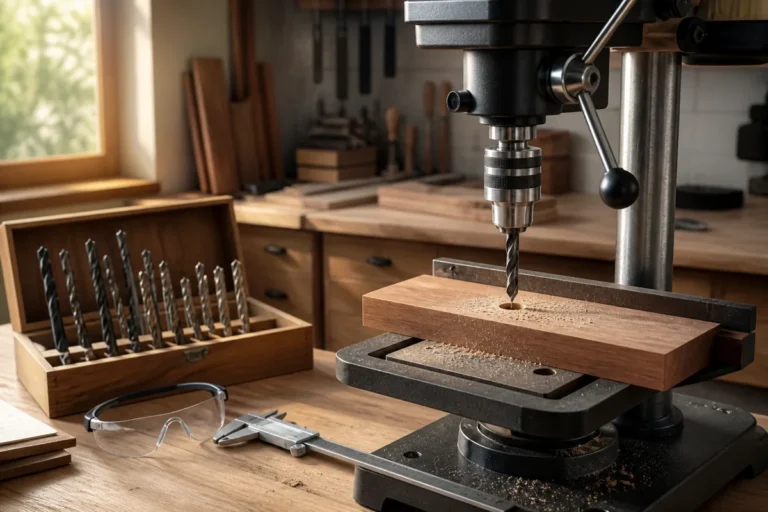
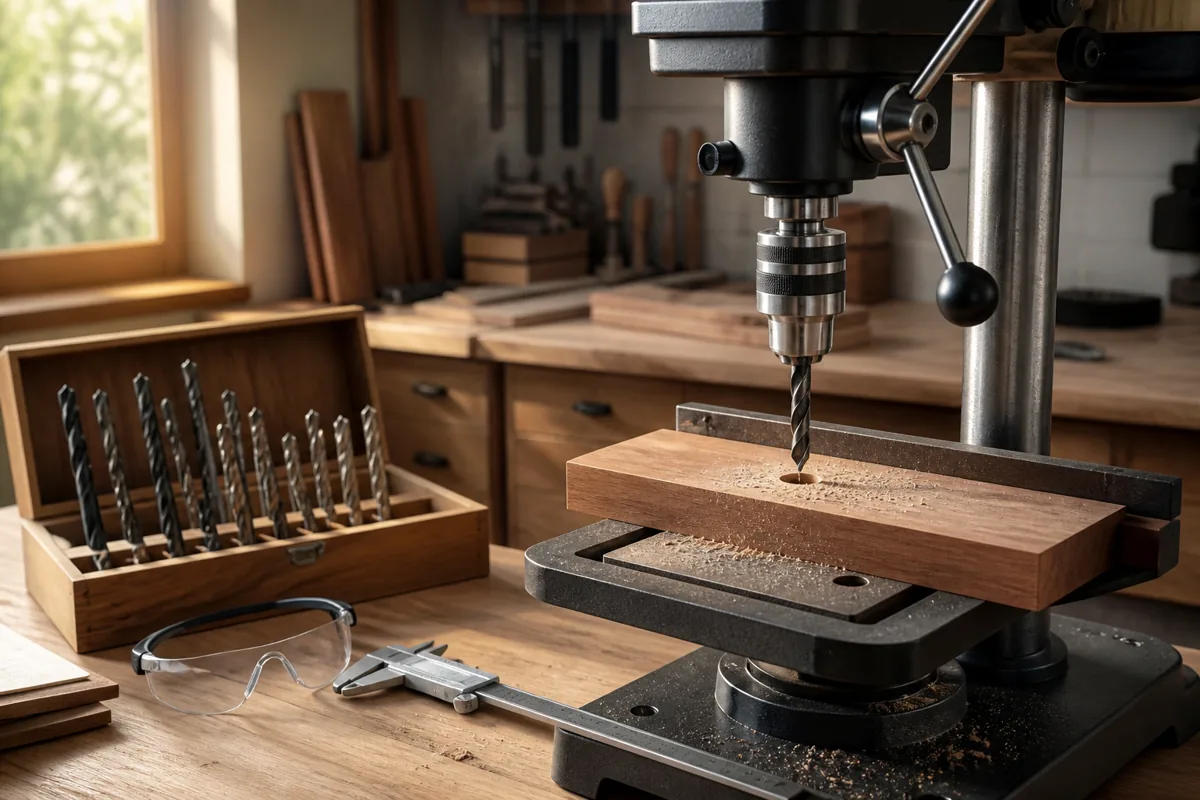
A drill press is not the usual first choice for cutting box joints. A table saw with a dado blade or a router with a straight bit removes the waste faster and leaves a cleaner, flatter bottom. But a drill press can produce accurate box joints when you use it to remove most of the waste between layout lines, then square the pockets with a chisel. It is especially useful for small boxes, thin stock, and shops that do not have a dado-capable table saw.
The machine matters because box joints punish small errors. A quill that deflects, a table that moves, or a fence that is not square can make every finger slightly different. Look for a drill press with low runout, a rigid column, positive depth control, and a table that stays locked while you work. The cheapest benchtop press can be adequate for occasional softwood boxes, but it is less forgiving in hardwood or wide stock.
As an Amazon Associate we earn from qualifying purchases at no extra cost to you.


Contents
What to Look For in a Drill Press
Choose a machine with at least 2 inches of quill travel for ordinary box-joint work. More travel is useful when drilling through thick sides or when a stop block and fixture raise the work above the table. A depth stop with two locking nuts is preferable to a loose collar because it lets you set a repeatable drilling depth.
Runout is the amount the bit wanders as it spins. Excessive runout makes holes wider than the bit and can blur the edges of the waste pockets. A practical target is roughly 0.003 inch or less at the chuck for fine woodworking. Manufacturers do not always publish a trustworthy number, so check the chuck and spindle for wobble if possible. A keyed chuck is often more secure than a low-cost keyless chuck, although it takes longer to change bits.
Variable speed is convenient but not essential. Forstner bits generally run slower than twist bits, and hardwood needs less speed than softwood. More important than a broad speed range is a reliable belt system, a motor that does not bog down, and a table that locks firmly.
Best Drill Press Types for Box Joints
| Drill press type | Best use | Main advantage | Main limitation |
|---|---|---|---|
| Benchtop | Small boxes and occasional work | Low cost and compact size | Less travel, rigidity, and table area |
| Floor-standing | Frequent box making and larger panels | Better capacity and support | Higher price and larger footprint |
| Radial-arm drill press | Angled or awkward setups | Flexible head position | More adjustment points can reduce repeatability |
| Mini drill press | Very small boxes and thin stock | Smallest footprint | Limited power and depth capacity |
For most woodworkers, a solid benchtop machine is the sensible choice. Search for benchtop drill presses for woodworking if you make small boxes from stock up to about 3/4 inch thick. A floor-standing press becomes worthwhile when you need a larger table, more throat depth, or repeated production. It also gives you more room for a box-joint sled, clamps, and sacrificial backing.
Bits and Fixture Choice
Do not use the drill press by simply plunging a large Forstner bit along a scribed finger. That approach creates rounded ends and makes spacing difficult. Instead, make a rigid guide or sled that references one edge of the work. Use a bit smaller than the pocket width, drill overlapping holes, and finish the sides with a sharp chisel and a router plane or flat file if needed.
For a 1/4-inch box joint, a 3/16-inch or 7/32-inch bit can remove waste without cutting into the layout lines. Drill a row of overlapping holes, leaving the layout lines visible. For a 3/8-inch joint, a 5/16-inch bit is a reasonable starting point. Test the setup on scrap first; the actual diameter and overlap depend on the bit and the accuracy of your fence.
Forstner bits leave a relatively flat-bottomed hole and track better than ordinary twist bits. Brad-point bits are useful for smaller holes and leave a clean entry, but their center spur can mark the bottom of a pocket. A sacrificial board under the work prevents breakout and gives the bit something to exit into.
Setup for Repeatable Joints
Build the fixture around a straight reference fence and a stop block. Clamp the stock against the fence, set the first hole or pocket from the edge, and use the same reference surface for every part. Do not flip one board casually unless the joint layout specifically requires it; flipping can turn a small fence error into a visible step across the joint.
Set the depth stop so the bit stops about 1/32 inch short of the final joint depth. Remove the remaining waste with a chisel. This prevents the drill bit from cutting through the face and gives you control over the finished shoulder. On a 1/2-inch-thick side, for example, drill to approximately 15/32 inch, then pare to the exact depth.
Keep the work clamped or held in a fixture. A spinning bit can grab a loose part, rotate it, and destroy the indexing accuracy. Never hold a small box side by hand directly beneath a large Forstner bit. Use a clamp, toggle clamp, or a sled with a handle and stop.
When a Cheaper Press Is Fine
A budget small benchtop drill press is fine if you make a few pine or poplar boxes each year, work with stock under 3/4 inch, and are willing to square the pockets by hand. Spend more when you use dense hardwood, need several matching boxes, or expect to drill deep pockets without repositioning the work.
If your main goal is clean, production-quality box joints, compare the cost of a drill press, bits, sled, and hand-finishing time with a router table and straight-bit setup or a table saw with a box-joint jig. The drill press is accurate when treated as a controlled waste-removal tool, not as a substitute for a purpose-built cutting method.