Best Drill Presses for Accurate Angled Furniture Joinery
What's inside
As an Amazon Associate I earn from qualifying purchases. This post may contain affiliate links at no extra cost to you.
An angled furniture joint is only as accurate as the setup that holds the work. A drill press can bore repeatable holes at a chosen angle, but it cannot make a loose fence, a flexing table, or an unsupported workpiece behave. For most furniture shops, a sturdy floor or benchtop drill press with a tilting table is enough; the right choice depends on workpiece size, quill travel, and how securely the machine holds its angle.
As an Amazon Associate we earn from qualifying purchases at no extra cost to you.


Contents
What matters for angled joinery
Look first for a table that tilts and has a clear angle scale. Many machines tilt 45 degrees in either direction, which covers most angled dowel holes, loose-tenon work, and chair parts. The scale is a starting point, not a precision reference: verify the table against the spindle with a machinist’s square or digital angle gauge, then lock it firmly. A table that shifts while tightening can spoil the setting.
Quill travel—the distance the spindle moves down—matters when drilling deep holes without repositioning the work. Around 3 inches is common and sufficient for many furniture tasks. Check the swing, too: it is the distance from the spindle to the column, doubled. A 12-inch swing gives roughly 6 inches from spindle to column, so wide panels may not fit under the bit where you need the hole.
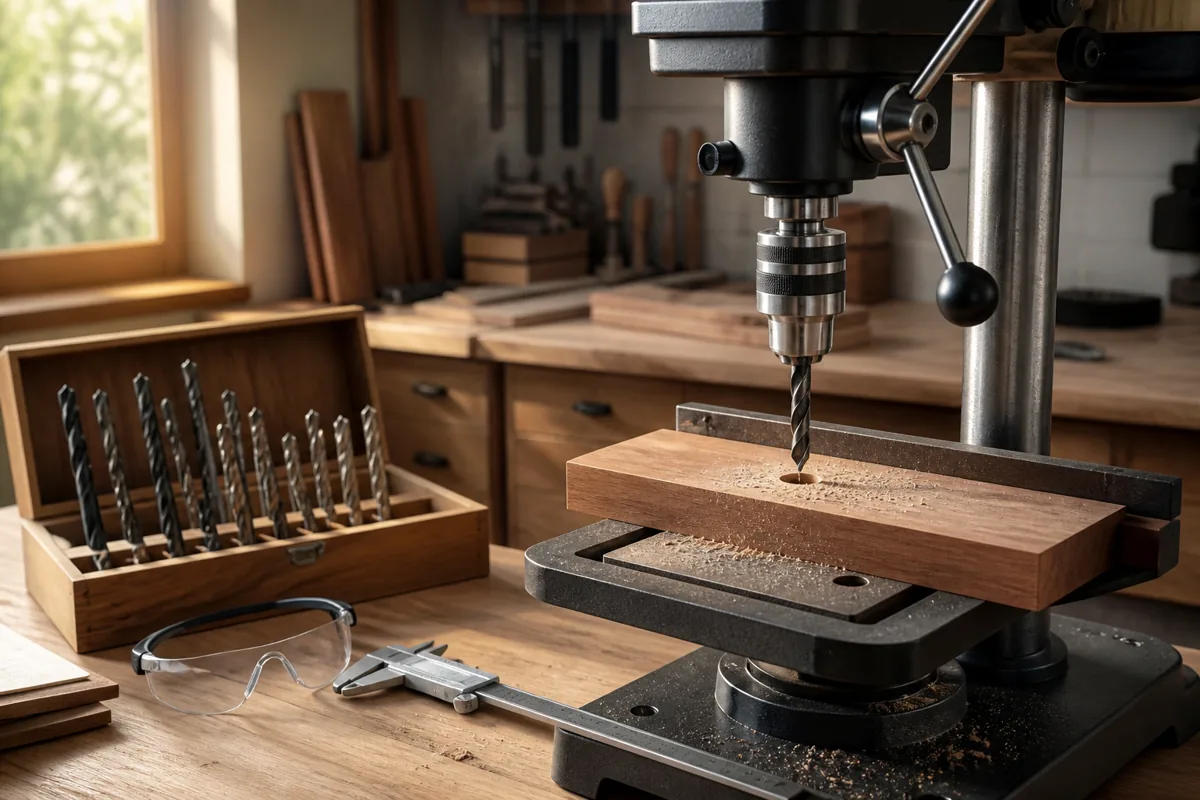
For repeatable depth, use the depth stop rather than judging by eye. For angled holes, support the piece with a wedge or cradle that keeps it from sliding downhill. A fence and clamps are essential; hands alone are not a safe or repeatable hold, especially when a bit catches.
Choose the machine around the work
A benchtop press is a sensible buy for small shops and occasional joinery. It costs less, takes less floor space, and can bore accurate holes in legs, rails, and modest-sized panels. Its limits show up with long or heavy parts: the table and stand have less mass, and the work may be difficult to position without hitting the column. Bolt the press to a rigid bench, not a light folding table.
A floor press is worth the extra space and cost if you regularly drill long chair parts, wide assemblies, or deep holes. Its larger table and greater working height make it easier to support awkward pieces. A heavier frame can also reduce vibration, though weight alone does not guarantee accuracy. Inspect the table lock, quill play, spindle runout, and how securely the head and table clamp in place.
Variable speed is convenient when switching between small bits and larger Forstner bits, but stepped pulleys are perfectly workable. Set speed with the machine off and unplugged. As a practical starting point, a 1/4-inch twist bit in hardwood can run around 1,500–2,000 rpm; a 1-inch Forstner bit is better kept near 500–800 rpm. Follow the bit maker’s guidance, and reduce speed if the bit burns or chatters.
Press choices at a glance
| Press type | Best fit | Main trade-off | Angled-joinery notes |
|---|---|---|---|
| Compact benchtop | Small parts, occasional dowels, limited shop space | Less reach and support for large work | Clamp a cradle to the table; secure the press to a heavy bench |
| Full-size benchtop | Regular furniture work with moderate-sized parts | Still needs a sturdy bench and may lack floor-press capacity | Often the best balance of cost, footprint, and table size |
| Floor-standing | Long legs, large assemblies, frequent drilling | Higher cost and substantial floor space | More room to position and support work; check table rigidity and lock |
What to buy for your shop
For a first machine, a full-size benchtop press with a tilting table, about 3 inches of quill travel, and a useful depth stop is a practical target. Compare full-size benchtop drill presses with tilting tables. Buy a floor-standing press if your parts routinely exceed the benchtop’s reach or you need a larger table to support them. Search floor-standing drill presses with tilting tables and compare table dimensions, quill travel, and the height under the spindle—not just motor horsepower.
A cheap compact press is fine for occasional, shallow holes in small stock if it has little quill play and its table locks securely. It is a poor bargain if the table rocks, the angle scale is hard to read, or the spindle visibly wobbles. If possible, test the quill with the machine off: pull it gently side to side near the chuck. Noticeable movement can translate into oversized or wandering holes. A dial indicator gives a more useful runout check; keep the bit short and clean when measuring, since a bent bit can mislead you.
Set up for accurate angled holes
Mark the hole center and establish a repeatable reference edge. Set the table angle with a gauge, then lock it and check again; locking can move the table slightly. If the work is too large or awkward to tilt, keep the table level and build a wedge-shaped jig to hold the work at the required angle. That approach often gives better support and safer clamping than balancing a long part on a tilted table.
Use a backing board where the bit exits to reduce tear-out. For a deep hole, drill in stages and clear chips instead of forcing the bit; a packed Forstner bit can overheat, burn the wood, or grab the work. Clamp the part and jig to the table, and position them so the bit cannot push the work into the column or off the table. Make a test hole in scrap of the same thickness and species. Check the angle and fit before drilling the furniture part.
Know what the press cannot fix
A drill press controls the bit’s path, but it does not automatically locate a hole relative to a joint, prevent tear-out, or make a poorly supported board safe. For angled dowel joinery, a simple jig that references the mating face may be more important than upgrading the motor. For large panels or repeated compound angles, a dedicated jig or router setup may be easier to control. Choose the press for the size and frequency of the work, then spend time on a rigid support and a test piece; those are usually the difference between a clean angled joint and a hole that needs concealing.