Best Bench-Top Drill Presses for Small Furniture Shops
What's inside
As an Amazon Associate I earn from qualifying purchases. This post may contain affiliate links at no extra cost to you.
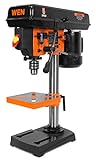
A bench-top drill press is useful in a small furniture shop when you need repeatable, square holes but don’t have room for a floor machine. The trade-off is reach: the head and column limit how far you can drill from an edge, and a light press can shift or vibrate under a large bit. Choose around the work you actually make—drawer fronts and chair parts have different demands from wide cabinet panels.
As an Amazon Associate we earn from qualifying purchases at no extra cost to you.


Contents
What to prioritize
Throat depth is the distance from the column to the spindle center. It determines how far from an edge you can drill without repositioning the work. A press with a 6-inch throat reaches about 6 inches in from an edge; it does not give you 12 inches of usable reach. Check the manufacturer’s stated throat depth rather than assuming the machine’s overall width tells you much.
Spindle travel is how far the quill moves in one plunge. Around 2 to 3 inches is enough for many furniture tasks, including counterbores and through-holes in common stock. A deep hole may require raising the table or repositioning the work between plunges. That can be inconvenient, and a bit can wander if you don’t keep the setup aligned.
Look for a rigid column, a table that locks firmly, and a depth stop you can set consistently. A laser is a useful rough guide, not a substitute for center-punching or a test cut. Speed changes matter too: smaller bits generally want higher speeds, while large bits and Forstner bits need lower speeds. If changing speed requires moving belts, check that you can do it safely and without a tedious setup.
Which size suits a small shop?
Compact presses save bench space and can be adequate for hardware holes, dowels, and small parts. Their short throat, limited travel, and lighter tables become frustrating when you drill wide panels or use large Forstner bits. A mid-size bench model is usually the better balance for a furniture shop: more reach and capacity without taking the floor space of a full-size machine. A floor press makes sense when you regularly work with tall components or need more throat depth, but it is not automatically more accurate.
For a broad starting point, compare bench-top drill presses for woodworking. Compare the throat, spindle travel, speed range, and table size—not just the motor rating or advertised swing. If you routinely drill well in from the edge of a wide part, look specifically for a larger throat rather than buying a compact press and hoping to work around it.
Quick comparison by shop use
| Press type | Best fit | Main limitation | Buy it when |
|---|---|---|---|
| Compact bench-top | Small parts and occasional holes | Short reach and less room for bulky work | Bench space matters most |
| Mid-size bench-top | General furniture work | Still limited on wide panels and tall stock | You want a practical all-rounder |
| Floor model | Tall parts or demanding, frequent use | Uses more shop floor space | Bench models regularly constrain your work |
Capacity, bits, and workholding
Don’t choose on horsepower alone. For woodworking, a stable setup and a speed range suited to your bits are often more useful than a bigger motor. Large Forstner bits can bog down a small press, especially in hardwood, but forcing the feed is a poor fix: it can overheat the cutter, burn the hole, or grab the work. Use the slowest suitable speed, clear chips from deep holes, and let the bit cut without leaning hard on the handle.
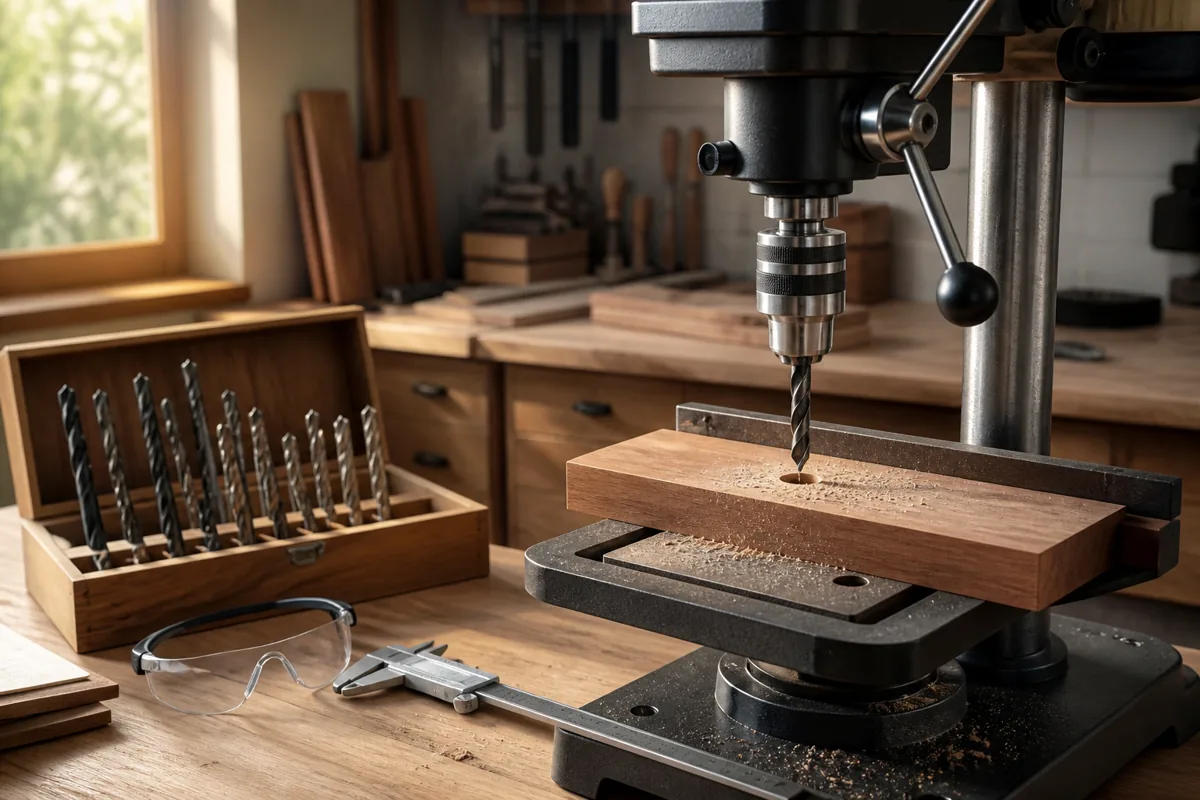
Workholding is not optional. A spinning board can injure you and damage the table, bit, or workpiece. Clamp the piece or use a drill-press vise; don’t rely on your hand to resist a grab. A sacrificial board beneath the work reduces tear-out as the bit exits. For angled holes, a tilting table can help, but tables that tilt and then lock poorly are a liability. A simple angled jig may be more repeatable.
For furniture parts, a fence or stop block can speed up batches of identical holes. Confirm that the table and fence stay square to the spindle, then drill a test piece before committing to a finished component. If you need accurate hole placement on a large panel, a bench press may run out of reach before its motor runs out of power.
When the cheaper press is fine
A basic compact model is a reasonable choice if your work is mostly small hardware holes, narrow parts, and occasional drilling. You can make it more useful with a clamped auxiliary table, a fence, and a sacrificial insert. Those accessories improve support and repeatability, but they do not increase the machine’s throat depth or spindle travel.
Pay more when you need a larger working envelope, frequent speed changes, or a table that holds position under heavier work. Before buying, check whether the press can sit securely on your bench, whether its head can be positioned for the pieces you make, and whether replacement belts or other wear parts are available. A press that technically fits your budget but cannot reach the holes on your furniture parts is not a bargain.
To compare larger options, browse mid-size bench-top drill presses. If you are considering a floor machine because of tall stock or reach, compare floor drill presses for woodworking against your available floor space and actual part dimensions.
Setup and safe use
Bolt the press to a solid bench if the base has mounting holes. A loose machine can vibrate, shift, or tip when a bit catches. Before drilling, set the speed with the machine unplugged, secure the work, and check that the bit clears the table and clamps. Remove the chuck key before switching on. For repeated holes, set the depth stop and verify it on scrap; relying on a visual estimate can leave a row of holes at uneven depths.
With those checks, a mid-size bench-top press covers a wide range of small-shop furniture work. Buy a compact one for genuinely small parts and occasional use. Step up in size only when reach, table support, or regular heavy drilling is a real constraint—not simply because a larger machine sounds more capable.