Best Drill Presses with Quick-Set Depth Stops
What's inside
As an Amazon Associate I earn from qualifying purchases. This post may contain affiliate links at no extra cost to you.
A drill press depth stop is useful only if it stays put, adjusts quickly, and returns to the same setting. The best systems let you drill a batch of holes without measuring every workpiece. They also prevent the quill from traveling too far into a part, fixture, or drill press table.
For most woodworking, a threaded depth-stop collar with a locknut is adequate. If you regularly drill shelves, dowel holes, hinge cups, or repeatable stopped holes, a turret-style stop or a drill press with a well-designed rack-and-pinion quill stop saves more time. The important distinction is not the largest motor or swing. It is how easily you can set, verify, and repeat the depth.
As an Amazon Associate we earn from qualifying purchases at no extra cost to you.
Contents
Depth-stop types worth considering
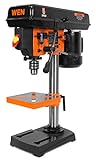
The simplest system uses a threaded rod, collar, and nut. You lower the quill to the required position, tighten the collar or nut, and drill until the stop contacts the quill head. This design is inexpensive and common on benchtop machines. It works well when you make one setup and drill a moderate batch.
A turret stop uses several fixed positions, often with threaded adjustment screws. You can set multiple depths and rotate between them. This is convenient for operations such as drilling a shallow counterbore followed by a deeper clearance hole. The drawback is that each stop usually needs its own careful calibration, and the turret can be awkward to reach on a cramped machine.
Some drill presses use a quill stop with a lever, handwheel, or rack mechanism. These are faster to adjust than a fully threaded rod, particularly when changing between jobs. Look for a positive lock. A depth scale alone is not enough; scales can be inaccurate, and a loose lock can allow the setting to creep during repeated drilling.
For a broad selection, compare drill presses with depth stops by the actual stop mechanism rather than by the product photos. Two machines may both advertise a “depth stop” while one has a coarse threaded rod and the other has a much faster, more useful adjustment.
Best choices by type
| Type | Best for | Strengths | Limitations |
|---|---|---|---|
| Benchtop drill press with threaded stop | General woodworking and occasional batches | Low cost, simple, easy to repair | Slow to change; locknuts can shift if poorly tightened |
| Benchtop press with turret stop | Several repeated depths | Fast changes between preset operations | More parts to calibrate; limited adjustment range |
| Floor drill press with extended quill stop | Large stock and frequent production work | Better access, longer travel, stronger frame | Higher cost and more floor space |
| Aftermarket depth-stop accessory | Upgrading an existing machine | Can improve speed without replacing the press | Fit varies; may not solve quill play or poor scales |
What to check before buying
Start with quill travel. A stop that adjusts quickly is not useful if the press has only 2 inches of travel and your fixture or bit requires more. Many woodworking tasks need less than 1 inch, but large Forstner bits, long brad-point bits, and deep mortises can use nearly all available travel. A practical target for a general-purpose press is around 3 inches of quill travel.
Check the stop’s resolution. A threaded stop may allow fine adjustment of roughly 1/32 inch or better, but only if the threads are clean and the locknut does not move the setting as it tightens. A lever-style stop is quicker for rough changes, but you may still need a threaded fine adjustment for repeatable work. Make sure the mechanism can be operated with the chuck and bit installed, not just shown in an empty product photograph.
Quill runout and spindle play matter more than a fancy stop. If the quill shifts sideways when extended, a bit can enter the work at an angle and produce a hole deeper on one side. Test for smooth travel and minimal wobble. A good depth setting cannot compensate for a loose quill, a flexing column, or a table that moves under pressure.
Table stability is another failure point. Tighten the table clamp before setting the stop, and use a sacrificial board to protect the table. If the table tilts or drops while drilling, the stop has not failed—the setup has. A larger table with a positive rack-and-pinion height adjustment is usually worth paying for when working with wide cabinet parts.
When the cheaper press is fine
A basic benchtop drill press with a threaded depth stop is fine for shelf-pin holes, pilot holes, and small batches of repeated drilling. If you normally make fewer than 20 holes and can verify the first piece with a ruler or depth gauge, a turret stop may not justify its extra cost.
The cheaper option becomes less attractive when you switch depths often, drill hundreds of identical holes, or need two operations on every part. In those cases, lost setup time adds up quickly. A stop that takes 30 seconds to reset instead of 3 minutes can pay for itself over a large cabinet project.
Do not choose a floor model solely because it has a larger motor. A 1/2-horsepower press is usually enough for woodworking drill bits and Forstner bits when used at sensible speeds. A heavier machine mainly buys you reach, stability, and a larger table. Those advantages are valuable, but they do not automatically produce a better depth stop.
How to set a stop accurately
Install the actual bit, turn off the machine, and lower the quill until the cutting edge reaches the desired depth. For a blind hole, measure from the point where the bit first contacts the work, not from the chuck or the top of the bit. Raise the quill, tighten the stop, and then lower it again to confirm the setting.
Drill a test hole in scrap from the same material. Measure its depth with a depth gauge, narrow rule, or the shank of a known-size bit. Allow for bit geometry: a brad-point bit’s center spur can reach deeper than its outer cutting edges, while a Forstner bit leaves a flat-bottomed hole but may compress fibers at high speed.
For production batches, check the first hole, the middle hole, and the last hole. If depth changes, look for a loose stop, a rotating quill collar, table movement, or packed chips preventing the workpiece from sitting flat. Clear chips between holes; a single shaving under a board can change depth by several thousandths of an inch, enough to matter for shallow hinge or dowel work.
Recommended shopping approach
For general furniture work, prioritize a rigid benchtop or floor drill press with at least 3 inches of quill travel, a positive quill lock, and a threaded stop that is easy to reach. For repeat production, look for a turret or quick-adjust system, then confirm that it still has fine adjustment and a reliable lock. If your current press is rigid but slow to set, an aftermarket drill press depth-stop upgrade may be the most economical fix.
Buy the more expensive mechanism when it removes a real bottleneck. Otherwise, spend the money on a stable table, a better fence, quality bits, and a setup that keeps every workpiece flat. Those improvements usually affect hole accuracy more than a premium depth-stop label.