Best Thickness Planers for Small Professional Furniture Shops
What's inside
As an Amazon Associate I earn from qualifying purchases. This post may contain affiliate links at no extra cost to you.
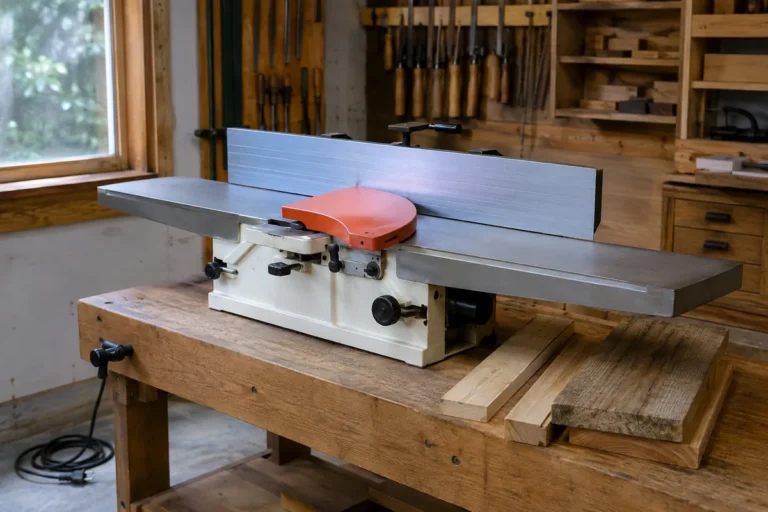
A thickness planer earns its floor space in a small professional shop when you regularly buy rough lumber, glue up panels, or need repeatable thickness across a batch of parts. It does not replace a jointer: one face must already be flat, or the planer will copy the cup and twist instead of removing it. But with a reliable infeed setup and sharp knives, a planer can turn rough boards into usable stock quickly and consistently.
Contents
What Small Shops Should Prioritize
For professional furniture work, cutting width is only part of the decision. A good machine should feed boards without stalling, hold a setting within roughly 0.5 mm (about 1/64 inch), and allow practical knife changes. Dust collection matters just as much. A planer produces a large volume of fine chips, and a clogged hood can cause chip marks, poor finish, and dangerous blowback.
Most small shops should look first at a 12- to 13-inch portable planer or a compact stationary planer. These typically accept stock around 12 or 13 inches wide and 6 inches thick, depending on the model. That covers table legs, cabinet parts, shelves, and most furniture components. A 15-inch machine becomes worthwhile when you routinely flatten wide panels or process substantial quantities of hardwood, but it demands more floor space, power, and dust-collection capacity.
For a starting point, compare 12-inch thickness planers by motor power, feed rate, knife design, and support—not just advertised cutting width.
Portable Planers: Best Value for Moderate Production
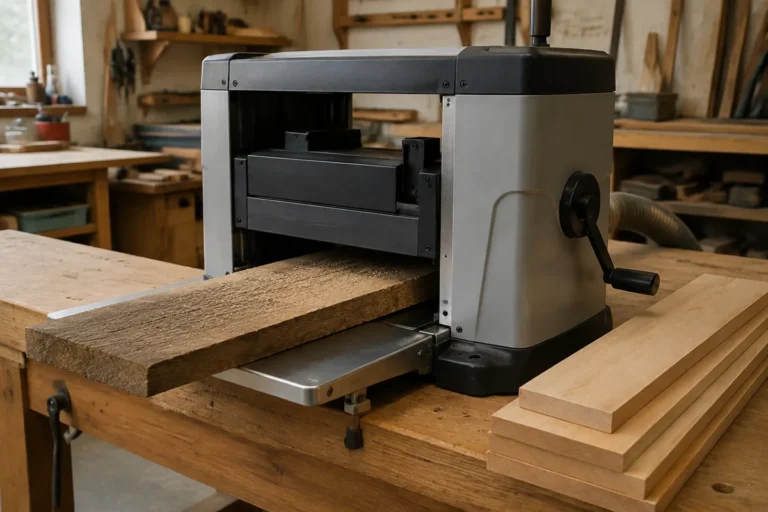
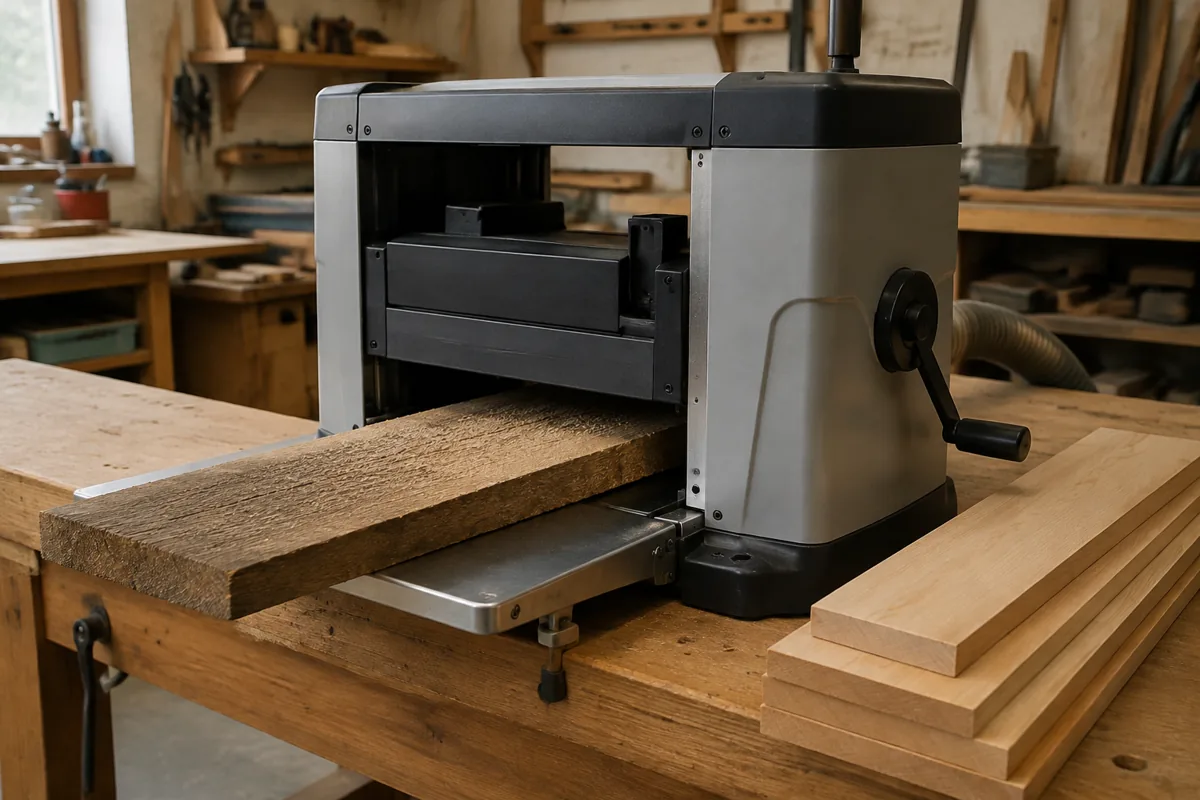
A portable planer is usually the sensible choice for a shop making occasional batches of furniture. It is cheaper, easier to move, and commonly runs from a standard 120-volt circuit. Expect a cutting width near 12.5 inches, a feed rate around 16 to 26 feet per minute, and a motor in the roughly 1-3/4 to 2-1/2 horsepower class.
The main weakness is vibration. Lightweight machines can produce snipe at the board ends, leave visible knife lines, and struggle when removing more than about 1/16 inch in one pass from dense hardwood. They also tend to be loud. In practice, you will get better results by taking several light cuts—1/32 inch or less for difficult stock—than by forcing a deep pass.
A portable machine is fine when you process a few dozen board feet at a time, have limited power, or need to store the planer between jobs. It is less attractive when the machine runs for hours every week. The folding tables and plastic-heavy housings can work, but they need careful setup and occasional tightening.
Stationary Planers: Better for Repeated Furniture Work
A compact stationary planer has a heavier frame, more substantial tables, and better resistance to movement during a cut. Many machines in this class use a 15-inch cutterhead, weigh several hundred pounds, and require 230-volt power. Their feed rates commonly fall between 16 and 30 feet per minute.
The extra mass reduces chatter and makes thickness settings more repeatable. It does not eliminate snipe; roller pressure and table alignment still matter. A stationary planer also needs a permanent location, adequate infeed and outfeed room, and a dust collector capable of moving roughly 800 to 1,200 cubic feet per minute at the machine. A small shop vacuum is generally inadequate for sustained work.
Choose this class if you make cabinets, dining tables, or batches of matching parts every week. The price premium is easier to justify when less sanding, fewer rejected boards, and faster knife changes directly affect production time. Browse 15-inch stationary thickness planers if your work regularly exceeds a 12-inch capacity.
Cutterheads and Knife Costs
| Cutterhead type | Advantages | Trade-offs | Best fit |
|---|---|---|---|
| Two-knife straight cutterhead | Low initial cost; simple design | More noise; knives need frequent adjustment; tear-out is more noticeable | Occasional work and tight budgets |
| Disposable double-edge knives | Quick replacement; consistent setup | Ongoing knife cost; damaged knives must be replaced | Small professional shops processing mixed stock |
| Helical or segmented carbide cutterhead | Quieter; good performance in figured wood; rotate individual inserts | Higher purchase price; slower initial setup | Regular production and difficult hardwoods |
A helical head is not automatically the right answer. It usually produces a better surface on figured maple, cherry, and reversing grain, and one damaged insert does not ruin the entire cut. However, a planer with a straight knife head can be perfectly adequate for pine, poplar, ash, and well-oriented maple. Check replacement insert or knife prices before buying; a cheap machine can become expensive if its consumables are hard to source.
Features Worth Paying For
A cast-iron or steel bed is more useful than decorative power claims. Look for positive table locking, a clear height scale, accessible adjustment controls, and sturdy extension tables. A depth-stop or preset thickness gauge helps when making repeated parts, but do not trust a printed scale blindly. Measure the first board with calipers or a reliable thickness gauge.
Three feed speeds are useful if the machine offers them: faster for rough dimensioning and slower for a cleaner finish. Many affordable planers have only one speed, which is acceptable if you finish-sand furniture parts afterward. Automatic head locking or a solid column-locking system helps prevent the cutterhead from creeping during a batch.
If your shop has a 230-volt circuit and enough dust collection, consider 230-volt woodworking thickness planers. Do not buy one simply for a larger horsepower number: the electrical installation and stationary footprint may cost more than the machine.
Avoiding Common Failures
Snipe usually comes from unsupported board ends, incorrect roller pressure, or a cutterhead that is not properly locked. Keep long boards supported level with the planer bed and feed several boards close together when practical. Tear-out comes from feeding against grain, taking too heavy a cut, or using dull knives. Waxing the bed lightly reduces friction, but avoid excess lubricant near the feed rollers.
Never plane dirty reclaimed lumber without checking it carefully for embedded metal. One nail can destroy knives, damage inserts, and leave a dangerous projectile. Keep the dust hood connected, wear hearing protection, and do not reach into the rollers while the machine is connected to power.
A Practical Buying Decision
Buy a portable planer if your workload is intermittent, your stock is usually under 12 inches wide, and 120-volt operation matters. Spend more on a helical-head version if you regularly work figured wood or value reduced noise and easier maintenance. Choose a stationary 15-inch machine when throughput, repeatability, and wide panels justify the floor space and electrical work.
For most small professional furniture shops, the best balance is a sturdy 12- or 13-inch planer with reliable parts availability, positive table locks, and a dust hood that seals properly. Put the remaining budget toward a proper dust collector, infeed and outfeed support, and spare knives. Those additions often improve finished results more than a modest increase in motor horsepower.