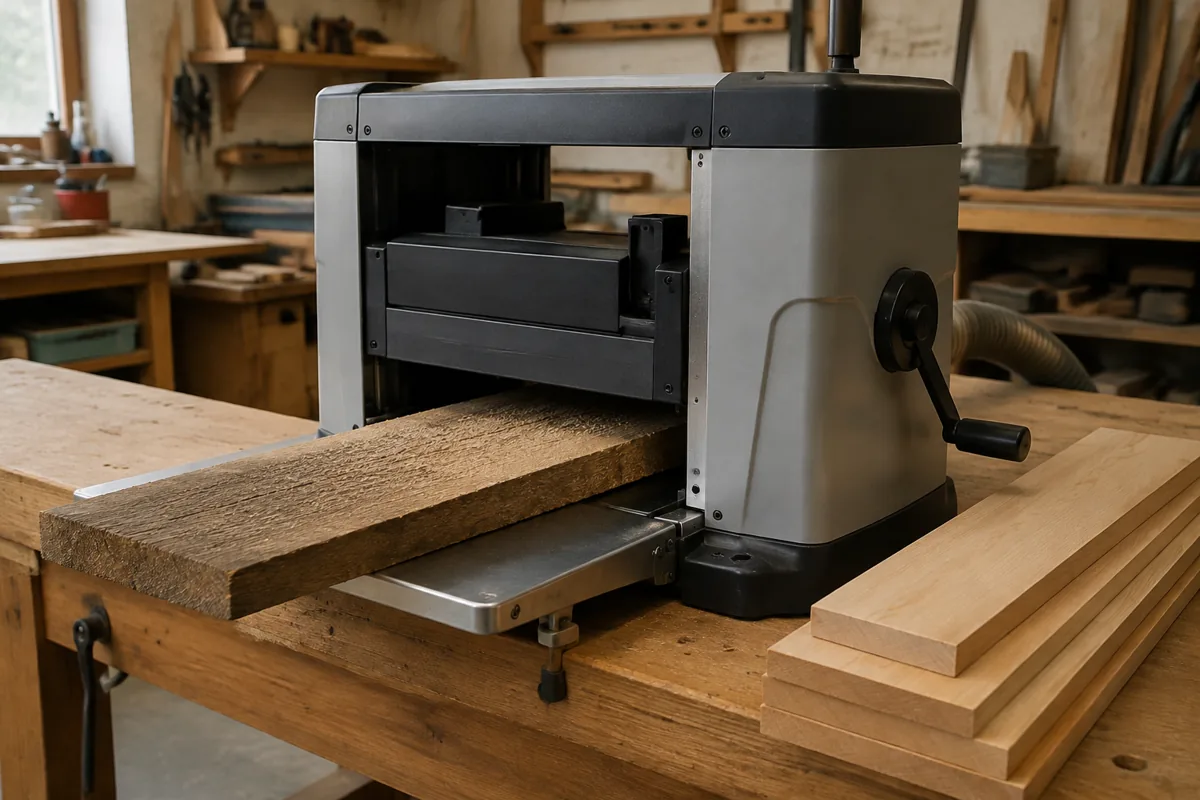
Best Planers with Sturdy Elevation Mechanisms
What's inside
As an Amazon Associate I earn from qualifying purchases. This post may contain affiliate links at no extra cost to you.
A thickness planer is only as accurate as its elevation mechanism. A sharp knife and a strong motor cannot compensate for a cutterhead that tilts, drops under vibration, or takes several turns to move a fraction of an inch. For most shops, the best planer is not simply the one with the largest cutting width. It is the machine whose head stays parallel to the table, locks securely, and can be adjusted without fighting backlash.
Contents
What Makes an Elevation Mechanism Sturdy
Portable planers usually raise and lower the cutterhead with two or four threaded posts. A handwheel, chain, or gear system connects those posts. The cutterhead housing travels along the posts, while the table remains fixed. This arrangement is compact and affordable, but it can develop play if the posts are poorly supported or the chain loses tension.
A sturdy mechanism has several useful traits:
- Multiple support posts: Four posts generally resist twisting better than two, especially when feeding wide or heavy boards.
- Short, stiff travel: Less unsupported structure means less deflection when the cutterhead is under load.
- Positive locking: Head locks or column locks prevent the setting from changing during a cut.
- Fine adjustment: A mechanism that moves roughly 1/16 inch per handwheel revolution is easier to tune than one with a coarse, loose drive.
- Accessible calibration: You should be able to check the scale against a reliable reference rather than trusting a printed pointer.
Look for a four-post thickness planer when repeatable setup matters. Four posts do not automatically make a planer accurate, but they provide a better foundation than a lightly supported two-post design.
The Best Planer Types for Different Shops
| Planer type | Typical capacity | Elevation strength | Best use |
|---|---|---|---|
| Portable benchtop | 12 to 13 inches wide, about 6 inches thick | Good when fitted with four posts and a head lock | Small shops, remodeling, occasional stock preparation |
| Heavy-duty portable | 12 to 13 inches wide, heavier castings | Very good; less movement under load | Furniture work and regular hardwood use |
| Stationary floor planer | 15 inches wide or more | Excellent, with a rigid table and substantial posts | Production work, wide boards, thicker stock |
| Helical or segmented-head planer | Usually similar to its base machine | Depends on the frame, not the cutterhead | Quieter cutting and easier maintenance |
A helical cutterhead does not make the elevation system stronger. It can reduce noise and make damaged inserts easier to replace, but the machine still needs rigid posts and a reliable locking system. Spend extra on a helical head for cutting performance, not as a substitute for a sturdy frame.
Portable Planers Worth Considering
A good benchtop machine is often the right choice for a hobby shop. It can flatten rough boards, remove glue squeeze-out, and fit on a mobile stand. The trade-off is limited width and less mass. A 12-inch planer may weigh roughly 65 to 100 pounds, while a 15-inch stationary model can exceed 400 pounds. The heavier machine is harder to move but is much less likely to shift or vibrate during elevation changes.
When shopping for a 12-inch thickness planer with four posts and a head lock, check whether the lock clamps the cutterhead housing firmly or merely adds resistance to the handwheel. A real lock should stop the housing from creeping during a cut. Locking procedures vary, so test the machine with a dial indicator or a scrap board before trusting the scale.
The cheaper option is fine if you plane short boards, work mostly in softwood, and make only occasional height changes. A basic portable planer can provide good results when mounted securely, supported at both ends, and kept clean. Paying more becomes worthwhile when you process long hardwood boards, need repeated settings, or are tired of correcting snipe and uneven thickness.
When a Stationary Planer Pays Off
A floor-standing planer has more mass around every part of the elevation system. Its posts are generally larger, the housing is stiffer, and the table gives longer boards better support. These machines are preferable when you regularly plane 8/4 hardwood or stock wider than 12 inches.
The main disadvantage is cost and space. A stationary planer may need a 240-volt circuit, dust collection with a 4-inch hose, and several feet of clear infeed and outfeed area. It is also not immune to problems. A dirty chain, dry posts, loose sprocket, or worn bronze bushing can cause one corner of the head to move differently from the others.
Before buying a 15-inch stationary thickness planer, confirm that replacement knives or inserts, drive belts, chains, and elevation components are available. A bargain machine becomes expensive if a small proprietary gear ends its useful life.
How to Test Elevation Accuracy
Do not judge a planer only by turning its handwheel in a showroom. Lower the head, clean the posts, and raise it by a measured amount. A practical test is to make ten full or partial handwheel turns, measure the actual movement with a dial indicator, then return to the starting point. Excessive backlash shows up when the handwheel changes direction but the head does not move immediately.
For woodworking, a few thousandths of an inch of repeatability is useful. More important is parallel travel. Measure from the table to the cutterhead at the left and right sides with the machine unplugged and the knives removed or safely covered. A difference of 0.010 inch can create visible thickness variation and uneven cuts. If the machine has adjustment screws or a cross-brace, correct the alignment before using it.
Common Failures and Maintenance
Snipe is often blamed on the elevation mechanism, but weak infeed support, a loose head lock, and lifting the board into the cutter are also common causes. Support long stock level with the planer table, lock the head after setting the height, and take a light final pass.
Uneven thickness across the board usually indicates misaligned posts, a tilted table, or a cutterhead that is not parallel to the feed path. Hard-to-turn elevation can result from packed dust, a dry threaded post, a stretched chain, or a bent component. Clean first; lubricate only where the manufacturer permits. Grease on exposed posts can collect abrasive dust and make the problem worse.
For frequent hardwood work, choose a heavier four-post machine. For occasional weekend use, a well-supported portable planer is often the better value. In either case, elevation accuracy comes from rigid construction, proper locking, regular cleaning, and verification with measurements—not from the width printed on the box.
