Best Table Saws for Small Production Woodworking Shops
What's inside
As an Amazon Associate I earn from qualifying purchases. This post may contain affiliate links at no extra cost to you.
A small production shop needs a table saw that can make repeatable cuts for hours without consuming all the available floor space. The best choice is rarely the biggest saw available. It is the machine that matches your material, electrical service, dust collection, and work rhythm without creating new bottlenecks.
For most one- to three-person shops, a 10-inch cabinet saw is the long-term choice. A high-quality contractor saw can be the better buy when the shop is in a garage, when the saw must move occasionally, or when the budget also has to cover a planer, jointer, and dust collector.
As an Amazon Associate we earn from qualifying purchases at no extra cost to you.

Contents
Table Saw Types at a Glance
| Type | Typical motor | Best use | Main compromise |
|---|---|---|---|
| Benchtop | 15 amp, universal motor | Occasional cutting and very limited space | Noisy, less stable, limited production durability |
| Contractor | 15 amp or 1.5–2 hp induction motor | Small shops, remodeling, mixed mobility | More vibration and weaker dust collection than a cabinet saw |
| Hybrid | 1.5–2 hp induction motor | Serious hobby and light production work | Usually 120V, with less reserve than a 3 hp saw |
| Cabinet | 3 hp induction motor | Daily ripping, sheet goods, and hardwood production | Heavy, expensive, and often requires 240V power |
Best Overall: A 3 HP Cabinet Table Saw
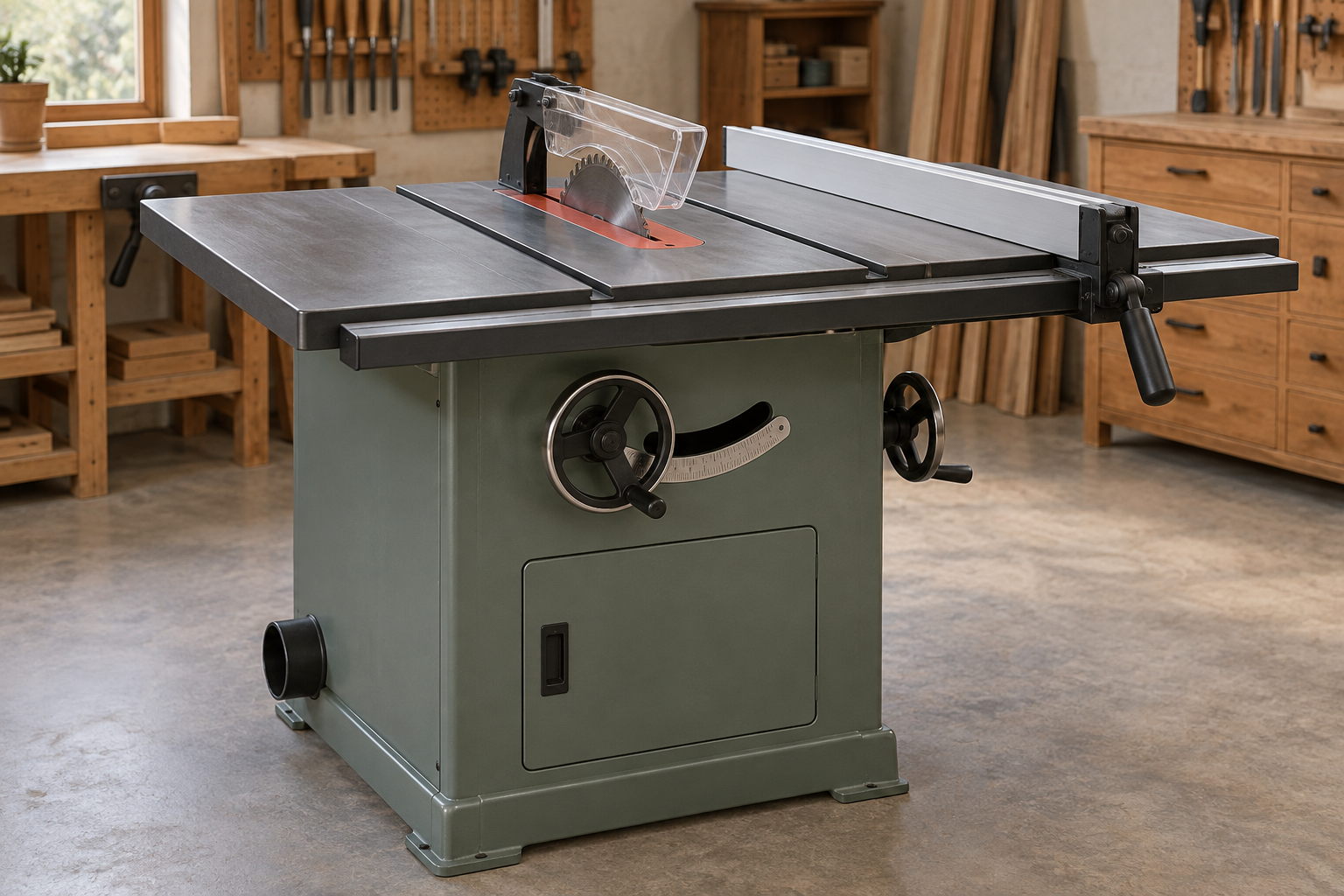
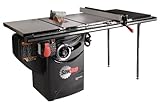
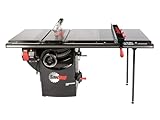
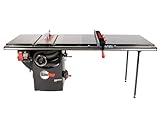
A 10-inch, 3 hp cabinet saw is the strongest general-purpose option for a small production woodworking shop. Its induction motor maintains speed in thick hardwood, its enclosed base improves dust collection, and its heavier cast-iron table reduces movement while cutting long boards. A 3 hp motor is also less likely to stall when ripping 8/4 stock than a 1.5 hp machine.
Look for a 30-inch or 36-inch rip capacity unless you regularly break down full sheets at the saw. A 52-inch fence is useful for cabinet work, but it consumes substantial floor space and may be unnecessary if you use a track saw for rough sheet breakdown. A rigid T-square-style fence should lock at the front with little or no deflection; a fence that moves 1/32 inch can turn a batch of supposedly identical parts into a fitting problem.
Before buying, verify that the motor can run on your shop’s electrical service. A 3 hp saw commonly needs a dedicated 240-volt circuit, often 20 or 30 amps. Do not assume an existing dryer or welder circuit is suitable without checking local electrical requirements. For this category, compare 3 hp cabinet table saws by fence quality, service support, and safety equipment rather than motor horsepower alone.
Best Value: A Hybrid or Contractor Saw
A hybrid saw is the sensible cheaper option for many shops. It usually has a cast-iron top, a reasonably accurate fence, an enclosed or partially enclosed base, and a belt-driven induction motor. It can rip plywood, solid lumber, and typical furniture parts cleanly when fitted with a sharp blade.
The limitation is reserve power. On a 120-volt, 1.5 to 2 hp saw, feeding 8/4 hard maple too quickly can pull the motor down, scorch the cut, or trip the breaker. That is not a problem if you make a steady, moderate feed and use a sharp rip blade. It becomes a problem in production runs where stopping to cool the motor or reset a breaker costs time.
A contractor saw with a folding or mobile stand is preferable when the machine must be stored against a wall. Choose one with a solid fence, adjustable table extensions, and a riving knife that stays aligned through blade changes. A cheaper saw is fine for occasional cabinet parts and trim-sized stock; it is a poor bargain if you routinely cut hundreds of linear feet of hardwood each week. See current hybrid table saws with cast-iron tables when comparing this tier.
Space, Infeed, and Outfeed Requirements
The saw’s published footprint is not the working footprint. A 96-inch board needs roughly 8 feet of infeed and outfeed clearance, plus room on the left and right for handling. For sheet goods, plan on at least 12 feet of clear length if the saw is used for full cuts, although a separate cutting table or track saw can reduce that requirement.
Outfeed support is not optional in production work. A board that drops off the back can lift at the front, bind against the blade, or pull the operator forward. Use a rigid outfeed table, roller support, or a folding table that remains level with the saw. Keep the table slightly lower than the cast-iron surface—about 1/16 inch is safer than having stock catch on a high edge.
Safety and Dust Collection
A riving knife is more useful than a decorative blade guard because it stays close to the blade and helps prevent a kerf from closing onto the teeth. Anti-kickback pawls and a guard are still valuable for through-cuts. For non-through cuts, use the riving knife configuration approved by the manufacturer rather than removing every safety part permanently.
Cabinet saws generally collect dust better, but no table saw is dust-free. A 4-inch port connected to a collector moving roughly 600 to 1,000 cubic feet per minute at the machine is a practical target. A small shop vacuum may capture some dust from a hybrid saw, but it will usually struggle with the volume produced by repeated ripping. Poor collection also allows fine dust to settle inside the cabinet and around the motor.
The Fence and Blade Matter More Than the Badge
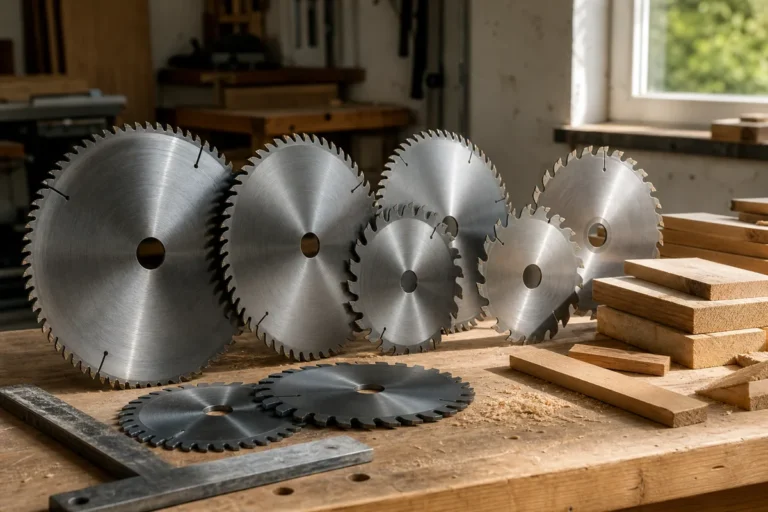
Budget for a quality combination blade and a dedicated ripping blade. A 40-tooth combination blade handles general plywood and solid wood, while a 24-tooth rip blade feeds faster in thick stock. Dull teeth cause burning, wandering cuts, and excessive motor load. If a blade starts requiring noticeably more feed pressure, sharpen or replace it instead of forcing the cut.
Check the fence parallel to the miter slot and blade before production work. The fence should be parallel or open very slightly toward the back of the saw; a fence that closes toward the blade can pinch the workpiece and increase kickback risk. Also inspect the miter gauge. Many stock gauges have too much play for accurate crosscuts, so a well-fitting aftermarket gauge or a dedicated crosscut sled may deliver a bigger accuracy improvement than a more expensive motor.
Which Saw Should You Buy?
Choose a 3 hp cabinet saw if you cut hardwood daily, have 240V power, and can dedicate a permanent location. Choose a hybrid saw if your work is furniture parts and sheet goods in moderate batches, especially when the rest of the shop still needs funding. Choose a contractor saw if mobility and storage matter more than maximum dust control.
Skip a benchtop saw for production work unless the parts are small and the machine is used only occasionally. Its light base can shift during a cut, its universal motor is loud, and its short table makes long stock harder to control. Browse 10-inch contractor table saws only if those limitations fit your workload. The money saved is worthwhile when it goes toward a proper dust collector, sharp blades, and stable outfeed support.