Festool TS 55 Plunge Saw Review: Is the Guide Rail System Worth It?
What's inside
- Festool TS 55 Plunge Saw Review: Is the Guide Rail System Worth It?
- What the cut-line and plunge action are worth
- Specifications that affect buying decisions
- The true system cost: saw, rail, clamps and extraction
- Which setup fits your situation?
- Ownership realities: what needs attention
- Verdict: is the guide rail system worth it?
- Related Guides
- Festool TS 55 Plunge Saw Review: Is the Guide Rail System Worth It?
- What the cut-line and plunge action are worth
- Specifications that affect buying decisions
- The true system cost: saw, rail, clamps and extraction
- Which setup fits your situation?
- Ownership realities: what needs attention
- Verdict: is the guide rail system worth it?
- Related Guides
As an Amazon Associate I earn from qualifying purchases. This post may contain affiliate links at no extra cost to you.
Contents
- Festool TS 55 Plunge Saw Review: Is the Guide Rail System Worth It?
- What the cut-line and plunge action are worth
- Specifications that affect buying decisions
- The true system cost: saw, rail, clamps and extraction
- Which setup fits your situation?
- Ownership realities: what needs attention
- Verdict: is the guide rail system worth it?
- Related Guides
Festool TS 55 Plunge Saw Review: Is the Guide Rail System Worth It?
Yes—if you make accurate, repeatable sheet-good cuts often, the Festool TS 55 plunge saw can justify its premium through its rail, splinter-guard and dust-control system; for occasional cuts, the saw-only price is only part of the bill, and a circular saw with a straightedge is usually better value.
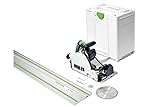
The TS 55 is a corded 160 mm (6¼-inch) plunge saw designed to run on a compatible guide rail. Its appeal is not simply that it cuts straight: the rail establishes the path, the replaceable splinter guard helps define the cut edge, and the plunge mechanism lets you start a cut within a panel. Whether that adds up depends on how much you value clean edges and repeatability—and what you already own.
As an Amazon Associate we earn from qualifying purchases at no extra cost to you.


What the cut-line and plunge action are worth
Splinter-guard accuracy: useful, but setup-dependent
The rail’s splinter guard sits beside the blade and supports the material fibers near the cut. Once it has been trimmed to the blade, its edge acts as a visual reference for where the blade will cut. That can make positioning straightforward, especially when cutting veneered plywood or melamine-faced panels where tear-out is conspicuous.
That edge is not a guarantee of a perfect cut. A worn or damaged guard, a misaligned rail, the wrong blade for the material, or a rail that shifts during the cut can all reduce accuracy. The guard also needs trimming to the particular blade and saw setup before it can indicate the cut line correctly. After changing blades, check that the indicated edge still matches the cut.
For practical accuracy, clamp the rail when the workpiece is narrow, slippery or expensive. Make a test cut in scrap from the same material before committing to a visible edge. The splinter guard is most valuable as a repeatable reference—not as a substitute for careful setup.
Plunge smoothness: control matters more than speed
A plunge saw lowers its blade into the work rather than needing an edge to start from. The TS 55’s controlled plunge action is useful for cut-outs, trimming panels to a line and making cuts that stop before the far edge. A smooth, deliberate plunge makes it easier to keep the base seated on the rail and avoid an abrupt entry that can mark the workpiece.
Use a steady feed and let the blade do the cutting. For a stopped cut, set the depth and start position carefully, keep hands clear of the blade path, and follow the manufacturer’s operating instructions. The saw’s plunge feature expands what you can cut, but it does not turn freehand work into a safe or accurate method.
Specifications that affect buying decisions
Specifications can vary by TS 55 generation and regional configuration. Confirm the exact model’s manual before buying accessories or planning a cut. The figures below describe the common current TS 55 configuration; they are not a promise that every kit contains the same items.
| Measure | Common TS 55 specification | Why it matters |
|---|---|---|
| Blade diameter | 160 mm (6¼ in) | Check blade compatibility and replacement-blade cost. |
| Maximum cutting depth at 90° | About 55 mm (2⅛ in), without a rail | Enough for typical sheet goods and many solid-wood panels; verify the depth available with your rail and setup. |
| Maximum cutting depth at 45° | About 43 mm (1⅝ in), without a rail | Bevel capacity is lower than straight-cut capacity. |
| Rated input | About 1,200 W on common corded versions | Requires mains power and a suitable extension lead for the work area. |
| Saw weight | Roughly 4.5 kg (10 lb), before rail | Portable enough for site work, but the full setup is bulkier. |
| Rail length | Common lengths include 800, 1,400 and 1,900 mm | Choose a rail that supports the full cut and leaves room to start and finish. |
The true system cost: saw, rail, clamps and extraction
A “Festool plunge saw kit” may bundle a rail, blade, case or other accessories, but kit contents vary. Compare the actual items in the box rather than assuming the word kit means a complete cutting setup. A guide rail is essential to the system; clamps are strongly recommended for many jobs; dust extraction is optional in the sense that the saw can operate without it, but it makes indoor work substantially more manageable.
| Purchase | Typical general-market range | Budgeting note |
|---|---|---|
| TS 55 saw by itself | About $700–$900 | Price depends on model, region and included blade or accessories. |
| Compatible rail, around 1.4 m | About $100–$160 | Longer or additional rails increase the total. |
| Rail clamps | About $50–$100 per pair | Useful when the rail cannot be held securely by the workpiece or its grip strips. |
| Compatible dust extractor | About $500–$900 | A major additional cost if you do not already own a suitable extractor. |
| One compatible blade | About $70–$120 | Allow for replacements or a second blade suited to a different material. |
Using those broad ranges, a saw, one rail, clamps and a new extractor can total roughly $1,350–$2,060 before tax. Add a blade if it is not included. Prices vary by country and change over time, so treat these as planning ranges, not quotes. If you already have compatible extraction or a suitable rail, the added cost can be much lower.
Which setup fits your situation?
| Your situation | Practical choice | Reason |
|---|---|---|
| Occasional DIY cuts, tight budget | Consider a circular saw with a clamped straightedge | Lower entry cost; suitable if you can tolerate more setup and a less integrated cut-line system. |
| Regular cabinet or furniture work | TS 55 with a rail sized for your panels | Repeated positioning and clean, predictable cuts can save time and reduce rework. |
| Small shop or limited storage | Buy the saw and one rail first; add accessories as needed | A rail and extractor take up space, so check storage and transport before building a full system. |
| Frequent indoor cutting or dusty materials | Plan for a compatible extractor | Extraction improves dust collection and helps keep the work area more usable; it does not eliminate all airborne dust. |
| High-volume panel processing | Compare the complete system with a dedicated panel saw or shop setup | The TS 55 is portable, but repeated long cuts may be faster with a more permanent cutting station. |
Ownership realities: what needs attention
- Splinter guard: Inspect it for damage and replace it when its edge no longer provides a reliable reference. Re-trim a new guard according to the saw and rail instructions.
- Blade condition: A dull or pitch-coated blade can worsen cut quality and make feeding harder. Clean or replace blades using the manufacturer’s guidance, and choose a blade appropriate to the material.
- Rail cleanliness: Dust and chips can interfere with seating and movement. Brush debris from the rail and check the grip strips and underside before a precision cut.
- Clamping and support: Support the panel so the offcut cannot pinch the blade. Keep the rail stable, particularly near the end of a cut.
- Dust extraction: Empty the extractor and inspect hoses and connections. A blockage reduces collection; extraction is not a replacement for suitable respiratory protection when conditions require it.
Most frustrations come from treating the saw as a standalone tool. Rail condition, blade choice, workpiece support and setup all contribute to the result. The system rewards care, but it also asks you to maintain more than just the saw.
Verdict: is the guide rail system worth it?
The TS 55 makes the strongest case for itself when you regularly break down sheet goods, need a dependable cut-line reference, or want plunge capability without setting up a table saw. Its splinter guard can improve confidence at the cut edge, and its rail-based workflow makes repeat cuts easier to position. Those benefits are less compelling if you make only a few rough cuts each year.
Before buying, price the whole setup you actually need: saw, compatible rail, clamps, blade and dust extraction if you lack it. If those pieces will see regular use, the guide-rail system can be worth the premium. If not, a less expensive saw-and-straightedge approach may meet your needs at a fraction of the total cost.