Best Planers for Small Shops with Limited Electrical Service
What's inside
As an Amazon Associate I earn from qualifying purchases. This post may contain affiliate links at no extra cost to you.
A small shop does not need a three-phase planer, but it does need a planer that will start reliably without tripping the breaker. For most home shops with 120-volt service, the practical choice is a 12- or 13-inch benchtop “lunchbox” planer. These machines are compact, widely supported, and typically run from a standard 15-amp circuit.
The limiting factor is not only the planer’s horsepower. The circuit may also be feeding lights, a dust collector, a battery charger, or another machine. A planer that looks acceptable on paper can become frustrating if its motor shares a circuit with other loads.
As an Amazon Associate we earn from qualifying purchases at no extra cost to you.


Contents
What Limited Electrical Service Means
A typical 120-volt, 15-amp circuit can supply about 1,800 watts in theory, but a motor should not be treated as a continuous 15-amp load. Startup current is much higher than running current, and a loaded cutterhead can pull enough power to trip a marginal breaker.
Planer motors are commonly advertised around 12 to 15 amps. That rating is only part of the picture. A machine with a 15-amp motor may work well on a dedicated circuit, while the same machine trips repeatedly when a shop vacuum starts on that circuit at the same time. Long, lightweight extension cords make the problem worse by causing voltage drop.
Before buying, identify the breaker size, outlet location, and what else is connected to that circuit. If the planer will be used in a garage, test the actual outlet rather than assuming it is on a dedicated line. A dedicated 120-volt circuit is a major improvement, even if it remains limited to 15 amps.
The Best Planer Type for a Small Shop
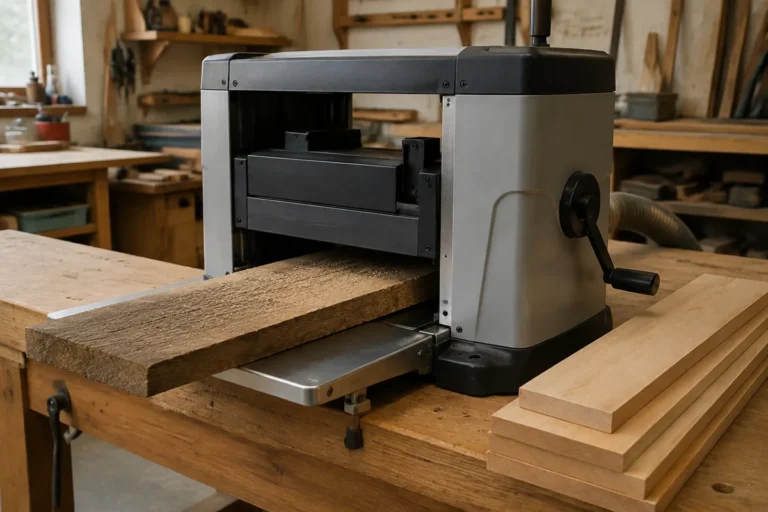
A 12- or 13-inch benchtop planer is usually the right answer. It can dimension boards up to roughly 6 inches thick and 12 or 13 inches wide, depending on the machine. It weighs enough to stay put during use but can be stored on a shelf or mobile cart afterward.
Start with a standard 13-inch benchtop planer if you primarily process common furniture stock, shelving, cabinet parts, and rough boards. A 15-inch stationary planer gives you a wider table and often a smoother feed system, but it generally costs more, takes up more room, and may require a 240-volt circuit or a substantially larger electrical supply.
Do not buy a 15-inch machine simply because it sounds more professional. If your electrical service cannot support it, the wider capacity is irrelevant. You will get more usable work from a dependable 120-volt planer than from a larger machine that cannot run without nuisance trips.
| Planer type | Typical electrical demand | Best use | Main compromise |
|---|---|---|---|
| 12-inch benchtop | 120V, commonly 12–15A | Small parts and occasional stock preparation | Narrower capacity and lighter feed system |
| 13-inch benchtop | 120V, commonly 12–15A | Most home furniture and cabinet work | Noise, snipe, and limited dust handling |
| 15-inch stationary | Often 240V, higher amperage | Frequent wide-board production | More space, cost, and electrical requirements |
Straight Knives or Helical Cutters?
Cheaper benchtop planers normally use two straight knives. They cut quickly and are inexpensive to replace. For construction lumber, painted projects, utility shelving, and occasional use, a straight-knife planer is often fine. The cheaper option makes sense when you can tolerate more noise and do not regularly plane figured wood.
A helical or spiral cutterhead uses many small carbide inserts. It usually costs more, but it can reduce tear-out in figured grain and lets you rotate or replace individual inserts instead of replacing a full knife set. It is not a substitute for correct feed direction: reversing the grain or taking too deep a cut can still produce tear-out.
Factory-installed helical heads are convenient but increase the purchase price. A standard 13-inch helical-head planer is worth considering if you work hardwoods often, value lower cutting noise, or dislike knife alignment. For occasional softwood work, spend the difference on dust collection, infeed support, and replacement knives.
Electrical and Dust Collection Setup
Use the shortest heavy-gauge extension cord practical. For a 15-amp planer, a 25-foot 12-gauge cord is a safer general choice than a long 16-gauge cord. Better still, place the planer near the outlet and avoid an extension cord entirely.
Run the planer alone while cutting. A shop vacuum may be acceptable between passes, but starting both machines together can trip a breaker. Large dust collectors are particularly unsuitable for a limited circuit because their motor startup load can exceed what the planer circuit comfortably handles.
Dust collection is not optional for long sessions. Planers produce a large volume of chips, and a clogged exhaust port increases cleanup and can interfere with ejection. A compact shop vacuum with a dust separator is a reasonable small-shop solution, but do not expect it to handle production quantities as well as a dedicated collector.
Features That Matter More Than Marketing
Look for a positive depth-stop system, accessible knife or insert replacement, sturdy folding tables, and a reliable circuit breaker or overload protector. Infeed and outfeed extensions should stay reasonably flat; sagging extensions can worsen snipe at the board ends.
Snipe is a common failure mode in benchtop planers. It appears as a deeper cut over the first or last few inches of a board. Supporting the board level with the planer tables, lifting the leading and trailing ends slightly, and feeding several boards end-to-end can reduce it. A planer with a cutterhead lock may hold thickness more consistently, but it will not eliminate poor support technique.
Take shallow passes. Removing about 1/32 inch per pass is a sensible starting point in hardwood, while softwood may allow more. If the motor slows audibly, the finish becomes rough, or the breaker trips, reduce the cut depth and feed rate rather than forcing the board through.
What I Would Buy
For most shops with limited electrical service, I would choose a 120-volt 13-inch benchtop planer on a dedicated circuit, with folding tables and readily available knives or inserts. Choose straight knives when the budget is tight and the work is mostly ordinary lumber. Choose a helical head when reduced tear-out, quieter cutting, and easier maintenance justify the added cost.
Only move to a 15-inch stationary planer after confirming the shop’s voltage, breaker capacity, floor space, and dust-collection plan. Electrical limitations are easier to work around than a planer that is too small for every board you build, but buying beyond the service available is an expensive way to create an unreliable machine.