Best Planers with Adjustable Feed Rates for Fine Finishes
What's inside
As an Amazon Associate I earn from qualifying purchases. This post may contain affiliate links at no extra cost to you.
A planer with an adjustable feed rate gives you control over two competing jobs: removing material quickly and producing a clean, furniture-ready surface. The slower setting generally improves the finish because each knife makes more closely spaced cuts. It does not fix a dull cutter, poor dust collection, or badly prepared stock, but it gives you another useful adjustment when grain, thickness, and appearance matter.
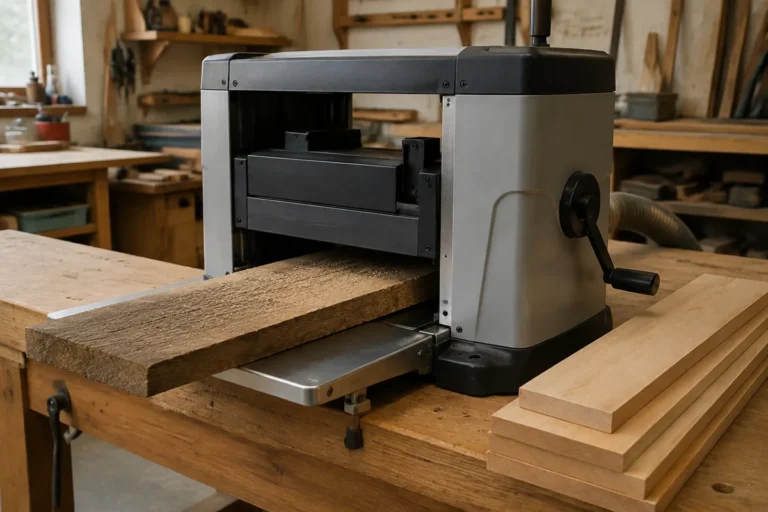
For most small shops, the best choice is a portable lunchbox planer with two feed speeds. Larger stationary planers offer more power, wider capacity, and better support, but they cost substantially more and need a dedicated circuit or permanent floor space. Start by deciding how much stock you process, rather than buying based only on maximum cutting width.
As an Amazon Associate we earn from qualifying purchases at no extra cost to you.

Contents
Why Adjustable Feed Speed Matters
Feed rate determines how far the board travels between knife cuts. A fast setting is useful for rough dimensioning, especially when removing 1/16 inch or less in several passes. A slow setting reduces the distance between cuts and usually leaves fewer visible ridges. On figured maple, cherry, and other difficult grain, that difference can save considerable sanding.
A typical portable planer may feed at roughly 16 feet per minute on its fast setting and 26 feet per minute on a higher-throughput setting, or offer a slower finishing speed near 8 to 12 feet per minute. The exact numbers vary, so check the specification rather than assuming that “two speed” means slow and fast in a particular range.
Feed speed is only part of the result. Cutterhead design matters just as much. A conventional straight-knife head is inexpensive and easy to service, while a helical or segmented head usually handles changing grain more quietly and with less tear-out. Helical heads cost more and use many small inserts, but rotating or replacing one damaged insert is easier than replacing a full knife set.
The Best Planer Types for Fine Finishes
| Planer type | Typical strength | Main limitation | Best for |
|---|---|---|---|
| Two-speed portable planer | Affordable, movable, useful feed-rate control | Short infeed and outfeed tables; more snipe | Small shops and occasional furniture work |
| Single-speed portable planer | Lowest purchase price and simple operation | No slower finishing pass | Construction lumber and general sizing |
| Stationary floor planer | Heavy build, long tables, stronger feed rollers | Higher cost and space requirements | Frequent milling of wide or long boards |
| Planer with helical cutterhead | Lower tear-out and quieter cutting | Higher initial cost | Figured wood and visible furniture surfaces |
A two-speed thickness planer is the sensible middle ground for many woodworkers. It costs more than a basic single-speed machine, but the slower setting is useful when you need to reduce sanding without moving up to an industrial-style planer.
What to Look for When Buying
Feed-rate controls: Confirm that the machine changes the actual feed speed, not just the cutterhead speed. A useful control is a mechanical gearbox or clearly specified low/high feed rate. Some machines advertise electronic speed control, but the range may be too narrow to make a practical difference.
Cutting width and height: A 12-1/2-inch capacity handles most cabinet parts and furniture components. A 13-inch planer provides slightly more room, but the difference is not enough to justify a poor cutterhead or weak feed system. Check maximum thickness as well; many portable planers top out near 6 inches.
Depth of cut: Treat the advertised maximum as a roughing limit, not a finish-pass target. Removing 1/16 inch in one pass can overload a portable machine, leave ridges, and increase snipe. For a clean final pass, remove about 1/64 inch, or less on wide or figured boards.
Table length and extensions: Short tables are a major source of snipe. A board can dip as it leaves the infeed roller, causing a deeper cut at the first or last few inches. Fold-out extensions help, but rigid auxiliary tables or well-supported roller stands are better. A heavy stationary machine with long cast tables has an advantage here.
Dust collection: Planers produce chips faster than most shop vacuums can handle. A 4-inch dust port connected to a collector is preferable. If chips pile up around the cutterhead, they can be recut into the surface, clog the hood, or force chips back onto the board. A 4-inch woodworking dust collection setup is a worthwhile upgrade if your shop does regular milling.
How to Get a Fine Finish
Begin with straight, stable stock. A thickness planer makes one face parallel to the opposite face; it does not flatten a cupped or twisted board. Joint one face first, or use a sled and shims for stock that cannot safely sit flat. Plane boards in the same direction as the grain whenever possible.
Take several light passes rather than one aggressive cut. Use the fast feed rate for initial sizing, then switch to the slower setting for the final two passes. On a 3/4-inch target thickness, taking 1/32 inch per side may be reasonable on a wide hardwood board, while 1/16-inch cuts are better reserved for rough stock and powerful machines.
Keep the board moving at a steady pace and support it level with the table. Do not push or pull it once the feed rollers have engaged. Mark one edge of the board so you can keep the grain direction consistent, and rotate end-for-end between passes only when you are deliberately trying to reduce directional tear-out.
When a Cheaper Planer Is Fine
A single-speed portable planer is adequate if you mostly dimension construction lumber, paint-grade parts, shelving, or hidden cabinet components. It can also produce good surfaces when fitted with sharp knives and used with light cuts. In that situation, spending the difference on dust collection, support tables, and replacement knives may be the better choice.
Pay for adjustable feed rates when you regularly work with hardwood furniture parts, figured grain, or boards that will receive a clear finish. The slower pass will not eliminate all tear-out, but it gives you a more controlled finish and can reduce the amount of hand sanding. If you mill several hundred board feet per month, skip lightweight portable machines and consider a stationary planer with a helical cutterhead.
Before buying, price the cutterhead, knives or inserts, dust collection, and support equipment together. A cheap planer that requires frequent knife changes and produces heavy snipe may cost more in time than a better two-speed machine. For occasional work, however, the inexpensive single-speed option remains perfectly serviceable when you use light cuts, sharp knives, and proper board support.