Best Jointers for Small Shops with Limited Floor Space
What's inside
As an Amazon Associate I earn from qualifying purchases. This post may contain affiliate links at no extra cost to you.
A jointer is one of the hardest stationary woodworking machines to fit into a small shop. The useful models are either compact enough to store on a shelf or heavy enough to keep a board stable during a cut, and those goals rarely overlap. For most small shops, the best choice is not the smallest jointer available. It is the machine that can flatten the stock you actually use without becoming a permanent obstacle.
As an Amazon Associate we earn from qualifying purchases at no extra cost to you.


Contents
What small-shop buyers need
A jointer flattens one face and squares one edge. It does not make a board parallel in thickness; that is the planer’s job. The most important specifications are cutterhead width, table length, fence quality, dust collection, and how easily the machine can be moved or stored.
A 6-inch jointer handles most furniture parts, cabinet rails, face frames, and general repair work. An 8-inch machine is more capable with wide boards, but it usually demands substantially more floor space and weighs enough that moving it becomes a two-person task. Table length matters just as much as width. Short tables can flatten short parts, but long boards tend to rock or dip as they enter and leave the cutterhead.
Measure the machine in use, not just its shipping dimensions. You need clear space in front of and behind the tables. A 6-foot board may require roughly 12 feet of straight clearance for a safe pass, although you can sometimes work diagonally in a small room. Leave enough room beside the fence to stand squarely and keep your hands away from the cutterhead.
The main jointer types for tight spaces
Benchtop jointers are the easiest to store. They commonly use a cutterhead around 6 inches wide and can be lifted onto a workbench or cart. A 6-inch benchtop jointer is a reasonable choice when you joint short boards, work mostly with rough stock under 5 feet, and value storage space more than speed.
The trade-off is stability. Lightweight machines can move during a cut, especially when flattening cupped hardwood. Their tables are often shorter, the fences can be less rigid, and alignment may require more checking. They also tend to have smaller dust ports or less effective chip containment. Mounting one to a heavy mobile cart helps, but it reduces the storage advantage.
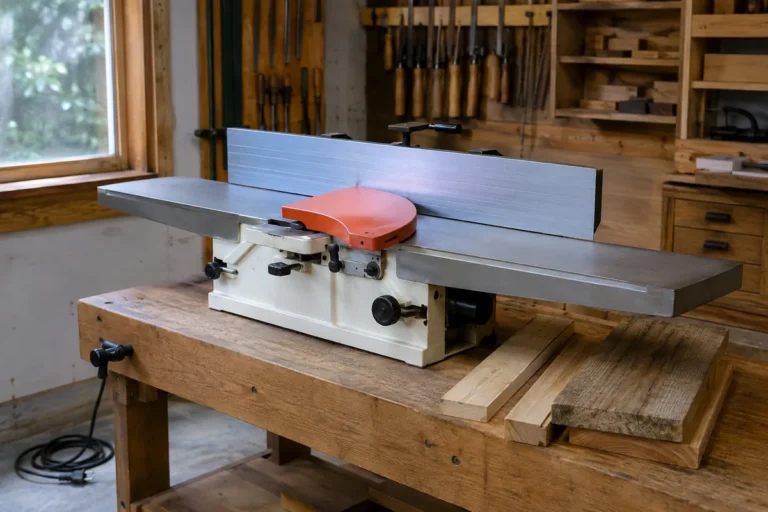
Floor-standing 6-inch jointers are the best general-purpose choice for many small shops. They offer longer cast-iron tables, a more dependable fence, and enough weight to resist movement. A parallelogram-style table adjustment is useful because it allows the tables to move without disturbing the cutterhead relationship as much as simpler designs. These machines commonly occupy about 2 by 5 feet, but their operating footprint is much larger.
Compact 8-inch jointers make sense when you regularly flatten boards wider than 6 inches or buy rough lumber that needs more aggressive correction. They are not automatically better for a small shop. The longer tables, wider cutterhead, and heavier base increase cost and storage demands. If most of your stock is already close to flat and under 6 inches wide, the extra capacity may sit unused.
Combination planer/jointers can save floor space because one machine performs both operations. They are attractive where every square foot matters, but switching between modes takes time, and the jointing tables are often shorter than those on a dedicated floor machine. They are most useful for a shop that needs both functions occasionally and cannot fit two separate machines.
Quick comparison
| Type | Typical capacity | Strengths | Limitations | Best fit |
|---|---|---|---|---|
| Benchtop 6-inch | Short to medium boards | Easy to store; lowest entry cost | Less stable; shorter tables | Occasional work and very tight shops |
| Floor-standing 6-inch | Most furniture stock | Stable; better tables and fence | Needs a permanent or mobile footprint | Best all-around small-shop option |
| Compact 8-inch | Wider and longer rough lumber | More capacity and table support | Heavier, larger, and more expensive | Frequent hardwood and wide-board work |
| Combination machine | Moderate jointing and planing | Two machines in one footprint | Mode changes; compromises in both functions | Shops with almost no floor space |
Features worth paying for
Prioritize a rigid fence that locks square and stays square. A fence that shifts by even a small amount can produce a tapered edge or an angle that becomes obvious when assembling a cabinet. A quick check with a reliable square should be part of setup, not an occasional repair.
Long tables are valuable for large workpieces, but table flatness and alignment matter more than a large number in the specifications. Run a straightedge across both tables and check for a ridge at the cutterhead. A mismatch can leave a step or hollow in the jointed face. On a used machine, inspect the table surfaces for deep rust, scoring, or grinding marks.
Cutterhead design is another practical decision. A straight-knife head is usually cheaper and gives clean results when the knives are sharp and adjusted correctly. Replacement knives are relatively inexpensive, but setup can be frustrating. A helical or spiral head with replaceable inserts costs more initially and usually reduces tear-out in figured wood. It also produces a different chip pattern, so good dust collection remains necessary.
Look for a machine with a 4-inch dust port if possible. A shop vacuum may manage a small benchtop jointer, but a dedicated dust collector is more effective on a floor-standing model. Poor collection allows chips to pile under the outfeed table, which can interfere with stock movement and create a slip hazard.
When the cheaper option is fine
A benchtop machine is not a bad purchase simply because it is light. It is fine for face-jointing drawer parts, small panels, and boards that you can safely control. It is also sensible if you already own a planer and use the jointer only to establish one flat reference face and edge.
It becomes a poor bargain when you routinely process 6-foot boards, dense hardwood, or stock with severe twist. The machine may technically complete the job, but repeated passes, movement, and alignment checks erase the savings. In that situation, spend the extra money on a used, well-maintained floor-standing 6-inch jointer or a floor-standing 6-inch jointer.
Storage and safe use
A mobile base is useful only if it locks firmly. Casters that flex or roll during a cut defeat the advantage of a heavier machine. For a benchtop unit, build a cart with a wide base and a positive clamp or bolted mounting points. Do not balance the jointer loosely on a folding table.
Use push blocks, keep the guard correctly adjusted, and never joint stock shorter than the machine manufacturer allows. Take light cuts—often around 1/32 inch for difficult grain—and feed at a steady rate. If the motor labors, the board stalls, or the machine chatters, reduce the cut and check that the knives are sharp. A small-shop jointer works well when its capacity matches your material; it cannot compensate for an undersized table, unstable stand, or rushed setup.