Best Band Saws for Small Shops with Limited Floor Space
What's inside
As an Amazon Associate I earn from qualifying purchases. This post may contain affiliate links at no extra cost to you.
Contents
Choosing a Band Saw for a Small Shop
A band saw earns its floor space when you resaw boards, cut curves, or break down rough lumber. In a compact shop, the right saw is not automatically the biggest one you can afford. A larger throat and cutting height help, but the machine also needs room for its table, fence, dust collection, and the long boards you feed through it.
Start by measuring the actual footprint, then leave working clearance around the table. A 14-inch saw may fit against a wall, but resawing an 8-foot board still requires enough open space in front and behind it—or a plan to angle the board through the shop. Check the machine’s weight and base dimensions, too: a heavy cast-iron saw can be stable and pleasant to use but difficult to move once it is installed.
As an Amazon Associate we earn from qualifying purchases at no extra cost to you.

What the Specifications Mean
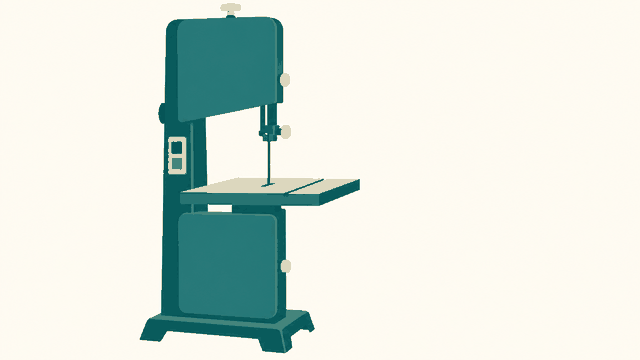
Throat capacity is the distance from the blade to the vertical frame; it sets the maximum width of a cut. Cutting height is the maximum stock thickness under the upper guide. These are different limits. A 14-inch throat does not mean the saw can resaw a 14-inch-thick board.
Wheel size is a useful rough guide, not a guarantee of performance. A well-built 14-inch saw can handle ordinary furniture-shop work, while a small benchtop unit is better suited to thinner stock and occasional curves. For resawing, motor power, blade choice, frame rigidity, and setup matter more than a large number on the box. A small motor pushed through thick hardwood can bog down, leave a wandering cut, or overheat the blade.
Compact Band Saw Options Compared
| Type | Typical strengths | Main limitations | Best fit |
|---|---|---|---|
| Benchtop saw | Small footprint, lower cost, easy to store | Limited cutting height and power; lighter frame can vibrate | Occasional curves and thinner stock |
| 14-inch floor-standing saw | Good balance of capacity, blade availability, and shop size | Often needs careful setup or upgrades for demanding resawing | General small-shop woodworking |
| Larger floor-standing saw | More capacity and often more resaw power | Higher cost, greater weight, more floor and blade-access space | Regular thick-stock work or production use |
These are broad categories, not performance guarantees. Compare the actual cutting height, motor rating, table size, blade range, and included fence for each saw. A used 14-inch machine can be a good buy if its wheels run true, guides are intact, and the frame has no cracks. Budget for a suitable blade and time to tune it.
Benchtop or Floor-Standing?
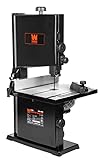
Choose a benchtop saw if you mostly cut small parts, templates, or curves in material around an inch thick. It can be a sensible budget choice for occasional work, especially if a floor-standing machine would crowd out a table saw or workbench. Its trade-offs show up when cutting thicker stock: less capacity, a smaller table, and less mass to resist vibration. Mount it securely to a solid bench rather than setting it on a lightweight folding table.
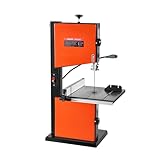
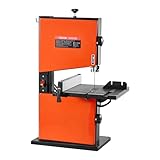
For a main shop saw, a 14-inch floor-standing model is often the practical starting point. Look for a stable base, a fence that locks square to the table, and enough cutting height for the stock you expect to use. Some models accept riser blocks, but added height does not add motor power or make a flexible frame more rigid. Before buying, verify whether the quoted capacity requires a riser and whether the saw’s blade guides support the blade sizes you want.
Browse 14-inch woodworking band saws to compare capacity and included features. If the work is mainly small curves, compare benchtop woodworking band saws instead of paying for unused resaw height.
Blades, Resawing, and Cut Quality
One blade cannot do every job well. A narrow blade—often around 1/8 inch—turns tighter curves, while a wider blade tracks more steadily for straight cuts and resawing. Tooth count and tooth shape matter as well. A coarse blade with fewer teeth per inch clears chips from thick stock; a fine blade gives smoother cuts in thinner material but can clog or burn when forced through a deep cut.
For resawing, a sharp 1/2-inch blade is a common starting point if the saw’s manual allows that width. Use a blade made for resawing, set the fence for drift, and feed steadily without forcing the stock. If the cut curves, the blade may be dull, poorly tensioned, incorrectly guided, or too narrow for the job. Slowing down can help, but it will not fix a blade that is blunt or misaligned.
Setup, Dust, and Shop Clearance
Plan on spending time setting up a new saw. Check that the table is square to the blade, the blade tracks correctly on the wheels, and the guides are close to the blade without rubbing during a cut. Follow the manufacturer’s tension guidance; too little tension encourages wandering, while excessive tension can strain the blade and machine. A tracking adjustment that seems to fix one blade may not suit a different blade width.
Dust collection is worth planning before the saw is wedged into a corner. Band saws produce fine dust and chips, and some machines have more effective ports than others. Connect a collector if available, but do not assume the port catches everything. Keep the blade path and lower cabinet clear of packed dust, which can interfere with tracking and conceal a damaged blade. Leave access to open the doors and change blades without moving the entire machine.
A Practical Buying Checklist
Write down the thickest stock you will cut, the widest piece you need to resaw, and the longest board you regularly handle. Then compare those needs against the saw’s stated capacity and your available floor space. If thick resawing is occasional, a properly tuned 14-inch saw and a good blade may be enough. If it is routine, a larger, more powerful machine can save time and reduce frustration—but only if the shop can accommodate its footprint and work clearance.
Set aside money for blades, a stable stand or base, and dust collection before choosing the most expensive machine your budget permits. A sound, modest saw with the right blade and careful setup is more useful than an oversized saw that crowds the shop or sits untuned.