Best Band Saws for Small Woodshops with Limited Floor Space
What's inside
As an Amazon Associate I earn from qualifying purchases. This post may contain affiliate links at no extra cost to you.
A band saw earns its floor space by doing jobs a table saw cannot do safely or efficiently: cutting curves, resawing boards, trimming rough stock, and making narrow rip cuts with relatively little waste. In a small woodshop, however, the wrong band saw can consume valuable space while offering too little throat capacity or too little rigidity to be useful.
The best choice is usually a 10- or 14-inch saw with a narrow footprint, a reliable fence, and enough resaw height for the lumber you actually use. Larger is not automatically better. A 14-inch cabinet saw may be ideal for resawing eight-inch boards, but it is a poor fit if you mostly cut small parts and occasionally make curved furniture components.
As an Amazon Associate we earn from qualifying purchases at no extra cost to you.
Contents
What to Measure Before Buying
Measure more than the machine’s published width and depth. Leave at least 24 inches in front of the table for feeding stock, and allow room behind the saw if the table tilts or the cabinet has a rear door. You also need clearance on the right side for long boards and a path to remove the blade.
Check the overall height against shelves, low ceilings, and overhead storage. Some compact saws are roughly 30 to 36 inches tall, while full-size floor models commonly approach 70 inches. A saw that fits physically may still be awkward if its table sits too low or if you cannot open the upper wheel housing.
Mobile bases help, but they are not a substitute for usable setup space. A saw that moves easily can be pulled away from the wall for blade changes, then parked beside a planer or workbench. Locking casters are important; vibration and wandering are common problems when the base does not hold firmly.
Specifications That Matter in a Small Shop
| Feature | What to look for | Why it matters |
|---|---|---|
| Throat capacity | 9 to 12 inches for general work | Determines how wide a curve or rip you can cut from the blade to the frame |
| Resaw height | At least 4 inches; 6 inches is more flexible | Allows thicker stock and bookmatched parts, but requires a stiff frame and sharp blade |
| Blade width range | About 1/8 to 1/2 inch | Thin blades cut curves; wider blades track better for straight cuts and resawing |
| Table size | About 12 by 12 inches or larger | Supports work without making the machine excessively bulky |
| Dust port | 4-inch port preferred | Improves dust collection, especially below the lower wheel |
Do not judge a saw by resaw height alone. A machine may advertise six inches of capacity but struggle with a six-inch hardwood board because the frame flexes, the guides are weak, or the included blade is poor. Frame rigidity, blade tensioning, and guide adjustment matter more than a large number on the box.
Best Types for Limited Floor Space
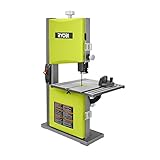
For most small woodshops, a 10-inch woodworking band saw is the sensible starting point. These machines are compact, usually fit on a stand or bench, and handle curves, small resawing jobs, tenons, and rough stock without requiring a permanent production area. They are also less expensive to equip with several blade widths.
The trade-off is limited resaw capacity. Many 10-inch saws provide around 4 to 5 inches of cutting height. That is enough for common 4/4 and 5/4 lumber, but not for regularly resawing thick boards. Their smaller tables can also make wide panels feel unstable unless you add an auxiliary support.
A compact 14-inch floor saw is the better choice when resawing is a regular part of your work. Look for a model with a solid cast-iron table, a rigid frame, and a properly adjustable upper guide assembly. A 14-inch woodworking band saw typically offers 6 inches or more of capacity and tracks a wide blade better than a small benchtop machine.
The downside is space and cost. A 14-inch saw may require a footprint around 24 by 30 inches before accounting for working clearance. It can also need a dedicated circuit depending on the motor and local electrical setup. If you only resaw one or two boards a year, the cheaper 10-inch saw is usually fine.
Benchtop band saws are attractive when every square foot matters. They can sit on a cabinet or folding stand and be stored when not in use. Choose one only if you accept its limits: smaller tables, lower resaw height, more vibration, and less convenient blade changes. A lightweight saw can work well for model parts and curves but become frustrating when pushed through dense hardwood.
Blade and Guide Quality
The included blade is often a starter blade, not a reason to reject the machine. A 1/4-inch blade with roughly 6 teeth per inch is useful for curves and general cutting. For straight cuts, use a 1/2-inch blade with about 3 teeth per inch. For clean curves, a 1/8-inch or 3/16-inch blade works better, provided the saw can tension it correctly.
Set the guides close to the stock—about 1/16 inch above the work—and keep the thrust bearings just behind the blade. Guides that are difficult to adjust encourage poor setup, which causes wandering cuts, burned edges, and premature blade wear. Ceramic guides are not essential for occasional use; good adjustment and a sharp blade matter more.
A common failure mode is buying a high-capacity saw and using a dull, overly narrow blade for resawing. The blade heats up, drifts away from the fence, and may eventually snap. Another is overtensioning a small saw in an attempt to force a wide blade to track. That can bend the frame or damage the tension mechanism.
Features Worth Paying For
Prioritize a rigid fence, a quick-release blade tension lever, a 4-inch dust port, and tool-free or low-tool guide adjustments. A decent light is useful, but it should not outweigh a better table or stronger frame. A built-in wheel brush and a lower wheel dust pickup reduce cleanup, though neither replaces a real collector.
Variable speed is useful only if you cut materials that benefit from it or plan to use the saw for more than ordinary woodworking. For wood-only work, a reliable single-speed machine is often cheaper and simpler. Spend the savings on quality blades, a mobile base, and a square auxiliary fence.
Buying Recommendations by Shop Size
Choose a 10-inch benchtop or compact floor saw for a shop under roughly 150 square feet, especially when curves and small joinery parts are the main jobs. A compact woodworking band saw is also the economical choice for beginners who are still learning blade selection and setup.
Choose a 14-inch floor model if you routinely resaw 6-inch stock, cut thick hardwood, or need a larger table for furniture work. Before buying, verify that replacement blades are readily available and that the saw can be moved through your doors and stairways. For many small shops, the best setup is a compact 10-inch saw on a locking mobile base rather than a larger machine that permanently blocks the main aisle.