Best Table Saws for Cutting Thick Slabs and Heavy Timber
What's inside
As an Amazon Associate I earn from qualifying purchases. This post may contain affiliate links at no extra cost to you.
Thick slabs and heavy timber expose the limits of a table saw quickly. The key figures are cutting depth, rip capacity, fence stability, and how well the machine handles a long, heavy workpiece without shifting. A larger saw is not automatically safer or more accurate: the stock still needs support, and the blade must be suited to the cut.
Contents
What the saw must do
Most 10-inch table saws cut about 3⅛ inches deep at 90 degrees and roughly 2¼ inches at 45 degrees. That is enough for many furniture parts, but not for a 4-inch-thick slab. A 12-inch saw typically offers more depth—often around 4 inches at 90 degrees—but check the manufacturer’s actual capacity. Blade diameter alone does not tell you the usable cut depth.
Rip capacity is a separate issue. A fence that reaches 30 or 50 inches from the blade helps with wide panels, but it does not make a saw suitable for resawing thick stock. For that job, the saw needs enough depth, a straight fence, and a safe method for controlling the stock. A band saw is often the better machine for deep resawing.
Compare saw types
| Saw type | Typical strengths | Limits for heavy stock | Best fit |
|---|---|---|---|
| Contractor or jobsite saw | Lower cost, portable, usually 10-inch blade | Limited depth; lighter table and stand can move under large stock | Occasional cuts in manageable boards, with outfeed support |
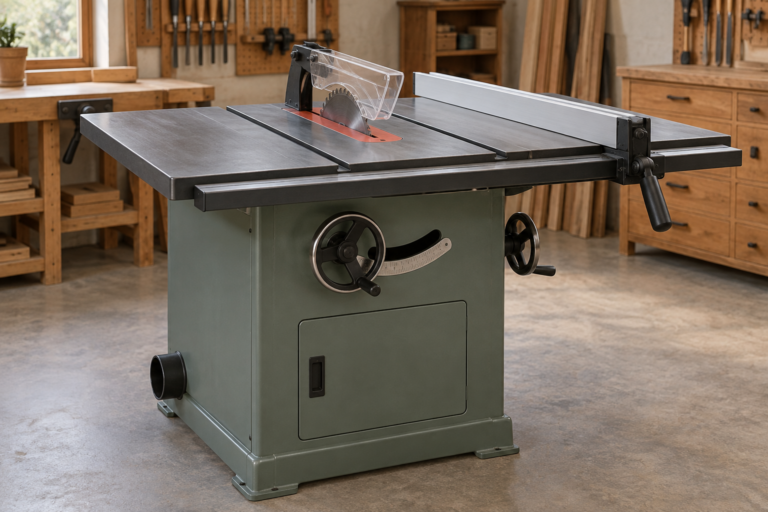
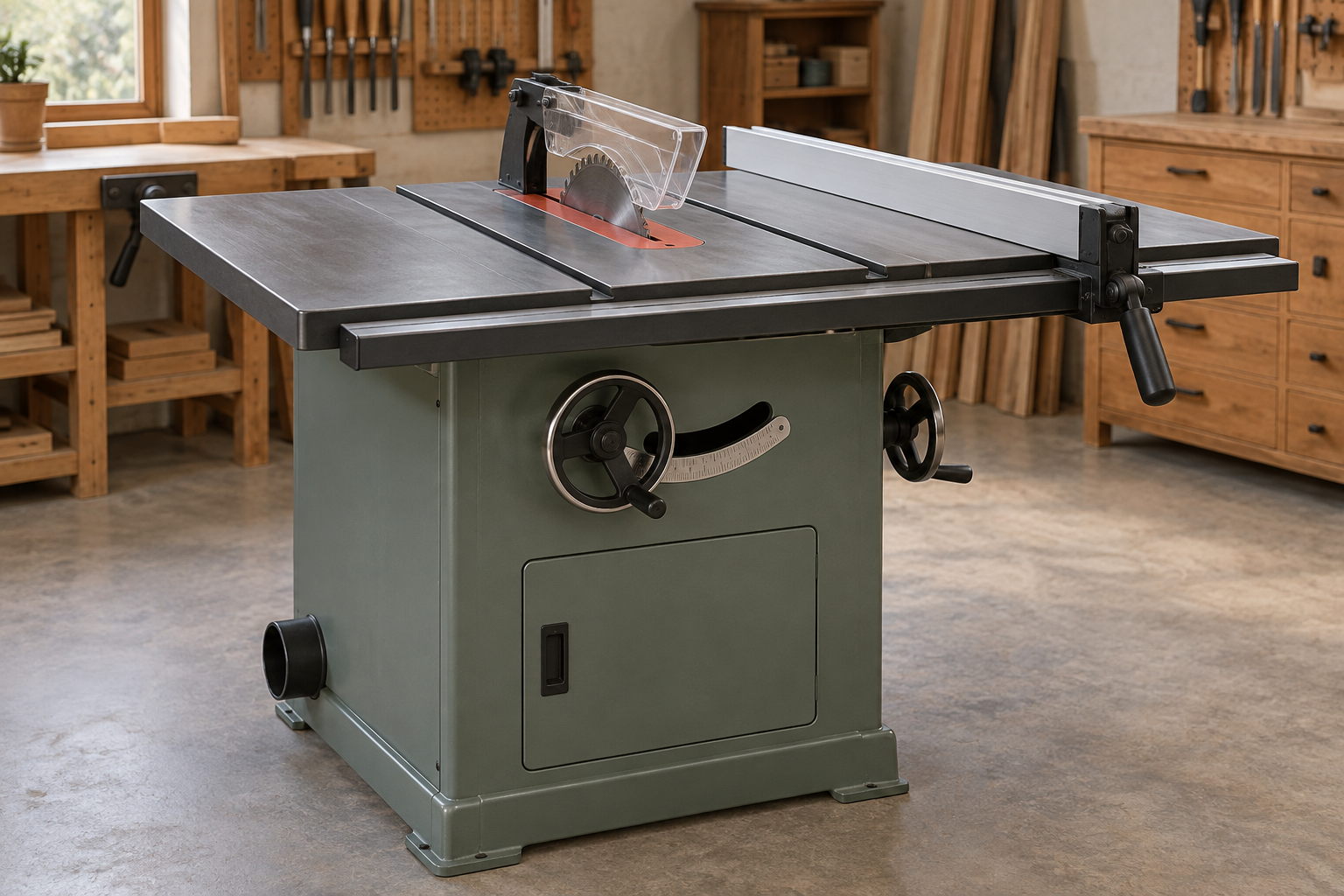
| Cabinet saw | Rigid cast-iron top, stable fence, strong motor | Usually still a 10-inch blade; does not solve cuts deeper than its capacity | Frequent accurate ripping and crosscutting in a fixed shop |
| 12-inch industrial or large-format saw | Greater cutting depth and often substantial power | High cost, space and power demands; heavy parts need careful handling | Repeated cuts near or above 3 inches thick |
For a small shop cutting ordinary 8/4 lumber—about 2 inches rough—an accurately set 10-inch cabinet saw is generally enough. Paying for a 12-inch machine makes sense when your work repeatedly exceeds the 10-inch saw’s safe capacity, not just because the stock looks substantial.
Choose for depth, rigidity and power
If thick stock is occasional, compare a well-built 10-inch cabinet saw with a large-format saw before spending more. Search 10-inch cabinet table saws for a fixed-shop option. These saws commonly use a 3 hp motor; that is typically a 240-volt machine, so check your shop circuit before buying. A 1½ or 2 hp saw may cut more slowly and require lighter passes, but can be fine for shorter stock and modest workloads.
For stock thicker than roughly 3 inches, look at 12-inch industrial table saws and verify the cut depth, arbor, voltage, and blade availability in the specifications. Do not assume every shop can power one: larger saws may need a dedicated 240-volt circuit and can draw substantial current. A heavier saw’s mass helps it stay put, but it does not support a long slab once it extends beyond the table.
Check the fence for repeatable locking at both ends, a straight rail, and enough clearance for the rip width you use. A fence that skews under pressure can pinch the blade or taper a cut. For slabs wider than the table, use a stable outfeed and side-support setup that cannot tip, and have another person help manage the load. A roller stand that can swivel or wander is not a substitute for a level, secured support.
Match the blade and cut plan
A general-purpose 10-inch blade with 40 to 50 teeth is a reasonable starting point for mixed work. Thick hardwood can bog a fine-tooth blade, especially if the feed is too fast or the blade is dull. A sharp ripping blade with fewer teeth—often 24 to 30 on a 10-inch blade—clears chips more readily and can reduce motor strain. For a 12-inch saw, buy a blade made for that diameter and confirm the arbor-hole size and maximum rated speed.
Do not force the feed to maintain a fast pace. A slowing motor, burning, or a cut that closes on the blade are warning signs to stop and reassess. Burns can come from a dull blade, misalignment, or slow rubbing; smoke and repeated motor overload are reasons to stop immediately. Verify that the blade is parallel to the miter slot and that the fence is aligned as specified by the manual. Keep the guard and riving knife installed whenever the cut allows.
Safer ways to handle thick stock
Before buying a larger saw, decide whether the job truly needs one. If the part is only slightly beyond capacity, cutting from both faces may work only when the stock can be held flat and aligned accurately for the second pass. It is not a sound workaround for a heavy, irregular slab that rocks or cannot be controlled. Never remove the guard or riving knife simply to gain clearance.
For rough slabs and deep resawing, a large resaw band saw is often a better purchase. Its blade can cut deeper stock in one pass, with less material lost to kerf, though it may leave a surface that needs planing. A planer can flatten faces after resawing, but it cannot correct a cut that wandered badly. For a one-off oversized cut, having a lumber mill or woodworking shop do the work may cost less than buying and wiring a larger saw.
Buying checklist
Measure the thickest stock you actually expect to cut, including rough material that may be thicker than its finished dimension. Compare that measurement with the saw’s published 90-degree capacity, then leave room for safe handling rather than buying right at the limit. Confirm voltage, circuit requirements, floor space, fence capacity, blade availability, and the cost of suitable outfeed support. For repeated heavy cuts, favor a rigid saw that stays aligned and has a dependable fence; for occasional 2-inch lumber, a quality 10-inch saw is usually the more sensible buy.