Best Stationary Table Saws for a Shared Garage and Woodshop
What's inside
As an Amazon Associate I earn from qualifying purchases. This post may contain affiliate links at no extra cost to you.
Contents
Choosing a saw for a shared space
A stationary table saw can make repeat cuts easier and more accurate than a jobsite saw, but it takes up floor space even when it is off. In a shared garage, the right choice depends less on maximum capacity than on whether you can keep the saw level, feed long stock safely, and still park a car or use the space for other work.
Measure the saw’s footprint, then mark out room for the infeed and outfeed paths. A 6-foot board needs roughly 6 feet of clear space on each side of the blade for a comfortable straight cut. Folding or mobile support stands can reduce the amount of space needed when the saw is stored, but they do not replace a stable, unobstructed cutting path. Also check doorway width, ceiling height, and the saw’s weight before buying; some cabinet saws are difficult to move without dedicated equipment.
As an Amazon Associate we earn from qualifying purchases at no extra cost to you.

The main stationary saw types
| Type | Typical fit | Advantages | Trade-offs |
|---|---|---|---|
| Contractor-style | Garage shop with room to move it | Good capacity and sturdier tables than most portable saws | Heavy; may need a mobile base; open stand can collect dust |
| Hybrid | Dedicated small or medium shop | Enclosed cabinet and solid work surface without the bulk of many cabinet saws | Still heavy and not easy to tuck away |
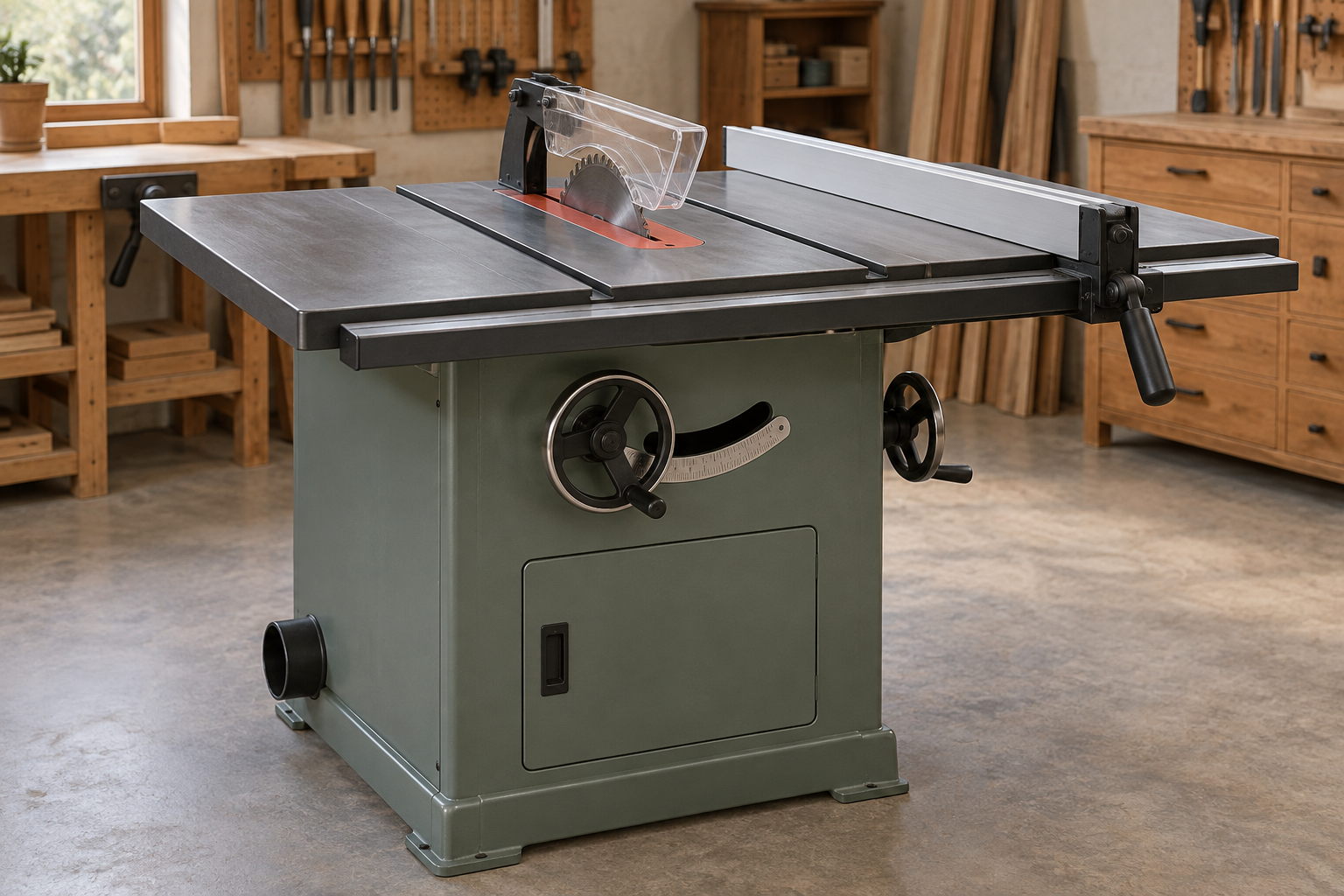
| Cabinet | Permanent shop with frequent, demanding work | Mass, power, and dust collection suited to regular use | High cost, weight, and space requirements |
| Benchtop or jobsite | Garage that must stay flexible | Portable, usually less expensive, easy to store | Smaller table and less mass; often needs added support for wide panels |
For occasional shelving, trim, or small furniture parts, a good portable saw may be enough. A stationary saw earns its footprint when you make repeated cuts, work with sheet goods, or want a heavier platform that stays put. Compare contractor table saws with hybrid table saws by capacity, fence, and service support, not by appearance alone.
What to check before buying
Power and wiring: Many saws in this class run on 120-volt household power; larger machines may need a 240-volt circuit. Read the manufacturer’s electrical requirements and check the circuit before purchase. A long extension cord or shared circuit can cause voltage drop and nuisance trips. Do not solve that by fitting a larger breaker: have an electrician assess the wiring if the circuit is not suitable.
Rip capacity: This is the maximum width the fence allows between it and the blade. Around 30 inches is useful for many furniture and cabinet jobs; wider capacity helps when ripping a sheet lengthwise, but the extra table and rail length need room. A large number on the spec sheet does not make a full sheet easy to handle alone. Use a helper or a properly supported outfeed arrangement, and never let a panel lever against the fence.
Fence and alignment: The fence should lock consistently and stay parallel to the blade. A fence that shifts at the far end can produce tapered cuts or bind the workpiece. Check whether the table and extension wings are flat and whether the blade can be aligned to the miter slot. Allow time for setup: even a well-built saw may need alignment after delivery or moving.
Blade and safety equipment: Confirm that the saw includes a riving knife, blade guard, and anti-kickback pawls, and that these parts can be used with your common cuts. A thin-kerf blade can reduce load on a modest motor, but it must match the riving knife’s thickness. Plan for a sharp general-purpose blade and a separate ripping or crosscut blade if your work calls for them. Keep the guard on whenever the cut allows it.
Dust collection and mobility
Table saws spread fine dust around a garage, especially when the cabinet leaks or the blade throws chips above the table. A lower dust port connected to a suitable collector helps, but it will not capture everything; an overhead guard with its own pickup improves collection on some setups. Check the port size and cabinet layout before buying. If you already own a shop vacuum, it may handle occasional use, but a collector is generally a better match for sustained fine-dust work.
A mobile base can make a stationary saw practical in a shared garage, but it adds cost and raises a stability question. Choose one rated for the saw’s weight and footprint, and lower it fully onto its feet before cutting. If the floor is uneven, test that all feet contact the floor and the saw does not rock. Moving a heavy saw over cracks or a threshold can also shift alignment, so recheck the blade and fence afterward.
Match the saw to the work
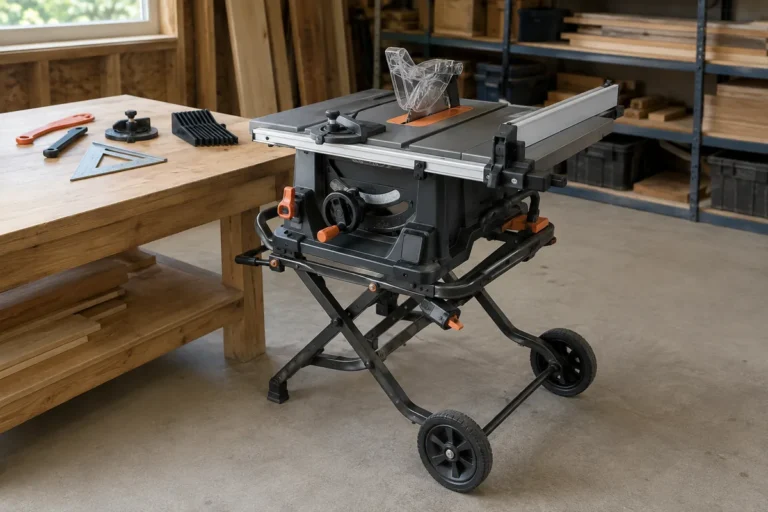
For a shared garage used a few times a month, prioritize a compact footprint, a reliable fence, and a stand or base that makes storage predictable. A portable table saw with a folding stand is a reasonable lower-cost choice when you can bring it out for each session and support long stock. You give up table area and some mass, but those compromises can be worth it if a permanent machine would block other uses.
For regular furniture or cabinet work, look for a stationary saw with a fence that locks firmly, enough rip capacity for your usual material, and a realistic dust-collection plan. A cabinet table saw makes sense when the shop has dedicated space, appropriate wiring, and a collector. It is not automatically the best buy for a home garage: a smaller hybrid or contractor-style saw can handle many of the same cuts at lower cost and with fewer installation demands.
Before ordering, verify delivery requirements, warranty coverage, and availability of replacement parts such as belts, throat plates, and guards. Then reserve room for safe handling, not just the machine. A saw that fits on paper but leaves no space to control a board is the wrong saw for that garage.