Best Table Saws for Making Accurate Mitered Cabinet Frames
What's inside
As an Amazon Associate I earn from qualifying purchases. This post may contain affiliate links at no extra cost to you.
Accurate cabinet-frame miters depend less on a saw’s advertised rip capacity than on how well its arbor, fence, blade and work support hold settings under load. For most shops, a well-tuned contractor or cabinet saw is the practical choice. A jobsite saw can make good miters too, but its lighter stand and shorter support make long, narrow frame parts harder to control.
Contents
What mitered frames demand from a saw
Frame miters are unforgiving: a small angle error shows up as a gap at the corner. A 45-degree cut that is off by just 0.1 degree can leave roughly a 1/32-inch gap across a 2-inch-wide frame face. Wider stock makes the error more visible. The saw’s bevel scale is only a starting point; verify the actual blade angle with a reliable square or digital angle gauge, then test on scrap of the same thickness.
For repeatable work, look for a stable table, a fence that locks parallel to the blade, a miter gauge with minimal play, and enough outfeed support for your longest parts. A sharp, flat-blade crosscut blade with about 60 to 80 teeth usually gives cleaner edges than the general-purpose blade supplied with many saws. Check the blade’s stated kerf and match the riving knife to it.
Saw types compared
| Saw type | Best fit | Main trade-off |
|---|---|---|
| Jobsite saw | Occasional frames, limited space, portable use | More vibration and less table support; fence and miter gauge may need upgrading |
| Contractor saw | Regular cabinet work in a modest shop | Heavier and costlier than a jobsite saw, but still needs dust collection and adequate support |
| Cabinet saw | Frequent production work and demanding stock | High purchase, space and electrical costs; excessive for occasional small frames |
A contractor saw is often the sensible middle ground: heavier construction helps resist movement, while its price and footprint are more manageable than a full cabinet saw. If you already own a jobsite saw, test its fence and gauge before replacing it. Spend first on calibration, a quality blade and support; upgrade the saw only if it cannot hold those settings or safely support your parts.
Buying priorities for cabinet frames
Start with fence behavior. Lock it at several positions and measure from the fence to the blade at the front and rear of the table. The fence should remain parallel, or be set to toe out very slightly at the rear if the manufacturer permits it; a fence that toes in can pinch stock against the blade and cause kickback. Do not compensate for a poor fence by pushing harder.
Next, check the miter slots and gauge. A loose bar can let the work rotate during a cut; an oversized or rough slot can make a gauge bind. A gauge with adjustable expansion or a well-fitted aftermarket bar is useful, but it is not a substitute for a stable sled or consistent technique. For repeated frame parts, a crosscut sled with a verified 45-degree fence is usually more reliable than a basic gauge. Keep hands out of the blade path and use a hold-down or clamp where practical.
Consider power and dust extraction in context. A 120-volt saw is convenient, but thick hardwood or a dull blade can slow it and encourage burning. A 240-volt cabinet saw is better suited to sustained cutting, though it may require a dedicated circuit and electrician. For thin frame stock, a good blade and a steady feed matter more than raw horsepower. Dust collection improves visibility and keeps the cabinet and shop cleaner, but even a cabinet saw’s built-in port may not capture all fine dust.
Shortlist by shop and budget
For a small shop or occasional projects, compare portable jobsite table saws with stands. Choose one with a fence that locks securely and a stand that does not rock. Add roller or folding outfeed support for long rails and stiles. The low-cost choice is fine if the saw cuts square, the table is stable and your parts are short; it is a poor bargain if you spend hours correcting drift.
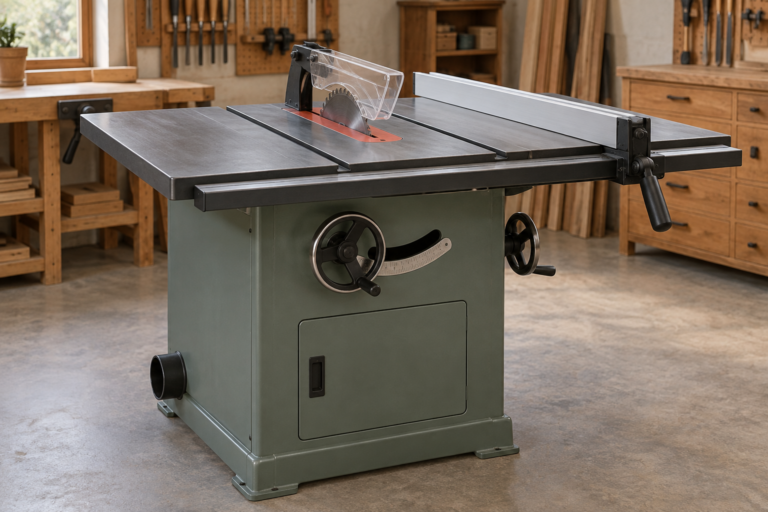
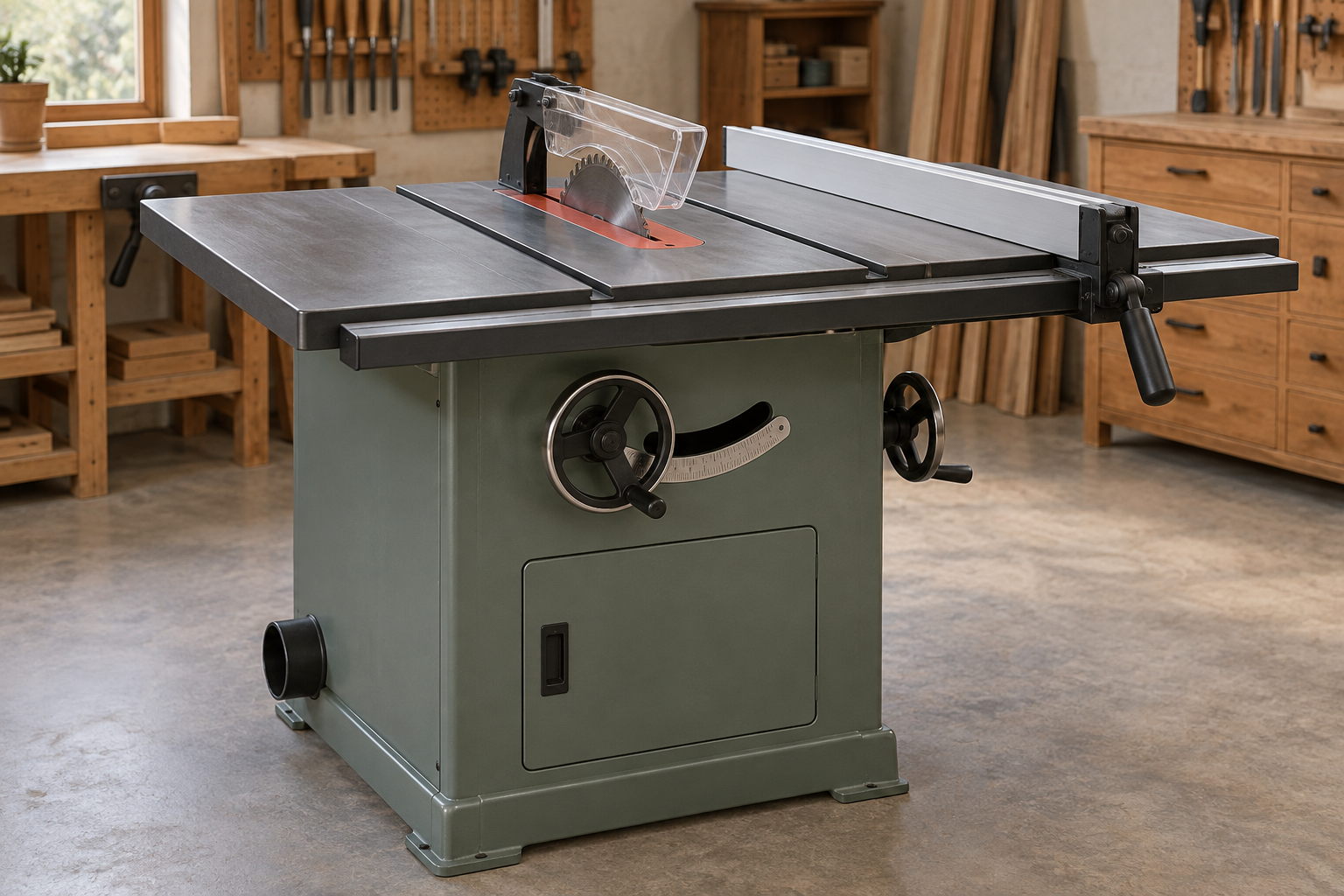
For frequent frame work, look at contractor table saws with cast-iron tables. Their mass and larger work surface make setup less fussy, but check whether the fence, miter gauge and dust port meet your needs before paying for extras. For a dedicated production shop, a cabinet table saw can make sense when it will run regularly and the shop has suitable power and dust collection. Do not buy one solely for a larger horsepower number.
A repeatable way to cut accurate miters
Before cutting project parts, unplug the saw and check blade alignment to the miter slot; follow the manual’s adjustment procedure. Install the intended blade, verify that it is clean and undamaged, then set the bevel against a gauge rather than trusting the scale. Make two test cuts in scrap and bring the pieces together. If the joint opens at the outside corner, adjust the angle in small increments and retest. Change one setting at a time.
Use a stop block for repeated lengths, but position it so the offcut cannot get trapped between the blade and fence. A crosscut sled is preferable for narrow pieces because it supports the work on both sides of the cut and keeps hands farther from the blade. Support long stock level with the table; a sagging end can steer a cut or lift the work. Feed smoothly without forcing the blade. Burn marks, chatter or a wandering edge are reasons to stop and check blade sharpness, alignment, support and feed—not to push harder.
Finally, dry-fit a complete frame before glue-up. Small errors can accumulate when several pieces are cut to nominal dimensions. If the corners close cleanly and the diagonals match, the setup is working. If they do not, correct the saw or sled before making the remaining parts.