Best Budget Compound Miter Saw
Key takeaways
- A criteria-led look at what separates a usable budget compound miter saw from a frustrating one: fence flatness, detent repeatability, blade deflection, dust ports, and vibration.
What's inside
As an Amazon Associate I earn from qualifying purchases. This post may contain affiliate links at no extra cost to you.
A cheap compound miter saw fails in predictable ways. The fence is not flat, the table casting twists, the blade deflects at the end of a cut, and the 45-degree detent lands near 45 rather than on it. None of that shows up on a spec sheet, which is why picking the best budget compound miter saw depends less on amps and advertised capacity than on a few mechanical details that decide whether your miters close.
Our approach is criteria-led rather than model-led. Saws in this bracket vary more from unit to unit than from brand to brand, so a verdict on one numbered machine tells you less than a checklist you can run in the aisle or in the driveway an hour after the box lands. Start with the class of saw your work demands. The capacities below are typical for each category, not promises about any one model.
As an Amazon Associate we earn from qualifying purchases at no extra cost to you. Product prices and availability are accurate as of the date shown and are subject to change.


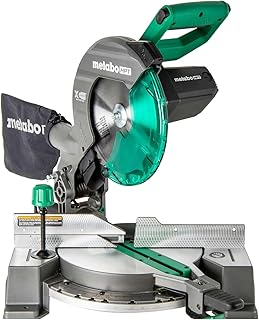


| Saw class | Typical crosscut at 90 degrees | Where budget versions cut corners |
|---|---|---|
| 10-inch compound, non-sliding | About 5-1/2 to 6 in. | Short fences, light castings |
| 10-inch sliding compound | Roughly 11 to 12 in. | Rail play, blade deflection |
| 12-inch compound, non-sliding | About 7-1/2 to 8 in. | Wobble from thin blade plates |
| 12-inch sliding compound | Roughly 12 in. and up | Weight, fence squareness, price creep |
What counts as the best budget compound miter saw
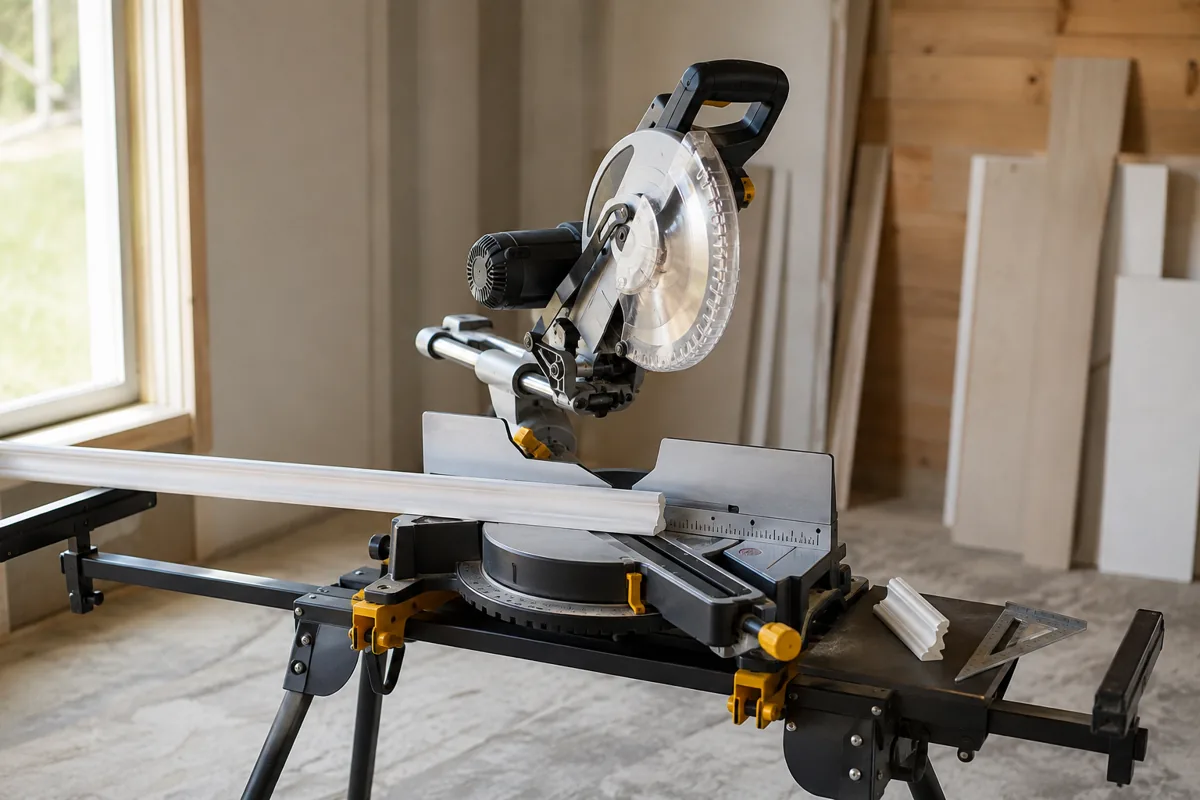
Budget here means the bracket under roughly three hundred dollars: single-bevel saws from the mainstream brands, big-box house brands, and a long tail of imports sold under names you will not recognize. Spend above that and you start paying for dual bevel, better detent plates, and dust shrouds that do something. Spend below it and you are usually buying a stamped fence and a motor with more marketing than torque.
Two conclusions follow. Single bevel is the sensible default at this money, since flipping a board is a minor nuisance next to what a dual-bevel head costs down here. And corded is still the value play. The cordless saws in the DeWalt XR, Milwaukee FUEL, and Makita LXT lines are genuinely good, but a bare tool often costs what a complete corded saw does, and a kit with batteries leaves the budget bracket entirely.
The mechanical criteria we judge on
Fence height, flatness, and adjustability
The fence is the most important surface on the saw and the first thing manufacturers cheapen. We want enough height to back up baseboard standing on edge, and two fence faces sitting in one plane. Lay a straightedge across both halves. If one side is proud, every miter will show a hinge at the joint. Machined aluminum fences bolted through slotted holes are worth hunting for, because slots let you square the fence to the blade. Riveted fences leave you with whatever the factory decided.
Base and table flatness
Run a straightedge across the table and out onto the extension wings. A slight dish at the center is common and mostly harmless. A twist is not, because it tips the stock and turns a square crosscut into an unintended compound one. Heavier castings tend to be flatter and they damp vibration, so we prefer weight in a saw that lives on a bench and only trade it away when the saw travels.
Blade, arbor, and deflection
Most saws down here ship with a thin 24- to 40-tooth blade that tears end grain and wanders in hardwood. Treat a good 60- to 80-tooth crosscut blade as part of the purchase price. Remember too that a 12-inch blade is always thinner relative to its diameter than a 10-inch blade of the same quality, so it flexes more. If accuracy matters more than capacity, buy the 10-inch saw.
Detents, bevel stops, and guard action
Positive stops should feel crisp and repeatable. Knock the head off a detent and back onto it several times, then check it against a machinist’s square. A miter scale with no fine-adjust or override lever becomes a long-term annoyance. On the bevel axis, confirm the stop screws are reachable and that the head locks without creeping. Then work the guard by hand a dozen times: a guard that snags is a guard you will eventually defeat.
Dust port and vibration
No miter saw collects dust well, and budget saws are the worst of a bad lot. We look for a port that accepts a standard shop vacuum hose without an adapter you have to fabricate, plus a shroud behind the blade that aims the stream at that port. For vibration, listen at spin-up and coast-down. A saw that shakes its stand blurs cut lines and shortens bearing life.
Best all-round value: 10-inch sliding compound miter saws
For most home shops this is the sweet spot: enough width for a 1×12 shelf, a stiffer blade than a 12-inch saw, and a machine one person can lift. Check the rails for side-to-side play before you commit to keeping it.
Sliding or fixed: capacity against rigidity
A slide buys crosscut width and adds joints where accuracy leaks out. Rails that rock even slightly let the blade wander mid-cut, and inexpensive linear bearings are the usual culprit. The check takes ten seconds: unplug the saw, pull the head fully forward, grip it, and try to push it sideways. Smooth travel is good, lateral slop is not.
If the work is trim, picture frames, and framing stock up to a 2×6, a non-sliding saw holds a tighter angle for less money and needs less bench depth behind it. If you break down shelving, treads, or wide panels, the slide earns its place, and we would take a 10-inch slider over a 12-inch fixed saw most days.
- ✔ Accurate enough for trim, cabinets, and framing once tuned
- ✔ Light enough for one person to move and store
- ✔ A better blade delivers most of the available gain for little money
- ✘ Stamped fences and light castings need checking with a square
- ✘ Dust collection is poor without a shop vacuum attached
- ✘ Detents, rails, and bevel stops drift and need periodic resetting
Setup and the upgrades worth paying for
Assume every saw in this bracket arrives out of adjustment. Half an hour with an accurate square and the manual’s adjustment pages separates a frustrating tool from a useful one. Square the blade to the table, square the fence to the blade, set the 45-degree stops, then cut a test miter in scrap and check the mating pair against a corner you trust.
After that, spend in this order: a quality crosscut blade, support at table height on both sides of the blade, and a shop vacuum on the dust port. Stock extension wings are too short to hold long trim, and unsupported stock lifts off the table at the end of a cut, which is where most bad miters are born.
Best for trim and tight shops: 10-inch compound miter saws
No slide means fewer places for accuracy to escape, a lighter saw, and a shallower footprint against a wall. Look for a tall two-piece fence and slotted mounting holes.
Budget miter saw FAQ
Is a 10-inch or 12-inch saw the better budget buy? Ten inches, unless you regularly cut wide boards or thick posts. Smaller blades are stiffer for the money, cheaper to replace, and easier to keep sharp, and the saws are lighter to carry.
Do I need a sliding saw to cut baseboard? No. Baseboard is cut standing against the fence, so fence height matters far more than crosscut width. A slide only becomes necessary for flat stock wider than about six inches.
Can a budget saw cut hardwood cleanly? Yes, with a fine-tooth crosscut blade, a slower feed, and firm hold-down pressure. What these saws struggle with is repeating one angle across dozens of cuts, which comes back to detents and fence rigidity.
Verdict
Rank your candidates in this order: fence quality and adjustability, table and casting flatness, detent repeatability, guard action, then dust port fit. Motor amps and capacity claims come last, because nearly every saw in this bracket has enough of both for shop work. A corded 10-inch single-bevel saw with a machined, adjustable fence and a fresh crosscut blade will out-cut a heavier 12-inch machine with a riveted fence every time.
Unbox whatever you buy expecting to tune it, budget for a good blade, and be willing to return a unit whose fence or table is out of true. Returns are the quality control step the factory skipped.
Best cordless value: 7-1/4 inch cordless miter saws
Worth it mainly if you already own batteries in a platform like DeWalt XR, Milwaukee FUEL, or Makita LXT. Capacity is limited, but it handles trim and 2x material where there is no outlet.