Table Saw Extension Table vs Mobile Base for Workshop Layout
What's inside
As an Amazon Associate I earn from qualifying purchases. This post may contain affiliate links at no extra cost to you.
Contents
Extension Table or Mobile Base: What Changes Your Workshop Layout?
A table saw extension table and a mobile base solve different problems. An extension table increases support and often improves outfeed handling, but it makes the saw’s footprint larger and usually leaves the machine in one place. A mobile base adds wheels underneath the saw so you can move it, but it does not automatically give long boards better support or make a compact shop safer.
The right choice depends on what causes trouble in your shop. If sheet goods tip, narrow stock falls off the side, or you lack room for an outfeed surface, start with an extension table. If the saw blocks the jointer, bandsaw, or main walkway, start with a mobile base. Many shops eventually use both, but buying both at once is not always necessary.
As an Amazon Associate we earn from qualifying purchases at no extra cost to you.



What an Extension Table Adds
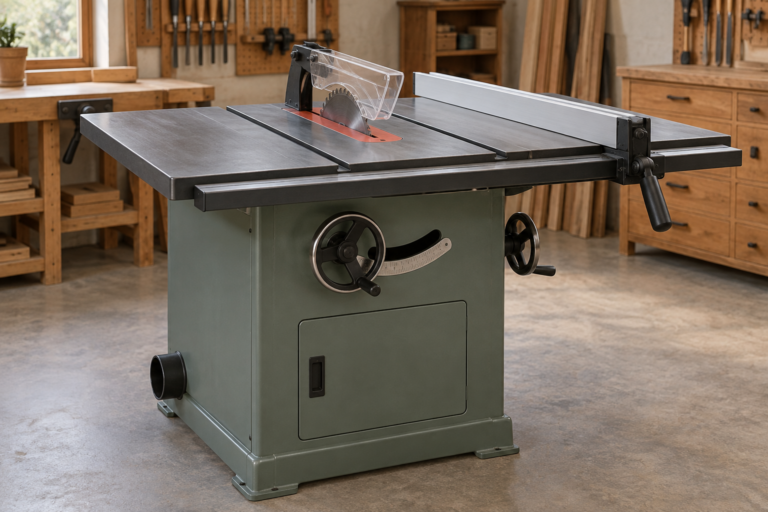
A side or rear extension table increases the saw’s usable support area. A 24-inch-wide side extension, for example, can make ripping a 4-by-8-foot plywood panel much less awkward. The panel still needs additional support at the front and rear, but the extra surface reduces the chance that the panel drops, twists, or pushes the fence out of alignment.
A rear extension is especially useful for crosscut sleds and long workpieces. A sturdy outfeed table can support boards after they pass the blade, reducing the downward force that makes a cut bind. For many table saws, an outfeed surface 24 to 36 inches deep is a practical target. It should be level with the saw table, or no more than about 1/32 inch lower. Higher is dangerous because the workpiece can catch as it leaves the blade.
The failure mode is poor construction. A flimsy extension table flexes under a sheet of plywood, and a table that is even 1/16 inch high can lift the workpiece into the blade. An extension attached only to thin factory rails may also pull the saw out of alignment. Use a rigid frame, confirm that the saw remains square, and check that the fence locks parallel to the blade after installation.
For a fixed machine, a table saw extension table and rail kit is usually the cleanest route. A homemade plywood table can work just as well if it is supported properly. Use at least 3/4-inch plywood, add a stiff apron or torsion-box structure underneath, and leave access to the blade-height and bevel controls.
What a Mobile Base Adds
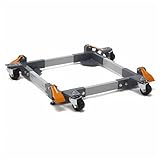
A mobile base lets you move a stationary machine away from a wall, rotate it for a better feed direction, or clear space for another operation. This matters in a small shop where a table saw, planer, jointer, and bandsaw compete for the same floor area. Moving the saw only 24 inches can be enough to align a long board with the garage door or avoid hitting a workbench.
Look for a base rated comfortably above the machine’s actual weight. If the saw weighs 300 pounds, a 400-pound rating is a bare minimum; 600 pounds gives more margin for an extension table, dust hose, and stored accessories. Locking casters must prevent both rolling and swiveling. A base that stops rolling but allows the saw to pivot can shift the fence relative to the cut line.
Wheel size affects how usable the base is. Casters around 2 1/2 to 3 inches in diameter handle minor floor joints and sawdust better than small furniture casters. They still will not make a heavy saw easy to move over thresholds. Before buying a universal table saw mobile base, measure the machine’s feet and check the adjustment range. Some bases fit only square or rectangular leg layouts, while others need adapters.
The main mobile-base failure is movement during a cut. If one foot does not contact the floor, the saw can rock when a board is pushed through. That movement can change the cut angle, pinch the blade, or pull the workpiece toward the fence. Set the base on the actual shop floor, remove dust from the leveling pads, and test it by pushing firmly against the fence before cutting expensive stock.
Direct Comparison
| Factor | Extension table | Mobile base |
|---|---|---|
| Primary benefit | More workpiece support and outfeed capacity | More flexible machine placement |
| Best for | Sheet goods, long boards, sleds, repeated ripping | Small shops and machines that block walkways |
| Space used | Increases the permanent footprint | Usually keeps the same footprint, but needs travel clearance |
| Main risk | Uneven surface or rail deflection | Rocking, drifting, or difficult leveling |
| Typical installation | Rails, brackets, tabletop, and alignment | Frame adjustment, casters, and leveling pads |
| Cheapest workable solution | Rigid plywood support on a fixed frame | Basic locking base matched to the machine |
Choosing for Your Layout
Measure the floor, not just the machine. Mark the saw’s footprint with tape, then add the longest board you normally handle. You need a clear feed path in front of the blade and an exit path behind it. For a 96-inch board, that path may require 12 to 16 feet of unobstructed length. An extension table does not solve a blocked feed path; it only improves support once the stock is already moving through the saw.
If your saw stays against a wall and you regularly cut plywood or long solid stock, choose an extension table first. A 24-inch side table plus a 30-inch outfeed table can be more useful than wheels. Keep the outfeed table removable or hinged if the added depth prevents access to another machine.
If the saw is used in the middle of a shared garage, a mobile base is usually the better first purchase. Move the saw into position before cutting, lower the leveling feet fully, and route the dust hose and power cord so neither can catch a caster. If you move the saw frequently, a heavy-duty machine mobile base with locking casters is worth the extra cost over light-duty shop furniture wheels.
When Both Make Sense
Use both when the saw needs substantial support but cannot permanently occupy the best floor position. Build the extension table as a rigid assembly, then mount the complete saw-and-table unit on a properly rated base. Check total weight before buying: a 250-pound saw, 70-pound extension, and 30 pounds of accessories already require a base rated well above 350 pounds.
With a combined setup, keep the center of gravity low and avoid storing heavy material on the extension. Verify that all leveling pads share the load when the casters are raised. The mobile base should move the assembly for layout changes, not serve as a substitute for stable support during a cut.
For the cheapest safe approach, buy only the part that fixes the actual problem. A solid pair of roller stands may handle occasional long boards, while a basic mobile base may be enough if the saw already has adequate factory tables. Spend more on rigidity and stability than on convenience features; a table saw that stays aligned is more valuable than one that rolls effortlessly but shifts under pressure.