Open-Stand vs Cabinet-Base Table Saw for Mobile Shop Layouts
What's inside
As an Amazon Associate I earn from qualifying purchases. This post may contain affiliate links at no extra cost to you.
“Open-stand” and “cabinet-base” describe the support beneath a table saw, but the difference affects more than appearance. It changes how much floor space the saw occupies, how easily it moves, how well it contains dust, and how much vibration reaches the floor. For a mobile shop, the right choice depends on whether the saw must travel between jobs, move around a crowded garage, or simply shift a few feet for storage.
As an Amazon Associate we earn from qualifying purchases at no extra cost to you.

Contents
What the terms mean
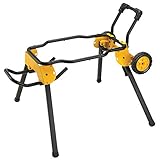
An open-stand saw has a motor and blade assembly mounted on an exposed frame, usually with folding legs or a wheeled stand. Many portable jobsite saws fall into this category. Some are light enough to carry; others are intended to roll rather than be lifted. The open frame leaves the underside accessible, but it can let sawdust scatter beneath the machine.
A cabinet-base saw encloses the blade mechanism and motor in a box-like base. The term is sometimes used loosely: a true cabinet saw is a heavy, full-size machine, while some contractor or hybrid saws have enclosed bases without the same weight or construction. Check the actual saw’s weight, footprint, dust port, and fence—not just the label.
Compare them for a mobile shop
| Factor | Open-stand saw | Cabinet-base saw |
|---|---|---|
| Typical footprint | Compact when folded; working footprint depends on outfeed and side support | Permanent base footprint, often about 2 by 2 feet, plus clearance for stock |
| Moving it | Often folds or rolls; lifting weight can range from manageable to awkward | Usually moved on a mobile base; heavy models may weigh several hundred pounds |
| Dust handling | Open underside can spill chips; a bag or shroud helps but rarely captures everything | Enclosure can improve collection when connected to a suitable dust collector |
| Stability | Varies; a light frame can shift on an uneven floor or under long stock | Mass helps resist movement, though a mobile base must lock securely |
| Best fit | Frequent transport, limited budget, occasional or moderate-duty cutting | Frequent shop use, better dust control, and a layout that can accommodate a substantial machine |
Moving is not the same as mobile
A folding stand is useful if you need to load the saw into a vehicle or clear the floor after work. But “portable” does not mean effortless. A saw weighing 60 pounds can be awkward to carry alone because the frame is bulky and the center of gravity is uneven. For regular movement across a shop, a wheeled stand is usually more practical than carrying handles.
A cabinet saw can also move within a shop if it sits on a properly rated mobile base. The trade-off is that you roll a heavy machine rather than fold it away. Check that the base locks the saw firmly, keeps it level, and does not block the cabinet’s dust port. On a sloped or cracked floor, small casters can make positioning frustrating; a level, smooth route matters.
Before buying either type, mark the saw’s working footprint on the floor. Allow room for the longest boards you expect to cut: a 6-foot board needs space for both infeed and outfeed, not just space around the base. A compact saw can still dominate a small room once its fence rails and support surfaces are included.
Cut quality and stability
The base alone does not determine cut quality. A well-aligned open-stand saw can make accurate cuts, and a cabinet saw can cut poorly if its blade, fence, or table is out of alignment. The useful questions are whether the fence locks parallel to the blade, whether the table stays stable under a workpiece, and whether the saw can maintain its speed through the stock you actually cut.
Light saws are more likely to move when feeding wide or long material, especially if the stand is not level or the floor is uneven. That movement is a safety and accuracy problem, not just an annoyance. Lock the wheels, brace or support the stand as directed by the manufacturer, and use roller stands or a proper outfeed table. Do not lean your body weight on the saw to steady it.
For repeated ripping of thick hardwood, a heavier cabinet-base machine often makes more sense. It generally offers a more substantial work surface and better dust containment, but costs more and takes longer to relocate. If most of your work is sheet goods, trim stock, or occasional cuts in a shared garage, a capable jobsite table saw with a folding stand may be the more sensible purchase.
Dust and power are layout issues
An open stand makes it easy for dust to escape around the blade and motor. A shop vacuum connected to the saw’s port can capture some dust, but fine dust may still escape, and a small vacuum can clog or lose suction when handling larger chips. A cabinet enclosure typically gives dust collection a better chance, though it still needs a suitable collector and sealed connections. Neither base replaces good shop cleanup or appropriate respiratory protection.
Power needs can limit where a saw can go. Many portable saws use a standard household circuit, but a long, undersized extension cord or a circuit shared with other equipment can cause voltage drop and poor performance. Larger cabinet saws may require a dedicated circuit, and some need a different voltage supply. Confirm the saw’s electrical requirements before building the layout around it; moving a heavy saw later is harder than adding a planned outlet.
Which one should you buy?
Choose an open-stand saw if you transport it to jobs, need to fold it away, or want to keep the initial cost and floor commitment down. It is a reasonable choice for a small garage shop, especially when cutting is intermittent and you can provide stable outfeed support. For a more convenient shop setup, compare portable table saws with rolling stands and check the folded dimensions, stand capacity, and how the wheels lock.
Choose a cabinet-base saw when it will stay in the shop most of the time, you make frequent or demanding cuts, and dust collection is a priority. A mobile base can make occasional repositioning possible, but it does not turn a cabinet saw into a jobsite tool. If you are comparing enclosed designs, look at hybrid table saws with enclosed bases as well as full cabinet saws; they may offer a middle ground in weight and price.
Whatever you buy, verify the total working footprint, not just the base dimensions. Plan for blade changes, fence movement, dust hoses, stock support, and a clear path to the controls. A saw that can technically be rolled aside but takes ten minutes to reconnect and level may not get moved when you need the floor space. Conversely, paying for a heavy enclosed machine is hard to justify if your real priority is putting the saw away after each session.

