Best Heat Press Machines
What's inside
As an Amazon Associate I earn from qualifying purchases. This post may contain affiliate links at no extra cost to you.
A heat press is one of those tools where the gap between “adequate” and “excellent” shows up after the tenth shirt, not the first. Buyers on forums and review sites consistently report that cheap presses struggle with even pressure distribution, temperature drift mid-cycle, and clamps that loosen after weeks of use. The right machine holds a stable platen temperature, locks with repeatable force, and gives you enough clearance to work around thick transfers without guessing.
What separates a genuinely useful press from a frustrating one is usually three things: whether the lower platen is fixed or moves out of your way, how precisely you can adjust pressure, and whether the unit offers automatic release at the end of a timed cycle. Below we compared eight current machines across published specifications, listed prices, and verified owner feedback from 2026 to identify which models solve those problems and which ones introduce new ones.
As an Amazon Associate we earn from qualifying purchases at no extra cost to you. Product prices and availability are accurate as of the date shown and are subject to change.


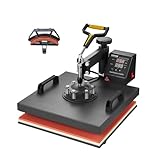


Quick Picks
| Product | Best For | Price |
|---|---|---|
| HTVRONT Auto Heat Press | Hands-off auto-release for beginners | $236 |
| VEVOR 5 in 1 Swing Away | Multi-surface versatility in one unit | $131.91 |
| VEVOR 2 in 1 (T-Shirts & Hats) | Pressing caps alongside flat garments | $116.99 |
| HTVRONT Auto Heat Press 2 | Fine-tuned pressure control at scale | $349.99 |
| Delclynee Slide Out | Pull-out platen safety for large transfers | $174.99 |
| VEVOR 16″ x 24″ Clamshell | Oversized projects on a tight budget | $226.89 |
| HTVRONT Heat Press (Standard) | Reliable 15×15 flat work | $236 |
| PTFE Teflon Sheet (3 Pack) | Protective consumables for any press | $7.89 |
How We Picked
We weighted four criteria: platen size and usability for the stated price, pressure-adjustment granularity (fixed, dial, or digital), auto-release versus manual timing, and the frequency of long-term complaints in verified purchase reviews. A machine that scores well on one criterion but fails on even pressure distribution ranks below one that is merely competent across all four.
The 8 Best Heat Press Machines in 2026
HTVRONT Auto Heat Press Machine for T Shirts
This is the most straightforward entry for someone who wants to stop babysitting a timer. The auto-release mechanism lifts the upper platen at the end of the programmed cycle, eliminating the most common cause of scorch marks on dark transfers. Owners praise the 15×15 inch surface for fitting most adult tee designs and the included heat mat. The trade-off is that pressure settings are not adjustable beyond the initial spring tension, so users working with thick puff vinyl or multiple layers report inconsistent results.
- Pro: Auto-release removes timing errors entirely.
- Pro: Large, clear digital display for temperature and time.
- Con: Fixed spring pressure limits material flexibility.
Skip this one if you regularly press thick or layered substrates that need tuned force.
VEVOR Heat Press Machine 5 in 1
The 5-in-1 concept is appealing on paper: swap between flat, cap, mug, plate, and hoodie platens without buying separate machines. Owners who actually rotate through all five report solid results, though many admit the cap platen is the least precise. The 12×15 inch flat area handles most standard designs. The 360-degree swing-away mechanism clears the lower platen fully, which is a genuine safety and workflow advantage over clamshell designs. The downside is that changing platens adds friction to high-volume flat work.
- Pro: One machine covers shirts, hats, mugs, and plates.
- Pro: Full swing-away access to the lower platen.
- Con: Pivoting between platens slows repeat flat-press workflows.
Skip this if you press flat garments almost exclusively and want a dedicated surface.
VEVOR 2 in 1 Heat Press for T Shirts and Hats
For sellers who add caps to a t-shirt line, this bundles both platens at a price below most single-purpose competitors. The 15×15 flat platen matches the industry standard, and the included hat attachment uses a curved silicone pad that owners describe as functional but not ideal for structured six-panel caps with buckram front panels. The swing-away design gives full clearance when loading shirts. Build quality is adequate for low-to-mid volume but the hinge pin on the hat arm is a recurring stress point in long-term reviews.
- Pro: Hat and flat platens included under $120.
- Pro: Swing-away upper clears the work surface completely.
- Con: Hat arm durability reports are mixed.
Skip this if hat pressing is more than occasional, or if you need a rigid frame for daily use.
HTVRONT Auto Heat Press 2
The upgrade here is adjustable pressure, which solves the primary complaint about the original model. A dial on top lets you increase or decrease clamp force without modifying the spring stack, making it usable for thin polyester film through thick foam transfers. The 15×15 surface, auto-release, and smart temperature regulation carry over. At $349.99 it is the most expensive unit on this list, and the price reflects the pressure-control system and reinforced frame. Owners report noticeably better color consistency on sublimation prints compared to fixed-pressure models.
- Pro: Dial-adjustable pressure for diverse substrates.
- Pro: Auto-release and digital timing both included.
- Con: Highest price point on this list.
Skip this if you only press thin vinyl on cotton and cannot justify the premium over the original.
Delclynee Slide Out Heat Press
The defining feature is the pull-out lower platen, which slides toward you on rails before you even close the upper. This eliminates the awkward “hold the transfer and press” maneuver that causes misalignment on clamshell machines. The 15-inch top over a 12.25-inch slide-out bed means you get clamshell-style heat from above with swing-away-style loading access. Owners specifically call out the reduced wrist strain during long sessions. The slide mechanism introduces a potential wear point over years of use, and the footprint is larger than a standard clamshell.
- Pro: Pull-out platen prevents transfer shift during loading.
- Pro: Reduced physical strain for repetitive pressing.
- Con: Slide rails add footprint and a long-term wear concern.
Skip this if bench space is very tight.
VEVOR 16″ x 24″ Clamshell Heat Press
For buyers who need to cover more than a 15×15 area—think all-over prints, tote bags, or garment panels—this is the most affordable way to get a 16 by 24 platen. The 1700W element heats fast and holds temperature well across the full surface. The clamshell hinge design means the lower platen does not swing away, so loading large transfers requires either a partner or careful positioning. Owners note the base is heavier than smaller units, which helps stability but makes repositioning annoying.
- Pro: Largest platen on this list at a mid-range price.
- Pro: 1700W heating element for fast recovery.
- Con: Clamshell design limits one-person loading of large sheets.
Skip this if your projects fit within 15×15 and you work alone frequently.
HTVRONT Heat Press Machine for Tshirts
Identical in price and footprint to the first HTVRONT model but without the auto-release function, this version suits users who prefer full manual control over the opening. The 15×15 platen, digital controls, and even heating are the same. The absence of auto-release is both a pro and a con: you can end a cycle early if a transfer looks ready, but you must watch the timer or risk scorching. Build consistency reviews are strong for this tier.
- Pro: Manual release gives you end-of-cycle control.
- Pro: Proven 15×15 platform with stable temperature.
- Con: Requires active attention during every press.
Skip this if you multitask during press cycles; the auto-release model above is worth the identical price.
3 Pack PTFE Teflon Sheet for Heat Press Transfer
Not a machine, but the single most common accessory buyers realize they need after their first scorch. These 16 by 20 inch non-stick sheets go between the upper platen and your garment, protecting both from direct heat contact and adhesive residue. At $7.89 for three, they are the cheapest insurance available. Owners report reuse across dozens of presses before visible wear. They do not prevent uneven pressure problems, but they do reduce surface marking and simplify platen cleanup.
- Pro: Covers most platens including the 16×24 unit.
- Pro: Reusable across many cycles at negligible cost.
- Con: No effect on pressure or temperature issues.
Skip this only if your transfers are fully covered by a carrier sheet that never contacts the platen.
Buying Guide
Pressure Type: Fixed Spring vs. Adjustable
Fixed spring pressure is calibrated at the factory and cannot be changed without disassembly. It works well for thin vinyl on single-layer cotton but produces incomplete adhesion on thicker materials or multi-layer designs. Adjustable pressure—whether a simple knob or a digital dial—lets you match force to substrate thickness. If your product line includes puff ink, HTV layers, or sublimation on rigid substrates, adjustable pressure is not optional.
Platen Clearance: Clamshell vs. Swing-Away vs. Slide-Out
Clamshell machines close like a book and are the simplest, but loading a transfer without shifting it requires holding everything in place while closing the upper platen. Swing-away units rotate the entire upper assembly out of the way, giving unrestricted access to the lower platen. Slide-out designs extend the lower platen toward you on rails. For one-person workflows on large or delicate transfers, swing-away and slide-out designs measurably reduce misalignment errors.
Auto-Release and Timing
Manual machines demand that you listen for the timer beep and immediately lift the handle. Distractions cause overcooking, especially on synthetic fabrics. Auto-release units open the platen mechanically at the end of the programmed cycle, which is a meaningful safety and quality feature when you are handling multiple garments in sequence. The technology adds cost but eliminates the single most common beginner error in heat pressing.
Our Verdict
For most buyers entering heat pressing with flat garment work and no existing workflow constraints, the HTVRONT Auto Heat Press Machine for T Shirts at $236 is the strongest overall value because auto-release prevents the highest-frequency failure mode. If budget is the binding constraint and you only need a flat surface, the standard HTVRONT at the same price without auto-release still delivers solid core performance. For multi-product sellers who also need hats and mugs without buying separate units, the VEVOR 5-in-1 at $131.91 wins on versatility alone.
FAQ
Do I really need a Teflon sheet?
Most sublimation and HTV transfers include a carrier sheet that touches the garment, but the upper platen can still contact the carrier and leave marks or residue over time. A PTFE sheet adds a sacrificial barrier that extends platen life and reduces cleanup, and at under ten dollars for three packs it is the easiest upgrade to make.
Is swing-away better than clamshell?
Swing-away designs give you full, unobstructed access to the lower platen, which means you can position transfers precisely without holding anything. Clamshells are simpler mechanically and cheaper at equivalent platen sizes, but loading accuracy suffers. If you press alone and frequently work with large or detailed transfers, swing-away is the better choice.
Can one heat press handle sublimation and HTV?
Yes. Sublimation and heat transfer vinyl both require a flat heated platen at the same approximate temperature range, and any machine with adjustable timing and sufficient pressure will work for both. The primary difference is that sublimation often benefits from slightly higher pressure, so adjustable models are more flexible across both applications.
What platen size should I start with?
For adult t-shirts, a 15×15 inch platen covers the vast majority of designs and is the industry standard. If you plan to press tote bags, garment panels, or full-front wraps, step up to 16×24. Smaller platens limit you to kids’ sizes and pocket-area prints and force expensive upgrades later.