Table Saw with a 30-Inch Fence vs 50-Inch Fence for Cabinet Shops
What's inside
As an Amazon Associate I earn from qualifying purchases. This post may contain affiliate links at no extra cost to you.
Contents
What the fence measurement means
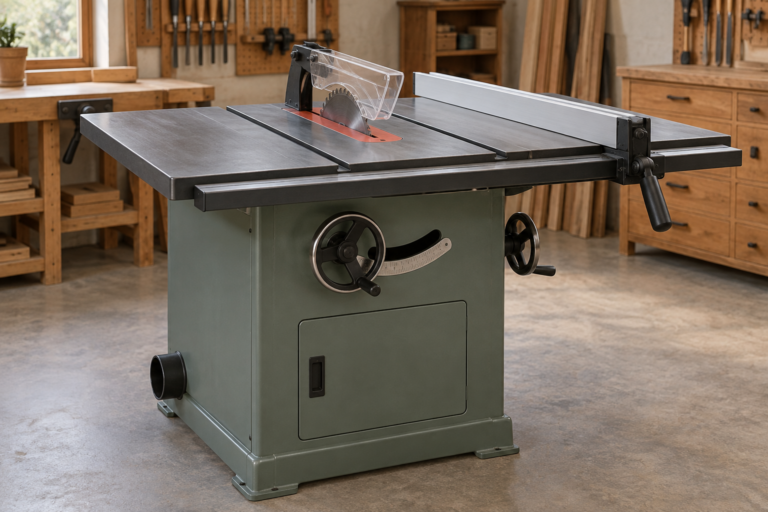
A table saw’s fence capacity is the maximum distance from the blade to the fence, usually measured to the right of the blade. A 30-inch fence can rip a panel roughly 30 inches wide; a 50-inch fence can handle panels roughly 50 inches wide, subject to the saw’s layout and the manufacturer’s stated capacity. It does not mean the saw cuts more accurately, has more power, or can safely support a wide sheet by itself.
For a cabinet shop, the practical question is how often you need to rip full-width plywood or other large panels with the fence set far from the blade. If most work is solid stock, narrow strips, and cabinet parts cut from sheets already broken down, 30 inches may be plenty. If you routinely rip 48-inch-wide sheets on the saw, the added capacity of a 50-inch setup can save handling and setup time—but only with adequate outfeed and infeed support.
As an Amazon Associate we earn from qualifying purchases at no extra cost to you.


When 30 inches is enough
A 30-inch fence suits shops that cut most sheet goods with a track saw, panel saw, or sliding table before bringing pieces to the table saw. For example, a 4-by-8-foot plywood sheet can be crosscut to manageable lengths and ripped into narrower cabinet components without ever making a 48-inch rip against the fence. This approach is often easier for one person and reduces the amount of sheet hanging unsupported from the saw.
It is also a sensible choice when floor space is limited. A long fence rail may project several feet beyond the saw, and a wide right-hand table or extension can make aisles awkward. Before buying, measure the actual installed footprint, including the rail at its full length, outfeed space, and room to move a sheet past nearby machines.
Choose a 30-inch table saw fence system when the capacity matches your normal work and your sheet breakdown happens elsewhere. A shorter fence is not a compromise if it avoids a risky, awkward cut you seldom need to make.
When 50 inches earns its keep
A 50-inch fence is useful when the saw is part of the shop’s primary sheet-goods workflow. It lets you rip a full 48-inch panel with a small amount of clearance, though the usable capacity must be checked against the saw’s blade position and fence scale. It can reduce the number of preliminary cuts and keep repeat rips on one machine.
The trade-off is more than the price of a longer rail. Large panels are heavy, flexible, and prone to tipping or binding if the operator cannot keep them flat and moving steadily. A 4-by-8-foot sheet of 3/4-inch plywood commonly weighs around 60 to 75 pounds, depending on material. Supporting that load safely may require a helper, a panel cart, roller or dedicated outfeed support, and clear floor space. Rollers can help carry weight but should not steer the workpiece or lift it above the saw table.
Consider a 50-inch table saw fence system if you regularly make wide rips and can support the material properly. For a new shop handling full sheets, compare the cost and space of that setup with a track-saw or panel-saw breakdown station. The latter may be the safer first cut, even if final sizing happens at the table saw.
Side-by-side comparison
| Factor | 30-inch fence | 50-inch fence |
|---|---|---|
| Typical fit | Cabinet parts, narrow panels, solid stock | Wide sheet rips up to about 48 inches, if the saw’s capacity allows |
| Shop footprint | Shorter rail and usually less right-side clearance | Long rail; requires more space to install and use |
| Sheet handling | Best when sheets are broken down first | Can avoid a preliminary rip, but needs strong support and controlled handling |
| Cost and setup | Generally lower cost and simpler to accommodate | Higher cost; check rail, extension table, and support requirements |
| Main limitation | Cannot make a single rip wider than its rated capacity | Does not make unsupported sheet cuts safe or eliminate the need for accurate setup |
Accuracy, safety, and common failure modes
Fence length alone does not determine accuracy. A properly aligned 30-inch fence can be more reliable than a poorly installed 50-inch setup. Check that the fence locks parallel to the blade and stays square to the table; verify alignment at both the front and rear of the blade with a reliable measuring method. Follow the saw and fence manufacturers’ instructions rather than assuming the scale is exact. Recheck after installation, after moving the saw, and if the fence has taken an impact.
One common failure is a long workpiece bowing or yawing into the blade because the operator is steering from too far away or the panel lacks support. That can pinch the blade, burn the cut, or cause kickback. Keep the workpiece against the fence without forcing it sideways, use a riving knife, and use a push stick or push block where the cut calls for one. Do not reach over or behind a moving blade to catch offcuts. For narrow rips, use an appropriate push device and follow the saw’s safety guidance.
Wide capacity can also encourage a cut that is technically within range but poorly supported. If the panel droops, twists, or requires the operator to walk around an obstacle mid-cut, break it down another way. A track-saw guide-rail system is often a practical companion for rough or first-stage sheet cuts. It does not replace a table saw for every operation, but it can turn an unwieldy sheet into pieces that are easier to rip accurately.
How to choose for your shop
Review a week of actual jobs. Note the widest rip you make, how often you make it, and whether it is a full-sheet cut or a cabinet part already sized by another machine. If wide rips happen only occasionally, paying for 50 inches may buy capacity you rarely use. If they happen every day and the saw is your established sheet-processing station, the extra capacity can reduce handling steps.
Before ordering, confirm the fence’s rated capacity, the saw’s compatible rail configuration, and whether the quoted price includes the extension table or only the fence and rails. Measure the room with the fence installed, then plan the material path from storage through the cut and out to the support area. A table saw outfeed support setup may matter more to safe, repeatable work than the difference between 30 and 50 inches.
For many cabinet shops, 30 inches is the better buy when sheet goods are broken down at a separate station and the saw handles sized parts. Choose 50 inches when wide fence-guided rips are a routine operation, the machine supports that capacity, and the shop has the space and handling equipment to use it well. If those conditions are not met, the longer fence adds reach—not a safer or more capable workflow.