Cabinet Table Saw vs Hybrid Table Saw for a Dedicated Woodshop
What's inside
As an Amazon Associate I earn from qualifying purchases. This post may contain affiliate links at no extra cost to you.
For a dedicated woodshop, the choice between a cabinet table saw and a hybrid table saw comes down to how often you cut sheet goods and hardwood, how much dust control matters, and whether you expect the saw to remain your main machine for the next decade. Both can produce accurate cuts. The difference is how easily they hold that accuracy under load, how much vibration they transmit, and how much maintenance they demand.
As an Amazon Associate we earn from qualifying purchases at no extra cost to you.


Contents
Cabinet and Hybrid Table Saws Defined
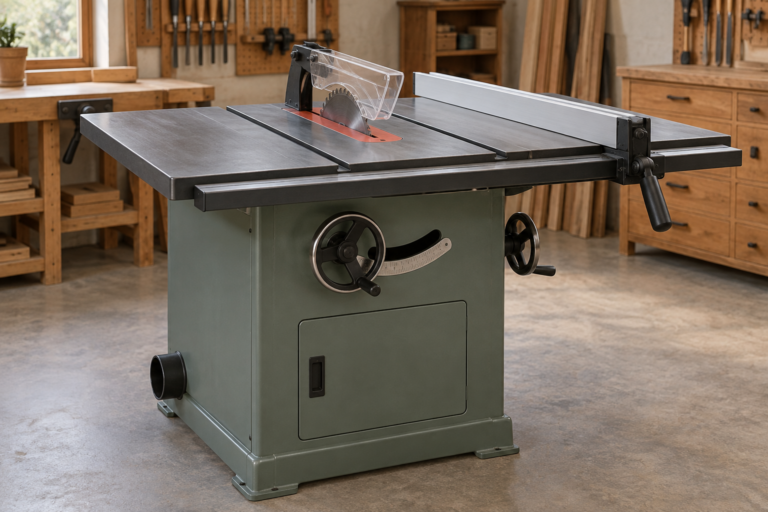
A cabinet saw uses a fully enclosed steel cabinet, a heavy trunnion assembly, and a larger motor—commonly 3 hp on a 240-volt circuit. The motor drives the blade through a belt system, and the trunnions usually mount to the cabinet rather than hanging from the underside of the table. That arrangement adds weight and keeps the blade mechanism stable.
A hybrid saw borrows some cabinet-saw features but is generally lighter and less expensive. It may have an enclosed or partially enclosed base, a 1-1/2 to 2 hp motor, and trunnions mounted to the underside of the table. Many run on 120 volts, although some can be wired for 240 volts. The best hybrid saws are serious woodworking machines, not glorified jobsite saws, but they have less reserve capacity.
For a shop that builds cabinets, furniture, or built-ins every week, a cabinet table saw is usually the stronger long-term choice. For a hobby shop cutting a few projects each month, a hybrid table saw can be entirely adequate.
Comparison at a Glance
| Feature | Cabinet table saw | Hybrid table saw |
|---|---|---|
| Typical motor | 3 hp, usually 240V | 1-1/2 to 2 hp, often 120V |
| Weight | 450 to 700 pounds with extension tables | 250 to 400 pounds with extension tables |
| Thick hardwood ripping | Fast, with more reserve power | Capable, but feed rate must be controlled |
| Dust collection | Usually better-sealed | Good on enclosed designs; variable on open bases |
| Initial cost | Higher, plus possible electrical work | Lower and easier to install |
| Best fit | Frequent production and heavy stock | Dedicated hobby shops and moderate workloads |
Cutting Capacity and Power
Motor horsepower is not the only measure of performance, but it becomes important when ripping thick or dense stock. A cabinet saw can maintain blade speed through 8/4 hard maple, white oak, or multiple glued-up panels with less slowing. That matters because a bogging blade encourages you to push harder, which increases burning, kickback risk, and stress on the motor and belt.
A hybrid saw can still rip 2-inch hardwood safely. The practical limitation is pace. You may need to feed at a steady, slower rate, use a sharp 24-tooth or 30-tooth ripping blade, and avoid taking a full-depth cut when a two-pass cut is safer. If you mostly work with 3/4-inch plywood, softwood, and ordinary furniture stock, the difference may not justify spending several thousand dollars more.
Do not confuse a larger motor with unlimited capacity. A dull blade, a misaligned fence, or wet lumber can overload either saw. The blade should remain sharp, the fence should stay parallel to the miter slot, and the stock must be supported before and after the cut.
Accuracy and Adjustment
The main cabinet-saw advantage is stability. Its heavier trunnions and cast-iron table resist movement when you adjust the blade angle or make a deep cut. Once the blade is aligned to the miter slot and the fence is set parallel, that setup tends to remain consistent.
Hybrid saws vary widely. A well-built unit with a cast-iron top and rigid trunnions can hold furniture-grade accuracy. Cheaper designs may shift slightly when the blade is tilted, or require more patience when aligning the trunnions. Check the blade at 90 degrees and 45 degrees, then verify that the fence remains parallel at both the front and rear of the blade.
Weight also helps when cutting long boards. A 600-pound cabinet saw is difficult to move accidentally. A lighter hybrid saw can creep or vibrate unless its base is level and its casters are locked. This is a solvable problem, but it is part of the ownership experience.
Dust Collection and Shop Air
Cabinet saws generally offer better dust collection because the cabinet encloses the blade and directs debris toward a 4-inch port. With a collector moving roughly 600 to 800 cubic feet per minute at the machine, you can capture much of the dust below the table. A blade guard with an overhead dust port improves collection further.
Hybrid saws with enclosed cabinets can perform nearly as well, but gaps around the motor, lower housing, and dust door reduce efficiency. Open-base hybrids release more dust into the room, especially when cutting narrow strips. That dust settles on jointers, planers, and filters, and fine airborne particles remain a health concern even when the floor looks clean.
If your shop has a modest collector or a high-efficiency shop vacuum, a hybrid saw may be the easier match. A cabinet saw does not eliminate the need for proper ducting, a clean filter, and a respirator when conditions require one.
Electrical, Space, and Mobility
A 3 hp cabinet saw commonly needs a dedicated 240-volt, 20-amp circuit. If your shop already has that service, installation is straightforward. If it does not, the electrical upgrade can erase much of the price difference between saw categories. Have the circuit installed to local code rather than relying on an extension cord or an overloaded general-purpose outlet.
Hybrids are easier to place in a garage or basement shop. Many can run from a suitable 120-volt circuit, though a dedicated circuit is still preferable. Their lighter weight also makes rearranging the shop less difficult. That matters if the saw must be rolled aside to use a planer or bring a vehicle into the garage.
Mobility is not automatically an advantage. A cabinet saw on a good mobile base can be moved, but it remains heavy and requires a level, stable setup before cutting. A lightweight hybrid is easier to reposition but more likely to move during a long rip if the base is poorly designed.
Which Saw Makes Sense for Your Shop?
Choose a cabinet saw if you regularly process thick hardwood, run the machine for several hours at a time, need dependable dust control, or want the most stable platform for repeatable furniture work. It is also the better choice when replacing a saw would be disruptive and you can afford the electrical and floor-space requirements now.
Choose a hybrid saw if your workload is intermittent, most material is 3/4-inch plywood or common lumber, your shop lacks 240-volt service, or mobility matters. Put the savings toward a quality fence, a proper dust collector, outfeed support, and good blades. Those upgrades often improve results more than moving from an adequate hybrid to an entry-level cabinet saw.
Before buying, measure the complete footprint with extension wings, fence rails, and outfeed space. Leave at least 3 feet of working clearance around the infeed and outfeed paths, more when handling 8-foot sheets. The best saw is the one you can align accurately, collect dust from effectively, and use without constantly fighting your shop’s electrical and space limitations.