Best Table Saws for Cutting Full Sheets of Cabinet Plywood
What's inside
As an Amazon Associate I earn from qualifying purchases. This post may contain affiliate links at no extra cost to you.
Contents
What matters when cutting full sheets
A 4-by-8-foot sheet of cabinet plywood is awkward on any table saw. The problem is not just table size: a full sheet weighs roughly 50 to 80 pounds, depending on thickness and core, and its broad surface can catch on the saw, fence, or floor. If the sheet tilts or shifts during a cut, the blade can bind, damage the veneer, or throw the workpiece back.
For repeatable cabinet work, look for a saw with at least 30 inches of rip capacity to the right of the blade; 50 inches or more is more convenient for breaking down sheets. A stable, wide support surface and a reliable fence matter at least as much as motor power. Even a powerful saw is a poor choice if one person has to balance a full sheet while keeping it against a short fence.
Which table saw type fits the job?
There are three practical choices: a portable jobsite saw, a contractor-style saw, or a cabinet saw. Jobsite saws are comparatively affordable and easy to store, but their small tables and lighter stands make full sheets harder to control. Contractor and cabinet saws offer more mass and room, but they still need proper infeed and outfeed support. A saw’s rip capacity describes the maximum distance to the right of the blade; it does not mean the saw can safely handle a full sheet without help.
| Saw type | Typical rip capacity | Best fit | Main trade-off |
|---|---|---|---|
| Portable jobsite | About 24–32 inches | Occasional cuts, limited storage | Less table support and mass |
| Contractor-style | About 30–50 inches | Garage shops and regular cabinet work | Larger footprint; some models need setup |
| Cabinet saw | About 36–50 inches | Frequent, precision-focused shop work | Higher cost, weight, and electrical demands |
Buying options by shop and budget
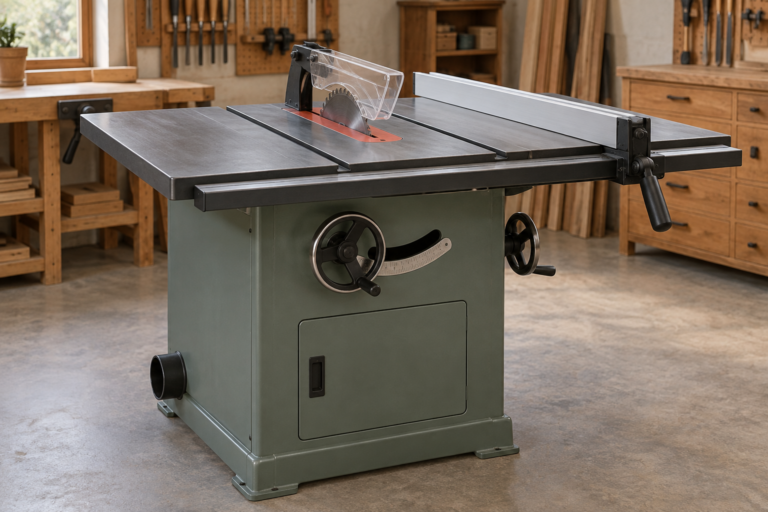
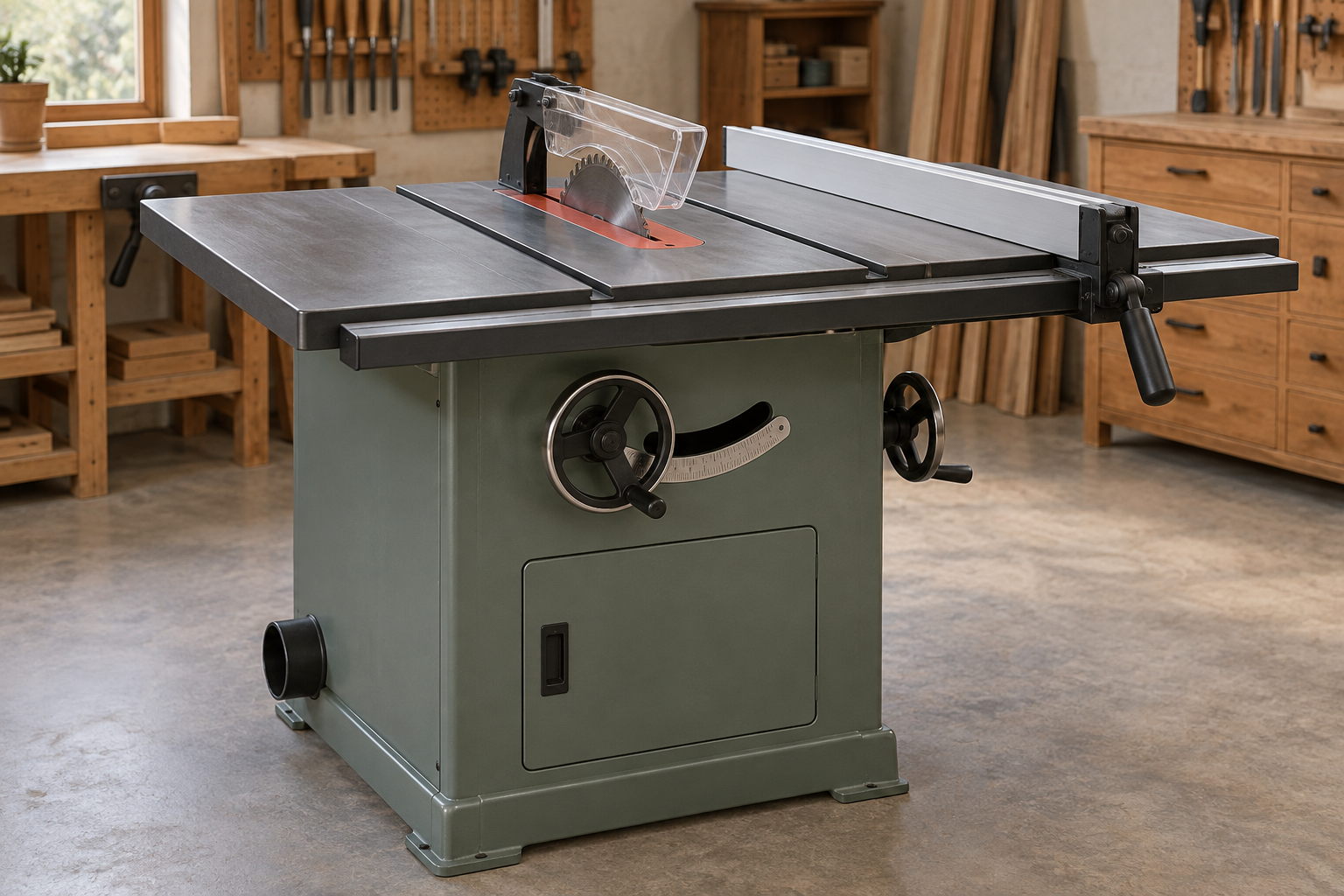
If you make cabinets regularly and have floor space, a cabinet saw with a 50-inch rip fence is the most capable table-saw setup for breaking down panels. Its mass helps resist movement, and the larger table is useful for repeated rips. Check the required voltage and the fence’s actual usable capacity before buying; some machines need a 240-volt circuit, and a wide fence does not replace outfeed support. Browse cabinet table saws with 50-inch rip capacity to compare configurations.
A contractor-style saw can be a sensible middle ground for a serious hobby shop. It is usually less costly than a cabinet saw and can provide enough capacity for cabinet parts, particularly when paired with a sturdy outfeed table or roller support. Verify that the fence locks parallel to the blade and stays square along its travel. A fence that shifts under pressure can turn a nominally accurate saw into one that produces tapered parts. See contractor table saws with wide rip capacity.
A jobsite saw is fine if full sheets are an occasional project rather than a weekly task. It costs less, stores more easily, and can make accurate cuts on smaller cabinet components. For a full sheet, use a helper and substantial infeed and outfeed support, or cut the sheet down first with a track saw. A portable saw’s stand and compact top can flex or tip if a heavy panel hangs too far beyond the table. Compare jobsite table saws with wide rip capacity if portability takes priority.
A safer way to break down a sheet
For a first cut, it is often safer to use a track saw or a circular saw with a straightedge on a sacrificial foam sheet, then use the table saw for narrower, manageable pieces. This avoids trying to control all 32 square feet of plywood at the fence. A 4-by-8 sheet can be supported on foam insulation laid over a flat floor or a suitable breakdown surface. Set the blade just deep enough to clear the panel, and use a guide long enough for the full cut.
If you do use the table saw, plan the entire operation before lifting the sheet. Provide level support at the same height as the saw on both ends of the cut, and have a helper guide the panel without pulling it sideways. Keep the fence on the waste side only when the cut and workpiece allow safe, stable control; do not trap a long offcut between the blade and fence. Use the riving knife, blade guard where practical, and a sharp plywood blade. A 60- to 80-tooth blade often leaves cleaner veneer edges than a general-purpose blade, though feed rate and blade condition also matter.
Features worth checking before purchase
Prioritize a fence that locks firmly at the front and remains parallel to the blade, a riving knife, a reliable blade-height mechanism, and a stand or base that does not rock. A wider rip capacity is useful only if you can support the sheet; a long extension wing alone may not prevent sag. Check whether the machine includes a usable outfeed arrangement or whether you need to build one. Also consider dust collection: plywood dust is persistent, and a cabinet saw with a decent dust port is easier to keep under control than an open-bottom portable saw.
Common failures are predictable. A sheet can bind when it sags, when the fence is misaligned, or when the operator twists the panel to correct its path. Chipped veneer often comes from a dull or unsuitable blade, poor support, or cutting the wrong face in the wrong direction. Before a long rip, check blade alignment and fence position with a straightedge or measuring method, and make a test cut on scrap. If the panel feels difficult to control at any point, stop the saw and switch to a safer breakdown method rather than forcing the cut.