Hybrid Table Saw vs Cabinet Table Saw for Furniture Making
What's inside
As an Amazon Associate I earn from qualifying purchases. This post may contain affiliate links at no extra cost to you.
Contents
The short answer
For furniture making, a cabinet saw is the better choice if you routinely cut wide panels, hardwood stock, or full sheets and have the space, wiring, and budget for it. Its mass, larger trunnions, and stronger motor make it a steadier machine under sustained work. A hybrid saw is a sensible choice for a small shop, occasional furniture projects, or a budget that needs to leave room for blades, dust collection, and other tools.
Neither category guarantees accurate cuts. A well-tuned hybrid saw can produce excellent furniture parts; a cabinet saw with a misaligned fence or dull blade cannot. Compare the whole setup—fence, table support, power supply, dust collection, and room to handle stock—not just the motor rating.
As an Amazon Associate we earn from qualifying purchases at no extra cost to you.

What the names mean
A hybrid saw sits between a contractor-style saw and a cabinet saw. It usually has an enclosed or partly enclosed base, a cast-iron table, and a motor in the roughly 1½–2 horsepower range. Depending on the design, it may run on ordinary 120-volt household power or need 240 volts. Check the actual electrical requirements; “hybrid” does not guarantee a particular plug or circuit.
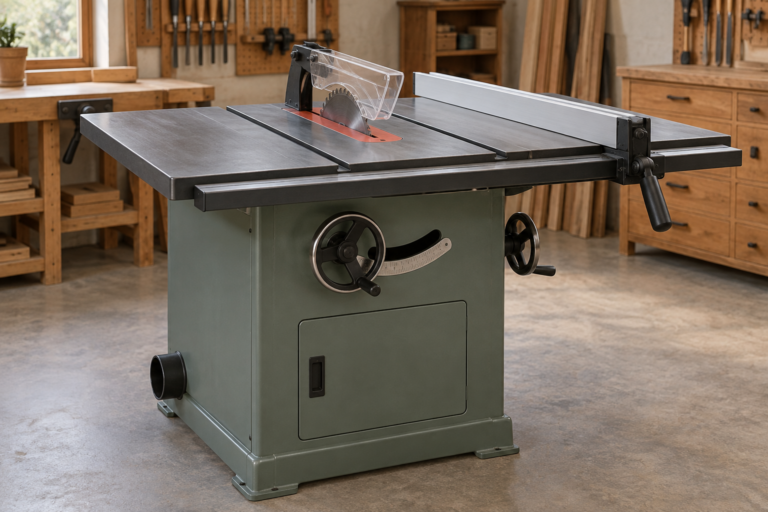
A cabinet saw has a fully enclosed cabinet, a heavier table and base, and commonly a 3-horsepower motor intended for 240-volt power. Its weight often exceeds 500 pounds, while hybrids are generally lighter. Exact weights and motor arrangements vary, so use the maker’s specifications rather than the category label when planning delivery and installation.
How they compare for furniture work
| Factor | Hybrid saw | Cabinet saw |
|---|---|---|
| Typical motor and power | About 1½–2 hp; electrical needs vary | Often about 3 hp on 240 volts |
| Hardwood ripping | Works well with a sharp blade and sensible feed rate; may bog down in thick, dense stock | More reserve for long or repeated rips |
| Stability | Usually adequate for furniture parts, but lighter base can transmit more movement | Heavy base and table resist movement and vibration |
| Footprint and moving | Usually easier to fit and reposition | Large, heavy, and harder to install or relocate |
| Cost and electrical setup | Lower purchase cost; may suit an existing circuit | Higher cost; commonly needs a suitable 240-volt circuit |
These are general patterns, not guarantees. Fence quality, arbor alignment, blade choice, and setup can matter more to cut accuracy than a modest difference in motor size.
Choose by the work you actually do
For small tables, chairs, cabinets, and occasional built-ins, a hybrid saw is usually enough if you are cutting dry, straight stock and do not force the feed. A sharp 10-inch combination blade can crosscut and rip general furniture parts; a dedicated ripping blade makes long rips easier. If the blade slows or the motor strains, stop and check the feed rate, blade condition, and stock. Forcing a cut risks a poor surface, a stalled saw, or kickback.
A cabinet saw earns its cost when you repeatedly rip thick hardwood, process batches of parts, or need a stable platform for daily work. It also helps when cutting dense species such as hard maple or white oak at production pace. It is not a substitute for proper technique: use a riving knife, keep the fence parallel to the blade, and use a push stick or push block when the work approaches the blade.
Neither saw is a safe or convenient way to break down a full 4-by-8-foot sheet alone. Support the sheet with an outfeed table, rollers, or a helper, and plan the cut so the panel cannot bind or tip. Many small-shop woodworkers make rough cuts with a track saw or circular saw, then bring manageable pieces to the table saw for final sizing.
Space, power, and dust collection
Measure the footprint with the fence rails installed, then allow clear infeed and outfeed space. A long board needs room to travel without striking a wall, stored lumber, or a person. A cabinet saw can be difficult to use well in a cramped shop even if it physically fits. Its weight also makes delivery, stair access, and future moves a real consideration.
Confirm the saw’s voltage, amperage, and circuit requirements before buying. A 240-volt machine may need an electrician to install a dedicated circuit, adding cost beyond the saw. Do not use an undersized extension cord to compensate for an inconvenient outlet; voltage drop can hurt performance and create a hazard.
Cabinet saws often contain dust more effectively, but both types need a suitable collector and a clear path for chips. A small shop vacuum may handle light use on some hybrids, but it can struggle with prolonged cutting. Check the saw’s dust port size and the collector’s airflow at the machine, not just its advertised horsepower.
Where the money makes the most difference
For many first furniture shops, a carefully chosen hybrid table saw leaves money for a good blade, measuring tools, dust collection, and stock support. Those purchases can improve everyday results more than buying a heavier saw while leaving it poorly equipped. Before purchase, check that the fence locks securely, the blade can be aligned to the miter slots, and the riving knife is compatible with the cuts you plan to make.
If you cut hardwood most days and have the electrical supply and floor space, compare 3-horsepower cabinet table saws. Budget for delivery and installation, a 240-volt circuit if needed, and adequate dust collection. A used cabinet saw can be good value, but inspect the arbor for play, the table and wings for damage, and the fence for reliable locking before committing.
Buy the cabinet saw when its extra capacity will be used often, not simply because furniture is the intended craft. If your work is occasional and your stock is manageable, a tuned hybrid saw is a credible furniture-making machine. Whichever you choose, reserve time to align the blade and fence, test cuts on scrap, and maintain a sharp blade; those steps determine whether the machine delivers clean, repeatable parts.