Best Table Saws with Compact Footprints for Narrow Workshops
What's inside
As an Amazon Associate I earn from qualifying purchases. This post may contain affiliate links at no extra cost to you.
Contents
What counts as compact
A table saw can have a small footprint and still be awkward in a narrow shop. The stand, fence rails, dust hose and space needed to feed a long board all count. A typical job cutting 8-foot stock needs roughly 8 feet of clear space in front of the blade and behind it, even if the saw itself occupies only a few square feet. If that much room is unavailable, plan to support long stock with rollers or an outfeed table, or break it down with another tool before ripping.
For most small woodworking shops, the useful choice is between a jobsite saw on a folding stand and a compact benchtop saw. Jobsite models usually have more capable fences and stands; benchtop models are lighter and easier to store, but often give up table support, adjustment range or fence rigidity. Neither is a substitute for a full-size cabinet saw when you routinely cut thick hardwood or need a large, stable work surface.
As an Amazon Associate we earn from qualifying purchases at no extra cost to you.


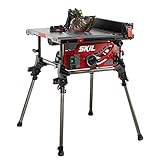

Compact table saw options
| Type | Typical footprint and capacity | Best fit | Main trade-off |
|---|---|---|---|
| Compact benchtop | About 20–25 inches deep; commonly 12–16 inches of rip capacity to the right | Occasional cuts, small parts, storage between jobs | Limited support and a fence that may need careful checking |
| Jobsite saw with folding stand | Often about 25–30 inches deep when set up; roughly 24–32 inches of right-side rip capacity | Regular shop use with a need to fold or roll the saw away | Stand and rails need parking space; more expensive and heavier |
| Small contractor-style saw | Often wider and heavier, with a larger table and longer rails | A semi-permanent shop where stability matters more than storage | Harder to move and still requires room for stock handling |
These are broad ranges, not guaranteed dimensions. Check the assembled saw’s footprint, rail extension and maximum rip capacity in the manufacturer’s specifications. A folded stand may save floor space but not wall space: long rails can stick out well beyond the motor and table.
Best all-around choice: jobsite saws
For a narrow workshop that still sees regular cabinet parts, shelving or furniture components, start with a compact jobsite table saw with a folding stand. The stand gets the blade to a usable height without requiring a permanent bench, and wheels make it easier to tuck the saw against a wall after work. A rack-and-pinion fence is a practical advantage: it is less likely to skew as you set a rip than a basic fence that clamps at one end.
Check the fence’s locking action and the blade-to-fence alignment before relying on it for narrow rips. A misaligned fence can pinch stock against the blade, increasing the chance of kickback. Follow the saw’s setup instructions, use the riving knife, and verify that the fence stays parallel through its full travel. A jobsite saw can handle plywood and ordinary hardwood stock, but its smaller table does not make a large sheet safe for one person to maneuver. Break sheets down with a track saw or circular saw first.
The compromise is price and bulk. If the saw will live folded in a closet and only cut a few boards a month, paying extra for a wheeled stand and a more elaborate fence may not be worthwhile.
Best for storage: benchtop saws
If the saw must be lifted onto a bench or stored on a shelf, a compact benchtop table saw is the smaller option. Many weigh roughly 40–60 pounds, though designs vary. They are suitable for trim, short boards and occasional straight cuts, provided the bench is solid and the workpiece is well supported.
The common failure is treating a light saw like a full-size machine. A narrow table can let a wide panel tip as it reaches the blade, and a small fence may deflect if a board is pushed hard against it. Secure the saw to the bench, add a level outfeed support, and do not use a makeshift fence extension that can shift during a cut. For repeated ripping of sheet goods or thick stock, the limits become frustrating and can make control worse.
Before buying, look for a usable riving knife, blade guard, accessible bevel and height adjustments, and a fence that locks squarely. A low price is fine for occasional, modest work; it is a poor bargain if the fence will not hold an accurate setting.
Measure the working space, not just the saw
Tape the saw’s full operating footprint on the floor, including the stand and any rails extended for your usual cuts. Then mark the path of a board as it enters and exits the blade. A 4-foot board needs less handling room than an 8-foot board, but both need enough lateral space to keep the stock controlled. If an aisle is only 30 inches wide, a long board may hit a wall before it clears the blade.
Fold-down or removable outfeed support can help, but it must sit level with the saw table and stay stable under the workpiece. A roller stand that is too high can lift the stock into the blade; one that is too low offers little support. Keep the power switch reachable, leave access to the blade for adjustments, and avoid positioning the saw where a cut forces you to stand in the likely kickback path.
A practical buying checklist
Compare maximum rip capacity with the cuts you actually make, not the biggest number on a box. A 24-inch capacity can be useful for breaking down narrower panels, but it does not solve the problem of supporting a full sheet. Confirm the saw accepts common replacement blades—often 10 inches on jobsite saws, though compact designs vary—and check whether the included blade is suitable for your work. A general-purpose blade may be adequate at first; a sharp, appropriate blade matters more than a long list of accessories.
Also consider dust collection, storage and service. Small saws still produce enough dust to make a narrow room unpleasant, and some ports need an adapter to fit a shop vacuum. If the machine will stay set up and you cut hardwood every week, choose the more stable jobsite or contractor-style option. If space and lifting weight dominate, and your work is mostly short, light stock, the cheaper benchtop saw is a reasonable choice.