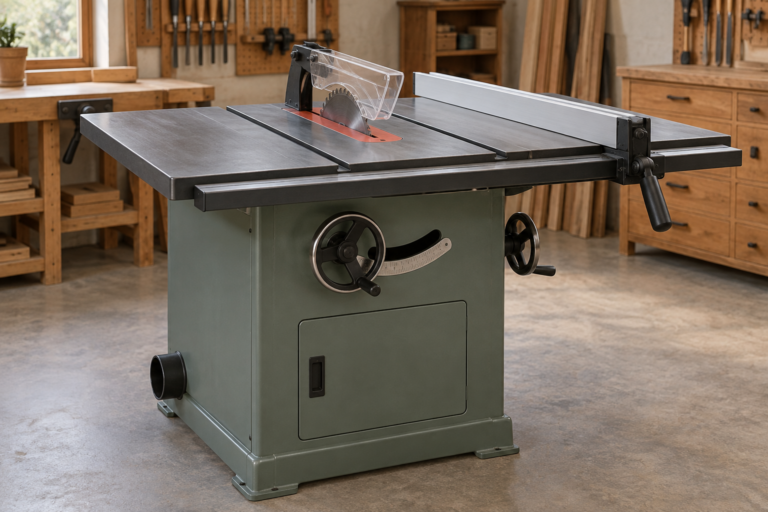
10-Inch vs 12-Inch Table Saw for Crosscutting Wide Hardwood Boards
What's inside
As an Amazon Associate I earn from qualifying purchases. This post may contain affiliate links at no extra cost to you.
Contents
The real limit is the cut, not the board width
A 10-inch table saw can crosscut a wide hardwood board. The question is how much material you need to remove in one pass, and whether you can support and control the board safely while doing it. Blade diameter sets the maximum depth of cut, but it does not determine how wide a board the saw can crosscut. For that, the important factors are the miter gauge or sled, the distance from the blade to the front and rear of the table, and your support setup.
For ordinary furniture parts, a 10-inch saw is usually the sensible buy. A 12-inch saw earns its keep when its extra blade depth solves a specific cutting problem, or when its larger table and heavier construction improve support and control. It is not a shortcut to safely cutting any width of hardwood.
As an Amazon Associate we earn from qualifying purchases at no extra cost to you.


Blade depth: what 10 and 12 inches actually buy
A typical 10-inch blade cuts about 3 to 3⅛ inches deep at 90 degrees. A typical 12-inch blade cuts roughly 4 inches. Exact capacity depends on the saw’s arbor height and blade geometry. That extra depth matters for thick stock, deep rabbets, or cutting a thick board on edge with a suitable jig. It does little for a flat crosscut through a board that is 8 or 12 inches wide: both saws still cut across the board in the same basic way.
A 10-inch saw can often crosscut stock up to about 3 inches thick in one pass, but a full-depth cut leaves little margin. Check the manufacturer’s listed capacity, and make sure the blade clears the work without raising it to its absolute limit. A 12-inch saw is more comfortable with thick material, but a taller blade exposes more teeth and can make the cut more demanding to control.
Crosscutting wide boards safely
Use a crosscut sled or a miter gauge with a substantial auxiliary fence. The board must stay flat against the table and square to the blade throughout the cut. A long board that hangs off the table can pivot, lift, or pull away from the fence; that can pinch the blade and cause kickback. Support the far end at table height with an outfeed stand or roller support, positioned so it does not steer the work.
For a board wider than your sled or gauge can safely control, do not improvise by balancing it against the rip fence. The rip fence is not a crosscut guide. Use a track saw or circular saw with a straightedge to rough-cut the board, then trim it on the table saw if a precise square edge is needed. For very wide or valuable hardwood, this two-step approach is often more controlled than wrestling the whole board across a small saw table.
Before the cut, check the board for twist, bow, and loose knots. A twisted board can rock on the table; a bowed edge can open or close against the blade. If the stock is rough, joint one face and one edge first where practical. Use a sharp, appropriate crosscut blade, keep hands clear of the blade path, and let the blade stop before lifting a cutoff from the table.
10-inch vs 12-inch: buying trade-offs
| Factor | 10-inch saw | 12-inch saw |
|---|---|---|
| Typical 90-degree depth | About 3 to 3⅛ inches | About 4 inches |
| Wide, flat crosscuts | Works well with a sled and proper support | Does not automatically increase crosscut width |
| Blade and accessory choice | Broad availability; usually less expensive | Fewer choices and often higher blade cost |
| Best fit | Most furniture and cabinet shops | Frequent thick-stock cuts or a specific depth requirement |
Cost, power, and shop fit
Ten-inch blades are widely available in general-purpose, rip, and crosscut designs, and replacement blades are typically easier to find at a range of prices. Twelve-inch blades tend to cost more, and the saw may demand more from the motor because it is driving a larger blade through the cut. Confirm the saw’s stated voltage and circuit requirements before buying; a larger blade does not guarantee more usable cutting power.
Compare the actual table and fence setup, not just the blade size. A stable cabinet saw with a well-fitting crosscut sled can handle wide boards better than a larger-blade saw with a cramped table and poor support. Check the distance between the blade and the front edge of the table, the sled’s usable travel, and whether the saw accepts the sled or miter gauge you plan to use. If you are shopping for a standard shop saw, start with 10-inch table saws; pay for a 12-inch model only if its added depth or the particular machine’s capacity addresses work you actually do.
When a 12-inch saw is worth it
Choose a 12-inch saw if your work repeatedly includes stock thicker than a 10-inch saw can cut in one pass, or if you need the additional blade depth for a planned operation. Check the product’s capacity rather than assuming every 12-inch saw cuts exactly 4 inches. Also account for the cost of blades and the space and electrical supply the machine requires.
If your main challenge is crosscutting wide boards, spend first on a safe, accurately fitting crosscut sled and reliable outfeed support. A table saw crosscut sled should hold the board firmly without binding, and its fence should be checked for square with a known-accurate method. A sled improves control; it does not make an oversized or unstable workpiece safe.
When the cheaper 10-inch option is fine
For boards up to roughly 2 inches thick, a good 10-inch saw has ample depth for common crosscuts. For wider boards, the limiting issue is generally support and workholding, not the blade’s diameter. If the saw’s table and sled can carry the piece through the cut without tipping or twisting, the smaller blade is not a disadvantage.
When a board is too wide to manage safely in one table-saw pass, use a track saw with a guide rail to make the crosscut, then finish the edge with a suitable setup if needed. That costs less than buying a larger table saw solely for width it does not provide. Buy the 12-inch saw for depth; buy better support or a different cutting method for width.