Best Table Saws for Workshop Owners Who Need Mobile Bases
What's inside
As an Amazon Associate I earn from qualifying purchases. This post may contain affiliate links at no extra cost to you.
Contents
Choose for your floor, not just your cut list
A mobile base can make a heavy table saw manageable in a small shop, but “mobile” covers two different jobs: rolling the saw across a smooth floor, and shifting it out of the way to reclaim work space. Before buying, check the saw’s weight, footprint, dust port, and where its stand touches the floor. A base that fits the cabinet but blocks the dust outlet or leaves the saw rocking is a poor fit.
For occasional moves on a flat concrete floor, a basic wheeled base may be enough. For a crowded workshop, look for a mechanism that lifts the saw clear of its feet or leveling pads when you press a pedal, then sets it firmly back down. The difference matters: cutting on a saw that still rests on loose casters can make the cabinet creep, especially when ripping long stock.
As an Amazon Associate we earn from qualifying purchases at no extra cost to you.


What to compare before you buy
| Feature | Why it matters | What to check |
|---|---|---|
| Rated capacity | The saw, extension wings, and attached accessories all add weight. | Choose a base whose published capacity exceeds the complete saw’s weight, with a sensible margin. |
| Footprint range | Cabinet saws and contractor saws have different leg positions. | Measure the distance between the actual contact points, not just the cabinet panels. |
| Locked-down stability | Casters can transmit vibration or let the saw shift during a cut. | Prefer a design that lowers the saw onto fixed feet or pads for use. |
| Floor and clearance | Thresholds, cords, and uneven concrete can stop small wheels. | Measure doorways and check wheel size, lift height, and pedal access. |
Capacity figures are not interchangeable with a promise of stability. A base can support the weight and still wobble if its frame is narrow, its locking hardware is loose, or the shop floor is uneven. If possible, test the saw with the base locked before making a long rip. Push gently on a corner of the table; movement at the feet is a warning to adjust or return the setup.
Pick the base style that fits your routine
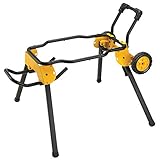
Integrated mobile stand: Common on portable and jobsite saws, this folds for transport and stores with the saw. It is convenient if you regularly load the saw into a vehicle. The trade-off is a smaller working footprint and less mass than a cabinet saw setup. Check whether the stand’s wheels are usable on your shop floor and whether it folds without trapping the power cord.
Universal mobile base: A frame under the saw’s existing legs, often with a pedal or lever-operated lift. This is a practical choice for many contractor and cabinet saws. Some models use adjustable corners; others need assembly to a specific size. Measure carefully: too much overhang can catch a boot, while a base set too tight can interfere with leveling feet or cabinet doors.
Simple caster kit: The least expensive route, and often fine for a light saw that moves only a few times a year. It can be a bad match for a heavy saw used for precision work if the wheels remain loaded while cutting. Verify that the casters lock, that the mounting points are strong enough, and that the added height will not compromise outfeed support.
If you are choosing the saw and base together, compare table saws with mobile bases against a saw with a separate universal base. Bundled stands are simpler, but a separate base can suit a heavier machine better.
Match the saw to the shop
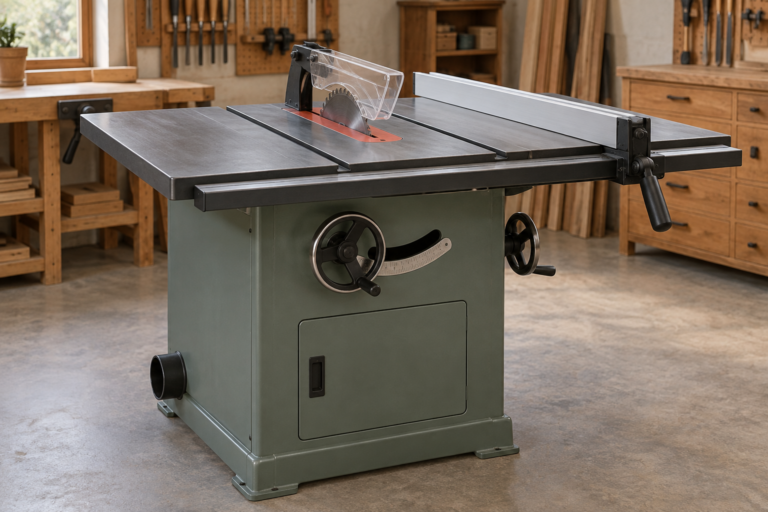
A compact contractor saw can be a sensible choice for a one-car garage or shared shop. It is easier to move and generally less demanding on the floor than a cabinet saw. The compromise is less mass and, depending on the design, less support for wide panels. A contractor table saw with a mobile base is worth considering if you need decent ripping capacity but still need to move the machine between jobs.
A cabinet saw is heavier and often better suited to regular work with hardwood and sheet goods, but its weight makes a properly rated base essential. Don’t assume a base advertised for “most table saws” will fit: confirm the minimum and maximum frame dimensions, load rating, and whether it can accommodate the saw’s legs. If the saw has a large cast-iron table or extension wings, include them in the weight and footprint check.
For a small portable saw, an elaborate heavy-duty base may cost more and occupy more floor space than the saw itself. A jobsite saw with a folding stand may be the better buy when quick setup and storage matter more than cabinet-saw mass.
Set it up so it stays put
Assemble the base on a level surface and tighten the fasteners after the saw is positioned. With the base lowered, confirm that all intended feet contact the floor; a single corner hanging above a dip can make the saw rock. Adjust leveling pads if provided. Lock the wheels before plugging in, and keep the pedal accessible without putting your foot near the blade area.
Move the saw with the blade fully lowered and the fence, miter gauge, and loose accessories secured. Unplug it first. When rolling across a threshold, guide the machine slowly and use a helper for a heavy cabinet saw; pulling hard on the fence rail or table extension can damage alignment. After moving, lower the saw, check that it is stable, and verify fence-to-blade alignment if the trip involved bumps or a floor joint.
Do not use a mobile base to compensate for a weak or damaged saw stand. Bent legs, loose cabinet bolts, and cracked welds need repair before adding wheels. Likewise, a base that causes the saw to sit high may leave the operator reaching awkwardly or put the table out of line with an outfeed surface. Check total working height before committing.
Spend where the risk is
For a light saw moved occasionally on smooth concrete, a basic, correctly sized caster solution is usually adequate. Pay more for a lift-and-lock base when the saw is heavy, used often, or needs to stay planted for accurate ripping. The important features are fit, capacity, and firm contact with the floor—not a long list of accessories. Measure first, confirm the base’s published limits, and choose a setup you can lock down reliably every time you cut.